APSC CCE Prelims 2023 GS II Question Paper with Answers (79 Questions)
Combined Competitive Examination (Preliminary) 2023, General Studies Paper II (CSAT). Every question is typed out below with its four options. Tap Show answer to check yourself, so you can use the page as a practice test.
About this paper
| Exam | APSC CCE Prelims |
|---|---|
| Year | 2023 |
| Conducted by | Assam Public Service Commission |
| Questions | 79 |
| Original PDF | Question booklet (PDF) |
Where the answers come from
- Official provisional answer key: 79 questions
Subject-wise questions
| Subject | Questions | Share |
|---|---|---|
| Reasoning | 25 | 32% |
| Aptitude | 24 | 30% |
| Mathematics | 16 | 20% |
| English | 14 | 18% |
All 79 questions with answers
-
What is the main objective of the Make in India' campaign?
- A The main objective is to ensure growth and valuable employment creation in the country with the help of top investors
- B The main objective is to ensure solid growth and valuable employment creation in the country with the help of top investors
- C The main objective is to ensure solid growth and valuable employment creation in the country with the help of investors
- D The main objective is to ensure solid growth and valuable employment creation in the country with the help of foreign investors
Show answer
Answer: (B) The main objective is to ensure solid growth and valuable employment creation in the country with the help of top investors
Official provisional answer key
-
An outcome of the Make in India' campaign is
- A manufacturing hubs in neighbouring countries
- B to focus only on digitalisation
- C creation of smart cities in India
- D to lay down strict and rigid guidelines to start a business
Show answer
Answer: (C) creation of smart cities in India
Official provisional answer key
-
Read the following passage carefully and answer Question Nos. 3 and 4 :
Since almost the beginning of cinema, we have had scary films. Of all the genres that exist,
horror is perhaps one of the most conventional. Many horror films rely on specific plot
devices, also called tropes, to make their audience frightened. When a trope is used too much,
it can become a cliché. But when used well, it can really make us jump out of our skin. Here
are some of the most used, and perhaps abused, clichés in horror films.
No matter what kind of house it is, the basement is a scary place in horror films. That's
usually where something is hiding or where the evil psychopath has hidden their tools.
Basements are always dark and often damp. You can only reach them by a narrow staircase.
And basements are always creepy, even when there isn't anything down there.
In older horror films, when protagonists were in desperation, it was difficult or impossible for
them to call for help or call the police. Mobile phones have made that situation a bit less
believable now. What's the solution to maintain suspense? No phone coverage! If you're a hero
in a horror film, it's almost certain that at a key moment, just when you absolutely need to
are making the call. Or both.
Directors of horror films love uninhabited places. This could be an abandoned hospital, a
scary empty house or a ghost town. There's something about lonely, empty places. What was
it like when people lived there? Why did they leave? May be it's also that they are so quiet,
which can be very scary too. Of course, abandoned places are also handy for horror film
directors in that it's more believable that you will have no phone coverage there either.
The hero has been driving for hours. It's night-time and it's beginning to rain. Suddenly he
sees a person on the side of the road. May be the company will keep him awake? In horror
films, giving anybody a ride is asking for trouble. The hero always does it, and it always ends
badly.
This horror film cliché was especially popular with horror films of the late 20th century. It
starts with a group of teenagers all enjoying themselves, and it ends with everyone dead
except one girl. At the beginning, the girl is usually innocent, shy and not particularly strong.
By the end, she has become the toughest and most resourceful person in the world. The last
girl almost always wins in the end.Why do horror film directors find abandoned places handy?
- A Abandoned places are very quiet which greatly contributes to creating a spooky atmosphere
- B It is more believable that there will have no phone coverage in abandoned places
- C Abandoned places are very quite and which greatly contributes to creating a spooky atmosphere
- D It is more possible that there will have no phone coverage in abandoned places
Show answer
Answer: (A) Abandoned places are very quiet which greatly contributes to creating a spooky atmosphere
Official provisional answer key
-
Read the following passage carefully and answer Question Nos. 3 and 4 :
Since almost the beginning of cinema, we have had scary films. Of all the genres that exist,
horror is perhaps one of the most conventional. Many horror films rely on specific plot
devices, also called tropes, to make their audience frightened. When a trope is used too much,
it can become a cliché. But when used well, it can really make us jump out of our skin. Here
are some of the most used, and perhaps abused, clichés in horror films.
No matter what kind of house it is, the basement is a scary place in horror films. That's
usually where something is hiding or where the evil psychopath has hidden their tools.
Basements are always dark and often damp. You can only reach them by a narrow staircase.
And basements are always creepy, even when there isn't anything down there.
In older horror films, when protagonists were in desperation, it was difficult or impossible for
them to call for help or call the police. Mobile phones have made that situation a bit less
believable now. What's the solution to maintain suspense? No phone coverage! If you're a hero
in a horror film, it's almost certain that at a key moment, just when you absolutely need to
are making the call. Or both.
Directors of horror films love uninhabited places. This could be an abandoned hospital, a
scary empty house or a ghost town. There's something about lonely, empty places. What was
it like when people lived there? Why did they leave? May be it's also that they are so quiet,
which can be very scary too. Of course, abandoned places are also handy for horror film
directors in that it's more believable that you will have no phone coverage there either.
The hero has been driving for hours. It's night-time and it's beginning to rain. Suddenly he
sees a person on the side of the road. May be the company will keep him awake? In horror
films, giving anybody a ride is asking for trouble. The hero always does it, and it always ends
badly.
This horror film cliché was especially popular with horror films of the late 20th century. It
starts with a group of teenagers all enjoying themselves, and it ends with everyone dead
except one girl. At the beginning, the girl is usually innocent, shy and not particularly strong.
By the end, she has become the toughest and most resourceful person in the world. The last
girl almost always wins in the end.Horror film as a genre
- A has rarely made into a cinematic expression
- B had become popular since the previous century
- C has always been considered as a cinematic subject
- D has relied on scientific fiction
Show answer
Answer: (C) has always been considered as a cinematic subject
Official provisional answer key
-
Read the following passage carefully and answer Question Nos. 5 and 6 :
Too many parents these days can't say no. As a result, they find themselves raising 'children'
who respond greedily to the advertisements aimed right at them. Even getting what they want
doesn't satisfy some kids; they only want more. Now, a growing number of psychologists,
educators and parents think it's time to stop the madness and start teaching kids about
struggle to set limits has never been tougher—and the stakes have never been higher. One
recent study of adults who were overindulged as children, paints a discouraging picture of
their future : when given too much too soon, they grow up to be adults who have difficulty
coping with life's disappointments. They also have a distorted sense of entitlement that gets in
the way of success in the workplace and in relationships.
Psychologists say that parents who overindulge their kids set them up to be more vulnerable
to future anxiety and depression. Today's parents themselves raised on values of thrift and
self-sacrifice, grew up in a culture where 'no' was a household word. Today's kids want much
more, partly because there is so much more to want. By every measure, parents are shelling
out record amounts. In the heat of the buying blitz, even parents who desperately need to say
no find themselves reaching for their credit cards.
Today's parents aren't equipped to deal with the problem. Many even wear the same designer
clothes as their kids and listen to the same music. And they work more hours; at the end of a
long week, it's tempting to buy peace with yes' and not mar precious family time with conflict.
Anxiety about the future is another factor. Experts agree : too much love won't spoil a child.
Too few limits will.
What parents need to find, is a balance between the advantages of an affluent society and the
critical life lessons that come from waiting, saving and working hard to achieve goals. That
search for balance has to start early. Children need limits on their behaviour because they
feel better and more secure when they live within a secured structure.
Older children learn self-control by watching how others, especially parents act. Learning
how to overcome challenges is essential to becoming a successful adult. Few parents ask kids
to do chores. They think their kids are already overburdened by social and academic
pressures. Every individual can be of service to others, and life has meaning beyond one's
own immediate happiness. That means parents eager to teach values have to take a long,
hard look at their own.What is the primary danger lurking behind the overindulgence of parents?
That children will not learn to be thrifty
That children are susceptible to anxiety and depression in their lives
That children learn life skills'
Show answer
Answer: (C)
Official provisional answer key
-
Read the following passage carefully and answer Question Nos. 5 and 6 :
Too many parents these days can't say no. As a result, they find themselves raising 'children'
who respond greedily to the advertisements aimed right at them. Even getting what they want
doesn't satisfy some kids; they only want more. Now, a growing number of psychologists,
educators and parents think it's time to stop the madness and start teaching kids about
struggle to set limits has never been tougher—and the stakes have never been higher. One
recent study of adults who were overindulged as children, paints a discouraging picture of
their future : when given too much too soon, they grow up to be adults who have difficulty
coping with life's disappointments. They also have a distorted sense of entitlement that gets in
the way of success in the workplace and in relationships.
Psychologists say that parents who overindulge their kids set them up to be more vulnerable
to future anxiety and depression. Today's parents themselves raised on values of thrift and
self-sacrifice, grew up in a culture where 'no' was a household word. Today's kids want much
more, partly because there is so much more to want. By every measure, parents are shelling
out record amounts. In the heat of the buying blitz, even parents who desperately need to say
no find themselves reaching for their credit cards.
Today's parents aren't equipped to deal with the problem. Many even wear the same designer
clothes as their kids and listen to the same music. And they work more hours; at the end of a
long week, it's tempting to buy peace with yes' and not mar precious family time with conflict.
Anxiety about the future is another factor. Experts agree : too much love won't spoil a child.
Too few limits will.
What parents need to find, is a balance between the advantages of an affluent society and the
critical life lessons that come from waiting, saving and working hard to achieve goals. That
search for balance has to start early. Children need limits on their behaviour because they
feel better and more secure when they live within a secured structure.
Older children learn self-control by watching how others, especially parents act. Learning
how to overcome challenges is essential to becoming a successful adult. Few parents ask kids
to do chores. They think their kids are already overburdened by social and academic
pressures. Every individual can be of service to others, and life has meaning beyond one's
own immediate happiness. That means parents eager to teach values have to take a long,
hard look at their own.Limits should be set on children's behaviour so that

- A they learn to deal with setbacks in life
- B they feel they are not missing out on anything
- C they learn the sacrifices made by their parents
- D they feel they are safe in a durable structure such as the family
Show answer
Answer: (D) they feel they are safe in a durable structure such as the family
Official provisional answer key
-
Read the following passage carefully and answer Question Nos. 7 and 8 :
The Scandinavian countries are much admired all over the world for their enlightened social
policies. Sweden has evolved an excellent system for protecting the individual citizen from
high-handed or incompetent public officers. The Swedish were the first to recognise that
public officials like civil servants, police officers, health inspectors or tax collectors can
make mistakes or act over-zealously in the belief that they are serving the public. As long ago
as 1809, the Swedish Parliament introduced a scheme to safeguard the interest of the
who is suitably qualified to investigate private grievances against the State. The official title of
the person is 'Justice Ombudsman' but Swedish commonly refer to him as the 'JO' or
be made in writing, the Ombudsman receives an average of 1200 letters a year. He has eight
lawyer assistants to help him, and he examines every single letter in detail. There is nothing
secretive about the Ombudsman's work, for his correspondence is open to public inspection.
If a citizen's complaint is justified, the Ombudsman will act on his behalf. The action he takes
varies according to the nature of the complaint. He may gently reprimand an official or even
suggest to the Parliament that the law needs to be altered.Why did Sweden introduce the institution of Ombudsman?
- A The Swedish were the first to recognise that public officials like civil servants, police officers, health inspectors or tax collectors cannot make mistakes
- B Sweden introduced the institution of Ombudsman for protecting the individual citizen from high-handed or incompetent public officers
- C The Swedish thought of making the State more powerful
- D The Swedish thought of collecting service tax from individuals
Show answer
Answer: (B) Sweden introduced the institution of Ombudsman for protecting the individual citizen from high-handed or incompetent public officers
Official provisional answer key
-
Read the following passage carefully and answer Question Nos. 7 and 8 :
The Scandinavian countries are much admired all over the world for their enlightened social
policies. Sweden has evolved an excellent system for protecting the individual citizen from
high-handed or incompetent public officers. The Swedish were the first to recognise that
public officials like civil servants, police officers, health inspectors or tax collectors can
make mistakes or act over-zealously in the belief that they are serving the public. As long ago
as 1809, the Swedish Parliament introduced a scheme to safeguard the interest of the
who is suitably qualified to investigate private grievances against the State. The official title of
the person is 'Justice Ombudsman' but Swedish commonly refer to him as the 'JO' or
be made in writing, the Ombudsman receives an average of 1200 letters a year. He has eight
lawyer assistants to help him, and he examines every single letter in detail. There is nothing
secretive about the Ombudsman's work, for his correspondence is open to public inspection.
If a citizen's complaint is justified, the Ombudsman will act on his behalf. The action he takes
varies according to the nature of the complaint. He may gently reprimand an official or even
suggest to the Parliament that the law needs to be altered.A critical feature of the Ombudsman is
- A he works alone without assistants
- B his work is subject to public scrutiny
- C he listens to oral complaints, alone
- D he only concentrates on major issues
Show answer
Answer: (B) his work is subject to public scrutiny
Official provisional answer key
-
Read the following passage carefully and answer Question Nos. 9 and 10 :
Mike and Morris lived in the same village. While Morris owned the largest jewellery shop in
the village, Mike was a poor farmer. Both had large families with many sons, daughters-
in-law and grandchildren. One fine day, Mike, tired of not being able to feed his family,
decided to leave the village and move to the city where he was certain to earn enough to
feed everyone. Along with his family, he left the village for the city. At night, they stopped
under a large tree. There was a stream running nearby where they could freshen up
themselves. He told his sons to clear the area below the tree, he told his wife to fetch water
and he instructed his daughters-in-law to make up the fire and started cutting wood from
the tree himself. They didn't know that in the branches of the tree, there was a thief
hiding. He watched as Mike's family worked together and also noticed that they had
nothing to cook. Mike's wife also thought the same and asked her husband, "Everything is
ready but what shall we eat?" Mike raised his hands to heaven and said, "Don't worry. He
is watching all of this from above. He will help us." The thief got worried as he had seen
that the family was large and worked well together. Taking advantage of the fact that they
did not know he was hiding in the branches, he decided to make a quick escape. He
climbed down safely when they were not looking and ran for his life. But, he left behind
the bundle of stolen jewels and money which dropped into Mike's lap. Mike opened it and
jumped with joy when he saw the contents. The family gathered all their belongings and
returned to the village. There was great excitement when they told everyone how they got
rich. Morris thought that the tree was miraculous and this was a nice and quick way to
earn some money. He ordered his family to pack some clothes and they set off as if on a
journey. They also stopped under the same tree and Morris started commanding everyone
as Mike had done. But no one in his family was willing to obey his orders. Being a rich
family, they were used to having servants all around. So, the one who went to the river to
fetch water enjoyed a nice bath. The one who went to get wood for fire went off to sleep.
Morris'wife said, "Everything is ready but what shall we eat?" Morris raised his hands and
said, "Don't worry. He is watching all of this from above. He will help us." As soon as he
finished saying, the thief jumped down from the tree with a knife in hand. Seeing him,
everyone started running around to save their lives. The thief stole everything they had
and Morris and his family had to return to the village empty-handed, having lost all their
valuables that they had taken with them.According to the passage, why did Morris and his family decide to rest under the
thief's tree?
- A Being a large family, they knew that they could easily defeat the thief
- B It was a convenient spot for taking a halt at night
- C There was a stream nearby and wood for his family to bathe and collect firewood
- D The tree had miraculous powers of bestowing riches
Show answer
Answer: (D) The tree had miraculous powers of bestowing riches
Official provisional answer key
-
Read the following passage carefully and answer Question Nos. 9 and 10 :
Mike and Morris lived in the same village. While Morris owned the largest jewellery shop in
the village, Mike was a poor farmer. Both had large families with many sons, daughters-
in-law and grandchildren. One fine day, Mike, tired of not being able to feed his family,
decided to leave the village and move to the city where he was certain to earn enough to
feed everyone. Along with his family, he left the village for the city. At night, they stopped
under a large tree. There was a stream running nearby where they could freshen up
themselves. He told his sons to clear the area below the tree, he told his wife to fetch water
and he instructed his daughters-in-law to make up the fire and started cutting wood from
the tree himself. They didn't know that in the branches of the tree, there was a thief
hiding. He watched as Mike's family worked together and also noticed that they had
nothing to cook. Mike's wife also thought the same and asked her husband, "Everything is
ready but what shall we eat?" Mike raised his hands to heaven and said, "Don't worry. He
is watching all of this from above. He will help us." The thief got worried as he had seen
that the family was large and worked well together. Taking advantage of the fact that they
did not know he was hiding in the branches, he decided to make a quick escape. He
climbed down safely when they were not looking and ran for his life. But, he left behind
the bundle of stolen jewels and money which dropped into Mike's lap. Mike opened it and
jumped with joy when he saw the contents. The family gathered all their belongings and
returned to the village. There was great excitement when they told everyone how they got
rich. Morris thought that the tree was miraculous and this was a nice and quick way to
earn some money. He ordered his family to pack some clothes and they set off as if on a
journey. They also stopped under the same tree and Morris started commanding everyone
as Mike had done. But no one in his family was willing to obey his orders. Being a rich
family, they were used to having servants all around. So, the one who went to the river to
fetch water enjoyed a nice bath. The one who went to get wood for fire went off to sleep.
Morris'wife said, "Everything is ready but what shall we eat?" Morris raised his hands and
said, "Don't worry. He is watching all of this from above. He will help us." As soon as he
finished saying, the thief jumped down from the tree with a knife in hand. Seeing him,
everyone started running around to save their lives. The thief stole everything they had
and Morris and his family had to return to the village empty-handed, having lost all their
valuables that they had taken with them.The thief had left back the bag of jewellery behind on the tree because
Mike's prayer to God was granted
Mike spotted the thief on the tree
Mike lit a fire that threatened to burn the tree
Show answer
Answer: (C)
Official provisional answer key
-
Read the following passage carefully and answer Question Nos. 11 and 12 :
Elections were in the air of the world's youngest democracy when I arrived in Thimphu. This
was for a by-election in the capital city, that dominated the conversation at dinners, even in
Thimphu's most fun night-spot Mojo Park (the best music in town). Bhutan has taken to
democracy with ease ever since 2008 when the first proper elections were held, a process
India has helped out with, sending officials from the Election Commission travelling to check
arrangements, explain electronic voting machine (EVM) technology and procedures. However,
there are many things uniquely Bhutanese :
Monks and nuns in this deeply religious Buddhist majority are not allowed to vote, so as to
avoid mixing religion and politics. All voters must wear their national dress on polling day,
but no one candidate, campaigner or voter—is allowed to wear the Kabney silk and Gyentag,
a scarf of honour, for men and women respectively, bestowed only by the King, Patang—the
ceremonial sword, or any other sign of rank or royal patronage to avoid a misuse of influence.
And, in deference to the environment, no posters can be put up on any public property,
including trees, and are mostly restricted to a community billboard for all. May be a thing or
two the world's largest democracy could learn from the youngest?
While polygamy is practised in some parts, so is polyandry, and divorce settlements are equal
and even-handed. Even so, Bhutanese women lag behind in one place that it counts :
Parliament. In the last National Assembly Elections, 3/4ths of the 47 seats had only male
candidates (nine had females), and four women were elected as MPs, "Misogyny plays only
one part of it", explains the only leader of a party (DCT) Lily Wangchuk, who runs a hotel in
downtown Thimphu. "Women just don't vote for women, and the lack of women role models in
modern Bhutan becomes a vicious cycle."
While Bhutan's government and people tell you they are devoted to preserving the country
and its beauty, it is plain to see Bhutan is changing everyday in little ways. Less youngsters
adhere to the traditional and once mandatory national dress (Goh and Kira), more and more
buildings now get permission to rise above the originally regulated two stories, and glass and
granite are seen more in Thimphu where once only wood and paint were allowed. Some
modernities are welcome, and the abundance of hydropower electricity means many Bhutanese
(including the very dashing US-educated Prime Minister Tshering Tobgay) drive hybrid cars.
The countryside is still pristine, and not covered with the plastic waste ubiquitous in India,
even as Bhutan explores more 'non-wood' uses for its 70% forest cover that is also mandated
in the Constitution.Bhutan aims to conserve its pristine environment by
- A encouraging glass and granite in place of wood
- B allowing election posters on any public property or any tree
- C encouraging fuel-based energy
- D not penalising plastic waste
Show answer
Answer: (A) encouraging glass and granite in place of wood
Official provisional answer key
-
Read the following passage carefully and answer Question Nos. 11 and 12 :
Elections were in the air of the world's youngest democracy when I arrived in Thimphu. This
was for a by-election in the capital city, that dominated the conversation at dinners, even in
Thimphu's most fun night-spot Mojo Park (the best music in town). Bhutan has taken to
democracy with ease ever since 2008 when the first proper elections were held, a process
India has helped out with, sending officials from the Election Commission travelling to check
arrangements, explain electronic voting machine (EVM) technology and procedures. However,
there are many things uniquely Bhutanese :
Monks and nuns in this deeply religious Buddhist majority are not allowed to vote, so as to
avoid mixing religion and politics. All voters must wear their national dress on polling day,
but no one candidate, campaigner or voter—is allowed to wear the Kabney silk and Gyentag,
a scarf of honour, for men and women respectively, bestowed only by the King, Patang—the
ceremonial sword, or any other sign of rank or royal patronage to avoid a misuse of influence.
And, in deference to the environment, no posters can be put up on any public property,
including trees, and are mostly restricted to a community billboard for all. May be a thing or
two the world's largest democracy could learn from the youngest?
While polygamy is practised in some parts, so is polyandry, and divorce settlements are equal
and even-handed. Even so, Bhutanese women lag behind in one place that it counts :
Parliament. In the last National Assembly Elections, 3/4ths of the 47 seats had only male
candidates (nine had females), and four women were elected as MPs, "Misogyny plays only
one part of it", explains the only leader of a party (DCT) Lily Wangchuk, who runs a hotel in
downtown Thimphu. "Women just don't vote for women, and the lack of women role models in
modern Bhutan becomes a vicious cycle."
While Bhutan's government and people tell you they are devoted to preserving the country
and its beauty, it is plain to see Bhutan is changing everyday in little ways. Less youngsters
adhere to the traditional and once mandatory national dress (Goh and Kira), more and more
buildings now get permission to rise above the originally regulated two stories, and glass and
granite are seen more in Thimphu where once only wood and paint were allowed. Some
modernities are welcome, and the abundance of hydropower electricity means many Bhutanese
(including the very dashing US-educated Prime Minister Tshering Tobgay) drive hybrid cars.
The countryside is still pristine, and not covered with the plastic waste ubiquitous in India,
even as Bhutan explores more 'non-wood' uses for its 70% forest cover that is also mandated
in the Constitution.One glaring reason that the representation of women in the Bhutanese Parliament
is poor is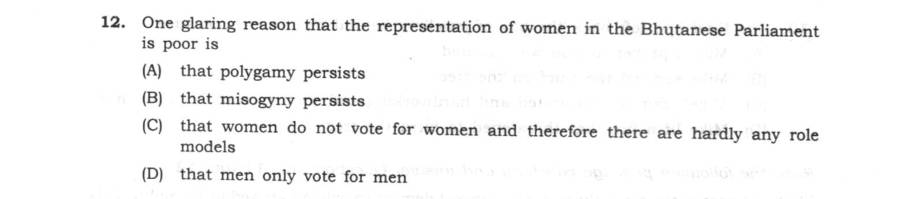
- A that polygamy persists
- B that misogyny persists
- C that women do not vote for women and therefore there are hardly any role models
- D that men only vote for men
Show answer
Answer: (C) that women do not vote for women and therefore there are hardly any role models
Official provisional answer key
-
Read the following passage carefully and answer Question Nos. 13 and 14 :
The development of nationalism in the third world countries, as is well-known, followed a very
different trajectory from that in the advanced capitalist countries. In the latter it was a part of
the process of the emergence of the bourgeois order in opposition of feudalism, while in the
former it was a part of the anti-colonial struggle. The impact of colonialism, though it differed
unifying supra-local economic structures through the introduction of market relations. The
struggle against colonialism, consequently, took the form of a national struggle in each
instance in which people belonging to different tribes or linguistic communities participated.
And the colonial power in each instance attempted to break this emerging national unity by
splitting people. The modus operandi of this splitting was not just through political
manipulation as happened for instance in Angola, South Africa and a host of other countries;
an important part of this modus operandi was through the nurturing of a historiography that
just denied the existence of any overarching national consciousness. The national struggle,
the national movement were given a tribal or religious character, they were portrayed as being
no more than the movement of the dominant tribe or the dominant religious group for the
achievement of narrow sectional ends. But the important point in this colonialism, while, on
the one hand, it objectively created the condition for the coming into being of a national
consciousness at a supra-tribal, supra-local and supra-religious level, on the other hand it
sought deliberately to subvert this very consciousness by using the same forces which it has
objectively undermined.How did nationalism originate in the third world countries?

- A As a struggle against feudalism
- B As a vehement opposition to colonialism
- C To advocate capitalistic movement
- D To strengthen localism
Show answer
Answer: (B) As a vehement opposition to colonialism
Official provisional answer key
-
Read the following passage carefully and answer Question Nos. 13 and 14 :
The development of nationalism in the third world countries, as is well-known, followed a very
different trajectory from that in the advanced capitalist countries. In the latter it was a part of
the process of the emergence of the bourgeois order in opposition of feudalism, while in the
former it was a part of the anti-colonial struggle. The impact of colonialism, though it differed
unifying supra-local economic structures through the introduction of market relations. The
struggle against colonialism, consequently, took the form of a national struggle in each
instance in which people belonging to different tribes or linguistic communities participated.
And the colonial power in each instance attempted to break this emerging national unity by
splitting people. The modus operandi of this splitting was not just through political
manipulation as happened for instance in Angola, South Africa and a host of other countries;
an important part of this modus operandi was through the nurturing of a historiography that
just denied the existence of any overarching national consciousness. The national struggle,
the national movement were given a tribal or religious character, they were portrayed as being
no more than the movement of the dominant tribe or the dominant religious group for the
achievement of narrow sectional ends. But the important point in this colonialism, while, on
the one hand, it objectively created the condition for the coming into being of a national
consciousness at a supra-tribal, supra-local and supra-religious level, on the other hand it
sought deliberately to subvert this very consciousness by using the same forces which it has
objectively undermined.The rise of nationalism was sought to be broken by the colonial powers by
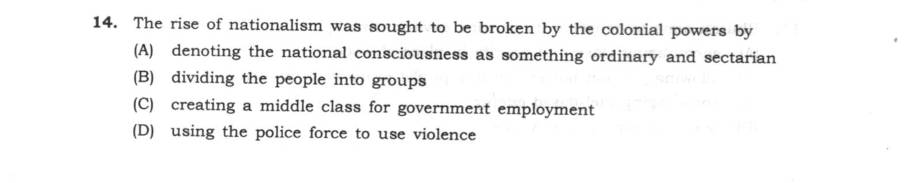
- A denoting the national consciousness as something ordinary and sectarian
- B dividing the people into groups
- C creating a middle class for government employment
- D using the police force to use violence
Show answer
Answer: (A) denoting the national consciousness as something ordinary and sectarian
Official provisional answer key
-
Small talk is a
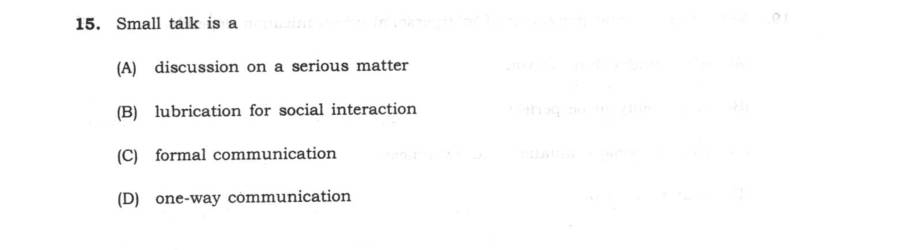
- A discussion on a serious matter
- B lubrication for social interaction
- C (formal communication
- D one-way communication
Show answer
Answer: (B) lubrication for social interaction
Official provisional answer key
-
If we want a continuing harmonious relationship in our negotiations, we will adopt
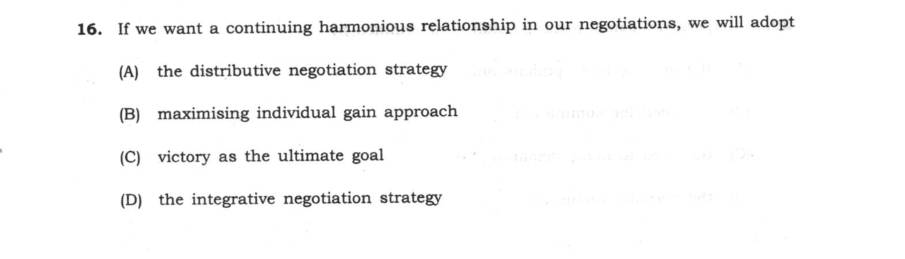
- A the distributive negotiation strategy
- B maximising individual gain approach
- C (victory as the ultimate goal
- D the integrative negotiation strategy
Show answer
Answer: (D) the integrative negotiation strategy
Official provisional answer key
-
Empathy is
to give advice
to try to change someone else's emotions
feeling sorry for someone
putting yourself in someone else's shoes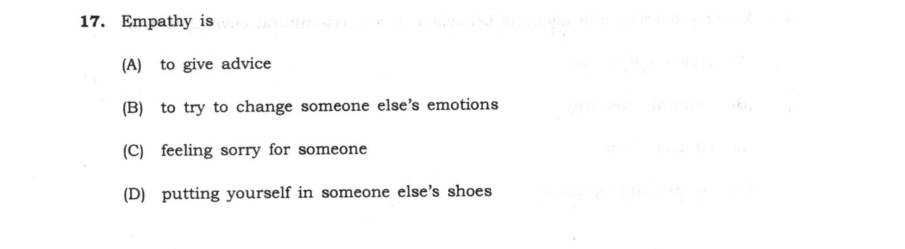
Show answer
Answer: (D)
Official provisional answer key
-
While communicating negative messages, it is important to
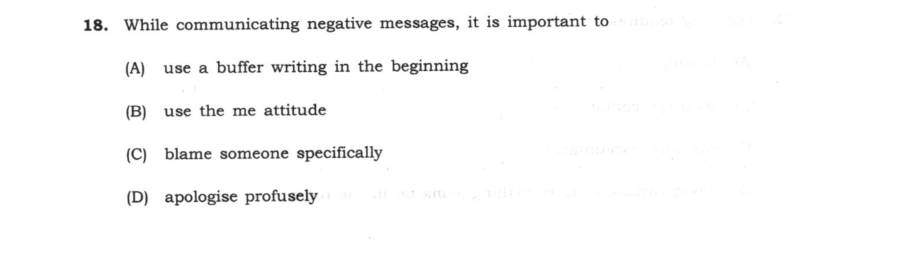
- A use a buffer writing in the beginning
- B use the me attitude
- C blame someone specifically
- D apologise profusely
Show answer
Answer: (A) use a buffer writing in the beginning
Official provisional answer key
-
Self-esteem, a vital ingredient of interpersonal communication depends on
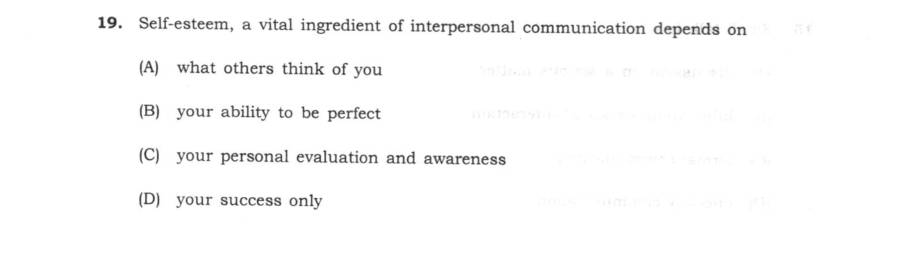
- A what others think of you
- B your ability to be perfect
- C your personal evaluation and awareness
- D your success only
Show answer
Answer: (C) your personal evaluation and awareness
Official provisional answer key
-
Interpersonal communication skill is determined by
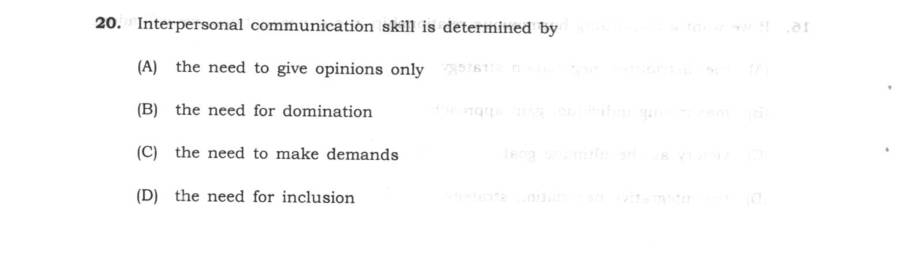
- A the need to give opinions only
- B the need for domination
- C the need to make demands
- D the need for inclusion
Show answer
Answer: (D) the need for inclusion
Official provisional answer key
-
Valuing diversity and adapting behaviour in a cross-cultural environment is
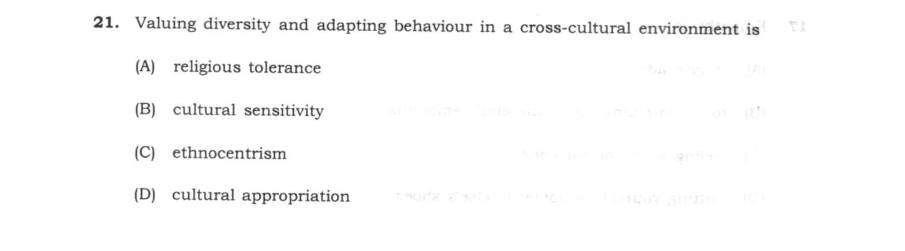
- A religious tolerance
- B (cultural sensitivity
- C ethnocentrism
- D cultural appropriation
Show answer
Answer: (B) (cultural sensitivity
Official provisional answer key
-
Listening requires
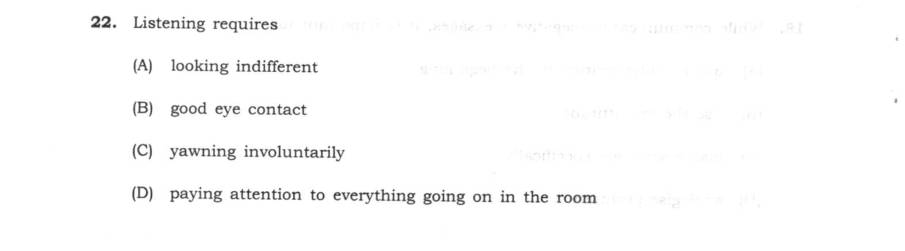
- A looking indifferent
- B good eye contact
- C yawning involuntarily
- D paying attention to everything going on in the room
Show answer
Answer: (B) good eye contact
Official provisional answer key
-
While communicating in a group, you should
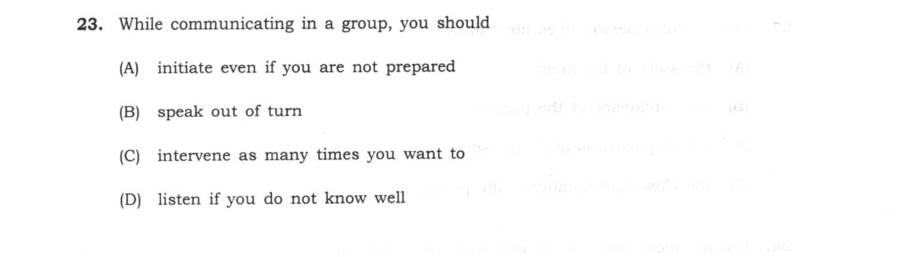
- A initiate even if you are not prepared
- B speak out of turn
- C intervene as many times you want to
- D listen if you do not know well
Show answer
Answer: (D) listen if you do not know well
Official provisional answer key
-
Feedback is crucial as it ensures
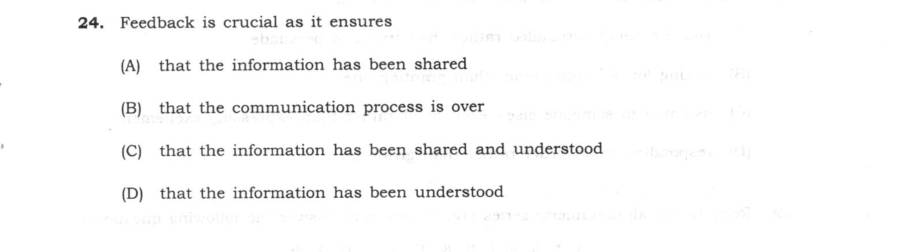
- A that the information has been shared
- B that the communication process is over
- C that the information has been shared and understood
- D that the information has been understood
Show answer
Answer: (C) that the information has been shared and understood
Official provisional answer key
-
Perceptions are largely not
biased
negative
dependent on the person's knowledge, attitude and beliefs
the truth and how things exist
Show answer
Answer: (D)
Official provisional answer key
-
A barrier in communication can be
- A use of jargons
- B use of visual aids
- C empathy with the speaker
- D courtesy
Show answer
Answer: (A) use of jargons
Official provisional answer key
-
The gait of a person does not convey
- A the state of his mind
- B the confidence of the person
- C the helplessness of the person
- D the closed personality of the person
Show answer
Answer: (D) the closed personality of the person
Official provisional answer key
-
You are most likely to pat and shake hands when
- A you are being persuaded rather than trying to persuade
- B asking for a favour rather than granting one
- C listening to someone else's excitement rather than expressing excitement
- D responding to an order rather than giving one
Show answer
Answer: (B) asking for a favour rather than granting one
Official provisional answer key
-
Refer to the alphanumeric series given below and answer the following question :
A, *, 5, 9, I, N, &, E, @, #, U, 1, &
How many vowels in the above arrangement are preceded by a symbol?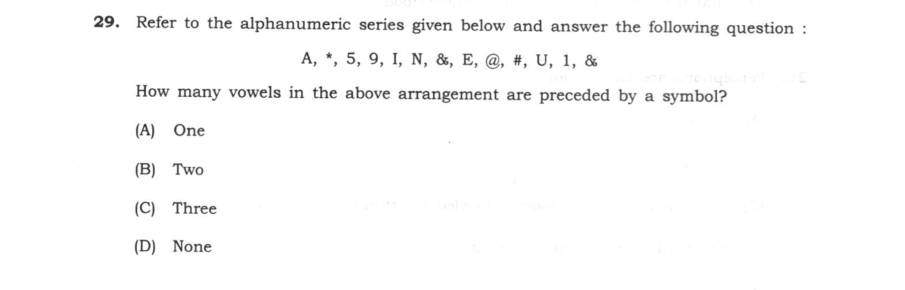
- A One
- B Two
- C Three
- D None
Show answer
Answer: (B) Two
Official provisional answer key
-
What is the missing element in the series given below?
ABD, EFH, IJL, MNP, QRT,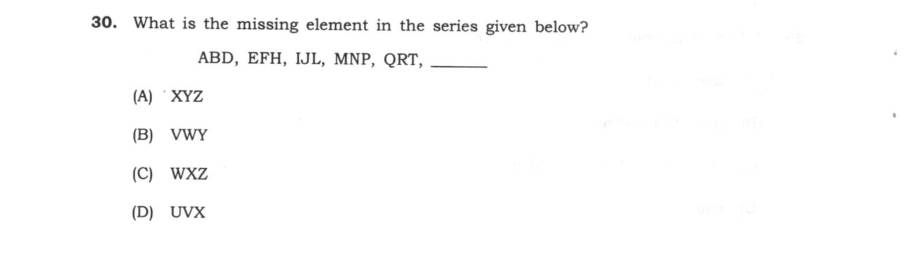
- A XYZ
- B (BVWY
- C WXZ
- D (DUVX
Show answer
Answer: (D) (DUVX
Official provisional answer key
-
When the digits within the following numbers are multiplied with each other, the
product of which number is the lowest?
435
)902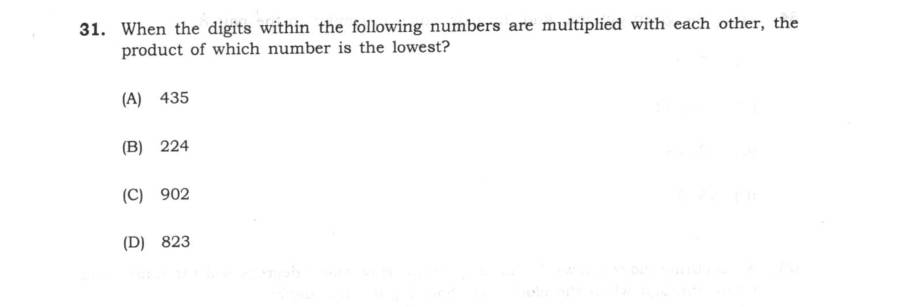
Show answer
Answer: (C)
Official provisional answer key
-
Rita told Mani, "The girl I met yesterday at the beach was the youngest daughter of
the brother-in-law of my friend's mother." How is the girl related to Rita's friend?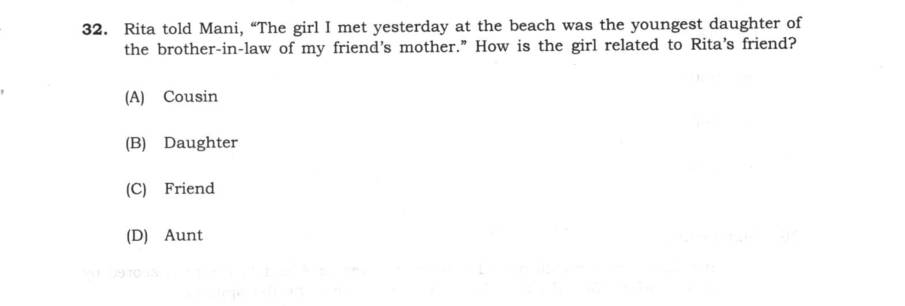
- A Cousin
- B Daughter
- C Friend
- D Aunt
Show answer
Answer: (A) Cousin
Official provisional answer key
-
If
A + B indicates A is the brother of B
A - B indicates A is the sister of B
A * B indicates A is the father of B
then which of the following means that C is the son of M?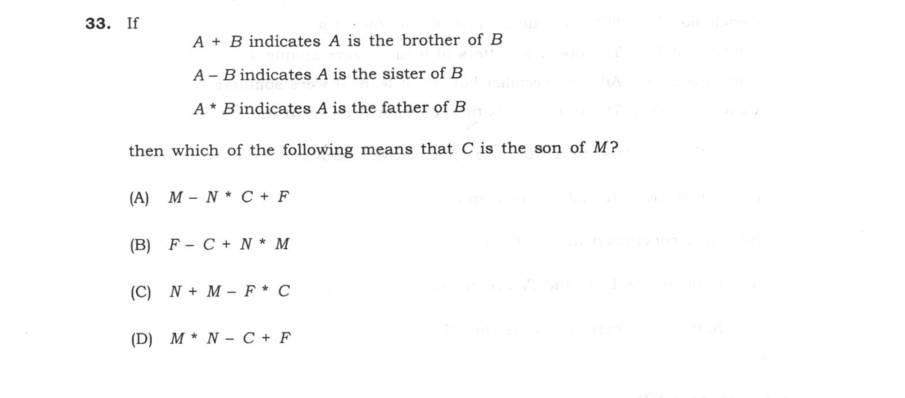
- A M - N *C + F
- B F - C + N *M
- C N + M − F * C
- D M *N − C + F
Show answer
Answer: (D) M *N − C + F
Official provisional answer key
-
From the given options, find the pair which is similar to the pair 8, 4.
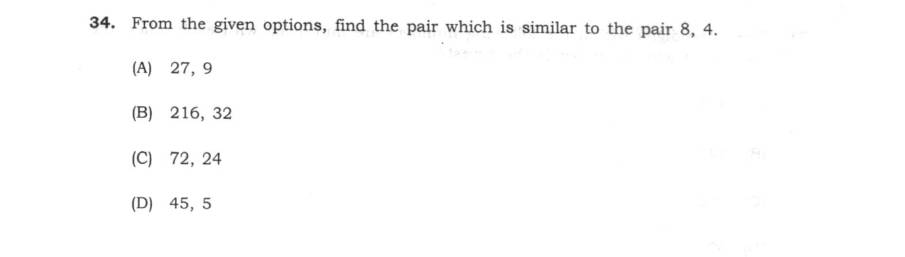
- A 27, 9
- B 216, 32
- C 72,24
- D 45, 5
Show answer
Answer: (A) 27, 9
Official provisional answer key
-
An accurate clock shows 7 a.m. at present. How many degrees will the hour hand
rotate through when the clock will show 1 p.m. next day?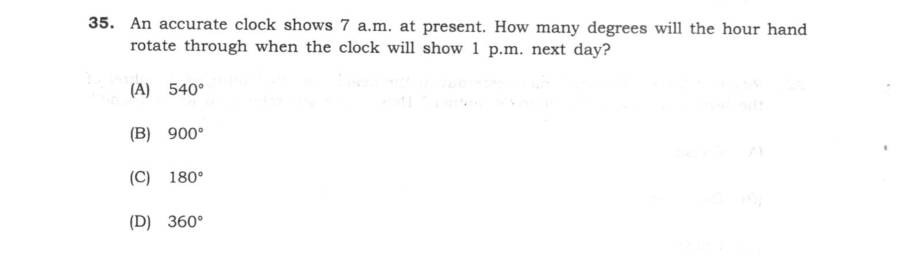
- A 540°
- B 006
- C 180°
- D 360°
Show answer
Answer: (B) 006
Official provisional answer key
-
Statement :
In a T20 cricket match played between two teams A and B, the runs scored by
team A were 150, of which 120 runs were scored by the spinners.
Conclusion I : 80% of team A consisted of spinners.
Conclusion II : The opening batters of team A were spinners.
Conclusion III : All the specialist batters of team A were spinners.
Conclusion IV : The top order batters of team A failed in the match.
Select the correct answer from the options given below.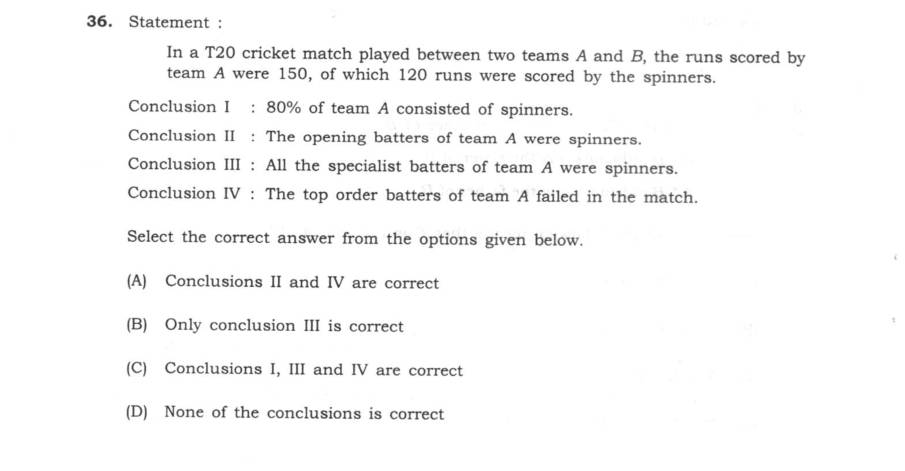
- A Conclusions II and IV are correct
- B Only conclusion III is correct
- C Conclusions I, III and IV are correct
- D None of the conclusions is correct
Show answer
Answer: (D) None of the conclusions is correct
Official provisional answer key
-
SOUTH is related to NORTH-WEST in the same way as WEST is related to
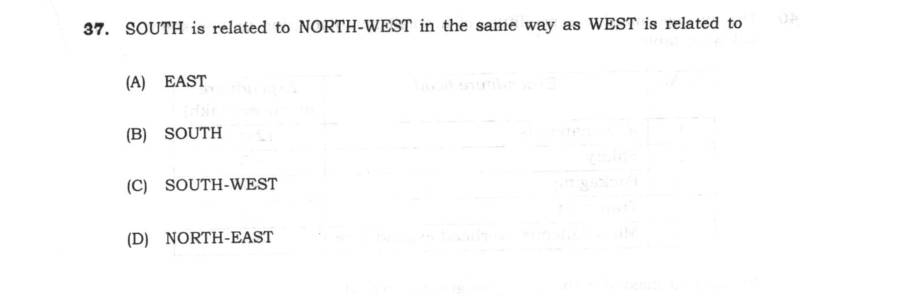
- A EAST
- B SOUTH
- C SOUTH-WEST
- D NORTH-EAST
Show answer
Answer: (D) NORTH-EAST
Official provisional answer key
-
Which of the following diagrams correctly represents lions, elephants and
animals?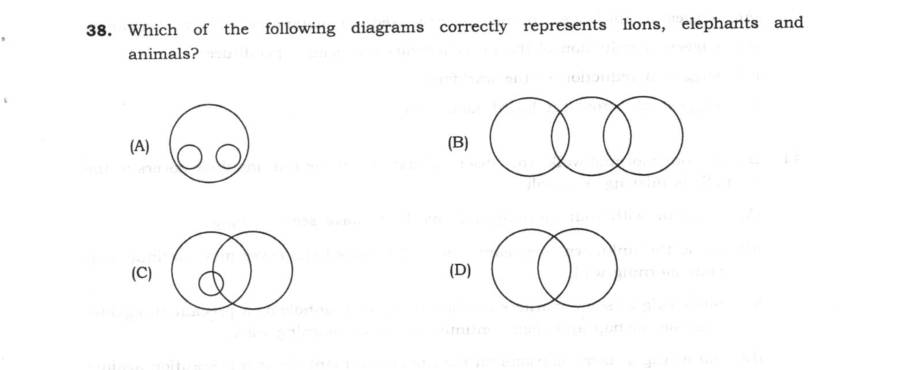
Show answer
Answer: (A)
Official provisional answer key
-
A garbage truck visits your locality every alternate day. You have observed that the
trashmen neither wear boots nor gloves while collecting garbage from the
households. You will
- A ignore the situation
- B approach the trashmen and rebuke them for not wearing any protective gear
- C approach the trashmen and offer some money to buy boots and gloves
- D describe the situation in your social media account with a photo of the scene and tag the local municipal authority to your post
Show answer
Answer: (D) describe the situation in your social media account with a photo of the scene and tag the local municipal authority to your post
Official provisional answer key
-
The average monthly expenditure of a small manufacturing unit is shown in the
following table :
Sl. No. Expenditure head Expenditure
(in rupees lakh)
1 Raw materials 12. 0
2 Salary 4. 5
3 Packaging 0·75
4 Transport 0·5
5 Miscellaneous overhead expenditure 3. 5
In order to maximize the profit margin, you would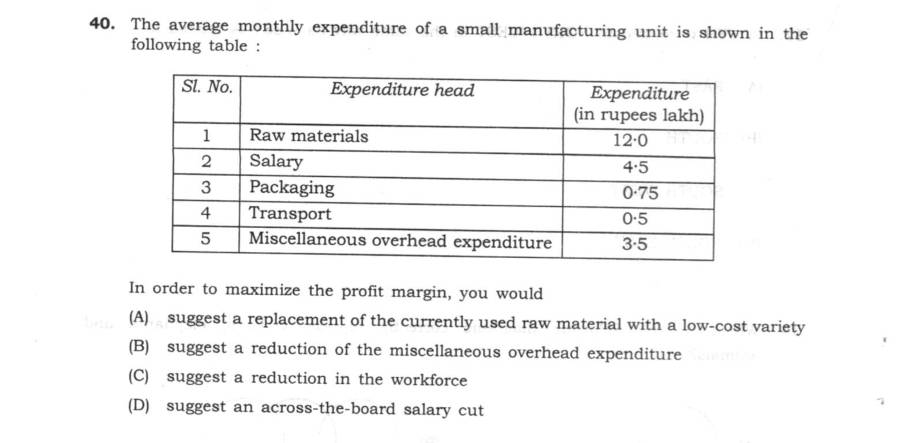
- A suggest a replacement of the currently used raw material with a low-cost variety
- B suggest a reduction of the miscellaneous overhead expenditure
- C ()suggest a reduction in the workforce
- D suggest an across-the-board salary cut
Show answer
Answer: (B) suggest a reduction of the miscellaneous overhead expenditure
Official provisional answer key
-
During your morning walk, you observed that one of the iron manhole covers in the
footpath is missing. You will
- A continue with your morning walk as if you have seen nothing
- B curse the unknown miscreant who had removed the cover and continue with your morning walk
- C put a twig or some markers on the uncovered manhole as a precaution against possible mishap and then continue with your morning walk
- D put a twig or some markers on the uncovered manhole as a precaution against possible mishap, alert the maintenance authority, if possible and then continue with your morning walk
Show answer
Answer: (D) put a twig or some markers on the uncovered manhole as a precaution against possible mishap, alert the maintenance authority, if possible and then continue with your morning walk
Official provisional answer key
-
You saw some kids studying in the neighbourhood school throwing garbage on the
road. You will
ignore the situation
?
force the kids to clean up the litter
make a visit to the school and request the Headmaster to sensitise the students
on civic sense and also on the virtues of cleanliness
Show answer
Answer: (D)
Official provisional answer key
-
Three persons are currently employed in a certain section of an office, of which you
are the in-charge. Two of the employees of the section are on leave today with your
prior approval. During the first hour of the day, however, you received a half-day
leave application from the third employee of the section. You would
- A approve the leave application immediately
- B summon the employee to your chamber and enquire about the urgency of his situation. Depending on that, you decide whether to grant him leave or not
- C summarily reject the leave application
- D summarily reject the leave application and rebuke the employee for his irresponsible behaviour
Show answer
Answer: (B) summon the employee to your chamber and enquire about the urgency of his situation. Depending on that, you decide whether to grant him leave or not
Official provisional answer key
-
A clock shows the time as 8:30 a.m. What is the measurement of the angle made
by the hands of the clock?
- A 75°
- B 60°
- C 30°
- D 45°
Show answer
Answer: (A) 75°
Official provisional answer key
-
If P' represents "', 'Q' represents '+', R' represents "' and 'S' represents '*', then
what will be the value of 9P3S4Q8R7?
12
B 15
10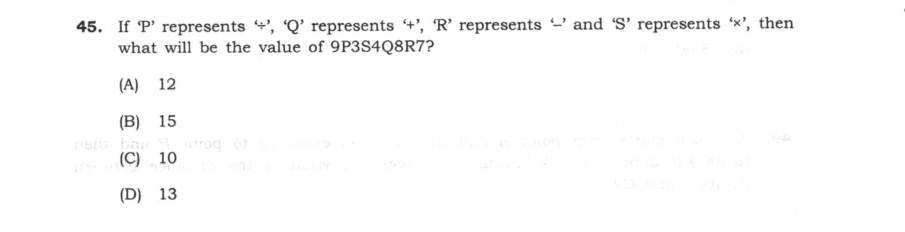
Show answer
Answer: (D)
Official provisional answer key
-
Which of the following does not belong to the rest of the group?
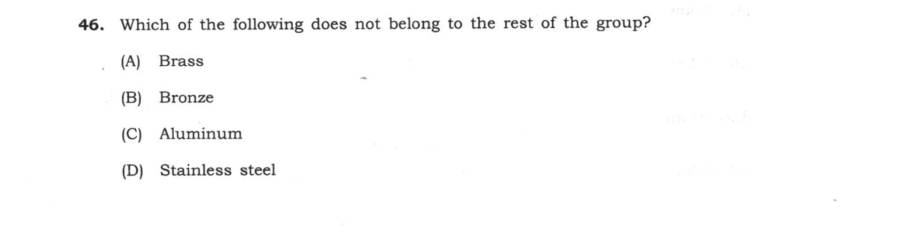
- A Brass
- B Bronze
- C (CAluminum
- D Stainless steel
Show answer
Answer: (C) (CAluminum
Official provisional answer key
-
If RHINO is coded as PFGLM, then TIGER will be coded as
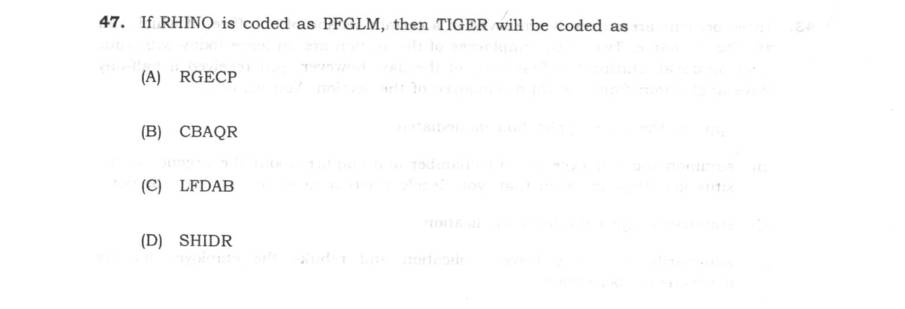
- A RGECP
- B CBAQR
- C LFDAB
- D SHIDR
Show answer
Answer: (A) RGECP
Official provisional answer key
-
X reached the venue of a meeting 15 minutes before time. Y reached the same venue
30 minutes late for the meeting. The meeting was over at 11 a.m., 30 minutes after
Y reached the meeting. At what time did X reach the venue of the meeting?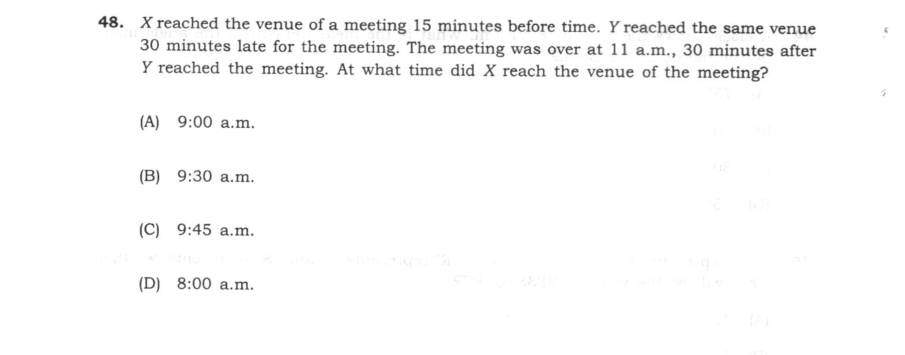
- A 9:00 a.m.
- B 9:30 a.m.
- C 9:45 a.m.
- D 8:00 a.m.
Show answer
Answer: (C) 9:45 a.m.
Official provisional answer key
-
A person starts from point A and travels 3 km eastward to point B and then
turns left and travels 4 km to reach point C. What is the distance between
points A and C?
- A 7 km
- B (B2 km
- C 10 km
- D 5 km
Show answer
Answer: (D) 5 km
Official provisional answer key
-
Below is a set of four diagrams where the 'square' represents 'teachers', the 'circle'
represents 'doctors' and the 'triangle' represents 'musicians'. Which of the diagrams
justifies the statement : "Some teachers are musicians; some musicians are doctors
but no teacher is a doctor"?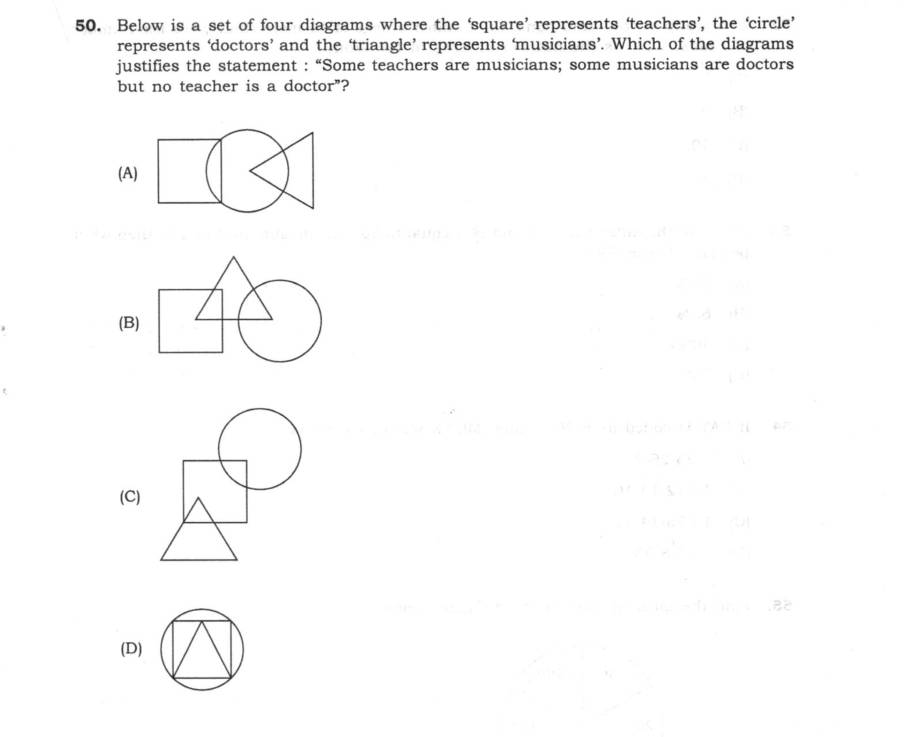
Show answer
Answer: (B)
Official provisional answer key
-
A person walks towards the direction of his house at 7 a.m. and observes his shadow
to the right. In which direction is he walking?
- A South
- B North
- C East
- D West
Show answer
Answer: (A) South
Official provisional answer key
-
In a group of cows and hens, the number of legs is 14 more than twice the number
of heads. What is the number of cows in the group?
- A 7
- B 9
- C 10
- D 8
Show answer
Answer: (A) 7
Official provisional answer key
-
If 80% of the difference of A and B is equal to 20% of the sum of A and B, then what
percent of A is B?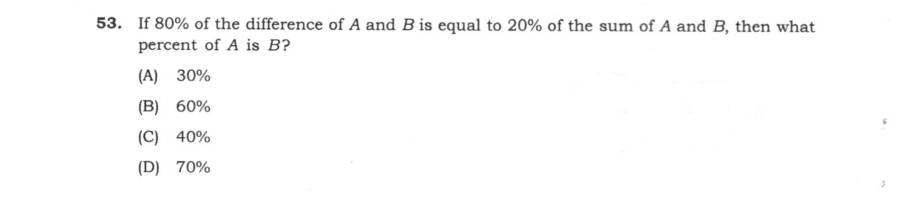
- A 30%
- B 60%
- C 40%
- D D70%
Show answer
Answer: (B) 60%
Official provisional answer key
-
If RAT is coded as 9-26-7, then MONK will be coded as
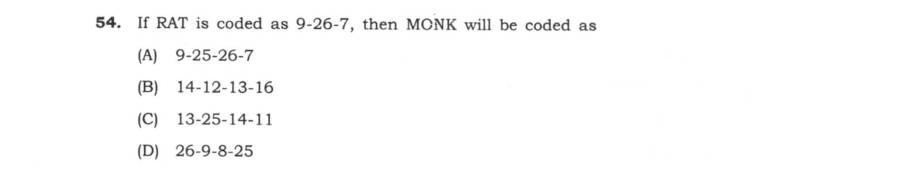
- A 9-25-26-7
- B 14-12-13-16
- C 13-25-14-11
- D 26-9-8-25
Show answer
Answer: (B) 14-12-13-16
Official provisional answer key
-
Find the missing number in the figure below :
? 200
20 104
32 56
14
320
6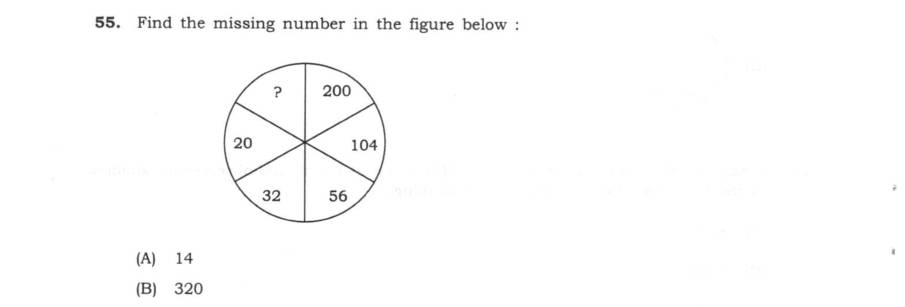
Show answer
Answer: (A)
Official provisional answer key
-
If
25-3=2
36-5= 1
16-4=0
then what is 81 - 5 = ?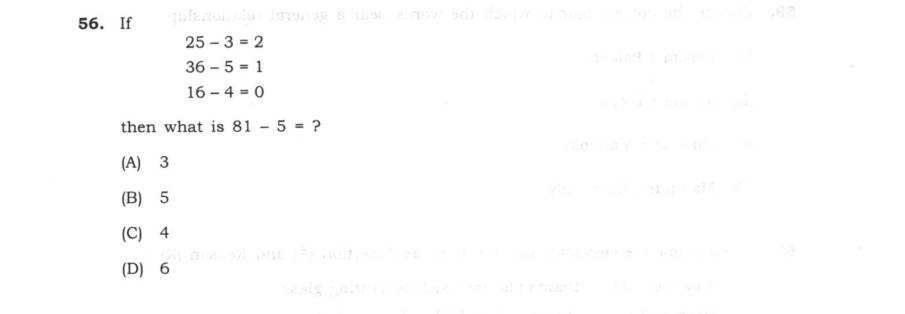
- A 3
- B 5
- C 4
- D 6
Show answer
Answer: (C) 4
Official provisional answer key
-
In the following sequence of numbers, which number will be present between
42 and 170?
6, 10, 22, 42, _, 170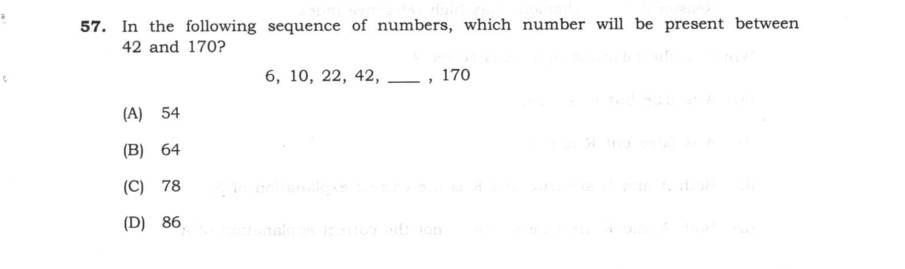
- A 54
- B 64
- C 78
- D D86
Show answer
Answer: (D) D86
Official provisional answer key
-
Five friends P, Q, R, S and T are sitting on a bench in a particular order wearing
blue, red, yellow, white and green caps (not necessarily in this order).
1. P is sitting on the right of Q (next to Q) and T and is wearing a red cap.
2. R is sitting in the second position from the right.
3. T is wearing a blue cap.
4. Q is wearing a green cap and S is not wearing a white cap.
What is the colour of the cap worn by R and his sitting position from the left?
(A) Yellow and third
(B) Green and fourth
(C) White and third
(D) White and fourth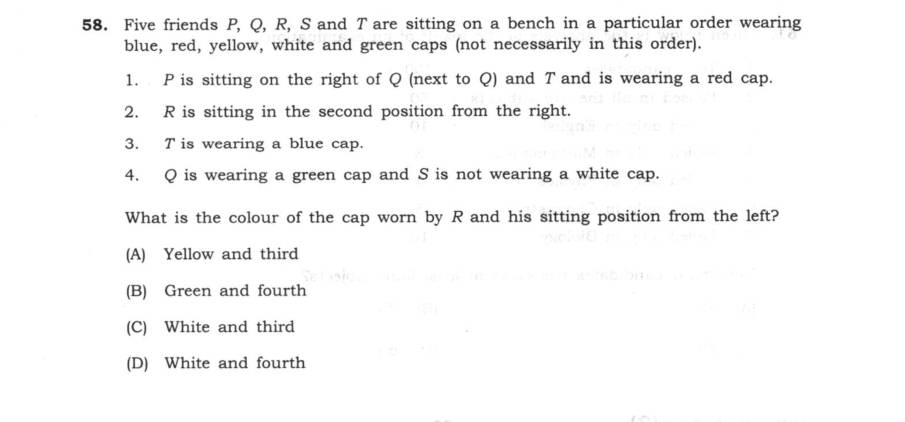
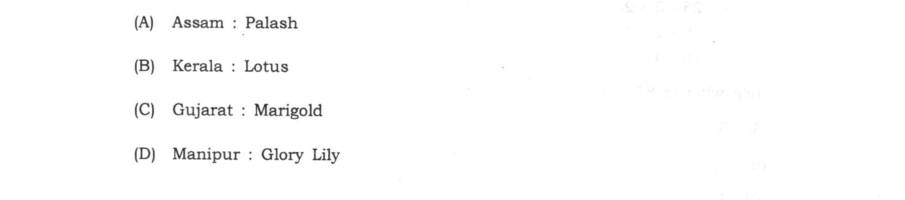
- A Assam : Palash
- B Kerala : Lotus
- C Gujarat : Marigold
- D (DManipur : Glory Lily
Show answer
Answer: (D) (DManipur : Glory Lily
Official provisional answer key
-
Given below are two statements labeled as Assertion (A) and Reason (R) :
Assertion (A) : Diamonds are used for cutting glass.
Reason (R) : Diamond has high refractive index.
Which of the following options is correct?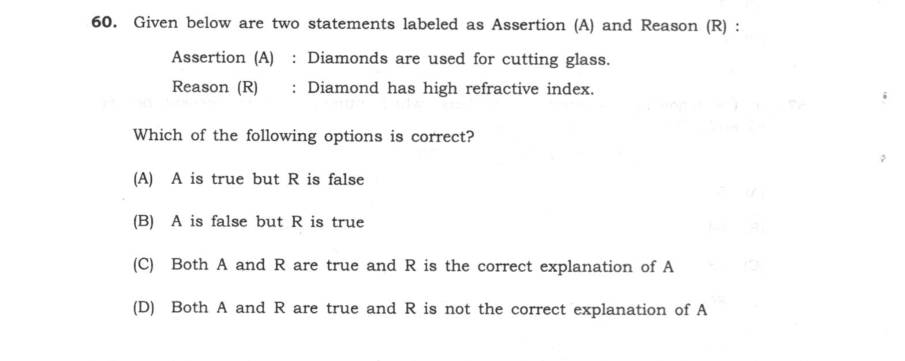
- A A is true but R is false
- B A is false but R is true
- C Both A and R are true and R is the correct explanation of A
- D Both A and R are true and R is not the correct explanation of A
Show answer
Answer: (D) Both A and R are true and R is not the correct explanation of A
Official provisional answer key
-
Given below is the analysis of the result of an examination :
1. Total candidates 100
2. Passed in all the five subjects : 50
3. Failed only in English 10
4. Failed only in Mathematics 8
5. Failed only in Physics 2
6. Failed only in Chemistry 5
7. Failed only in Biology 10
How many candidates passed in at least four subjects?
85 35
70 65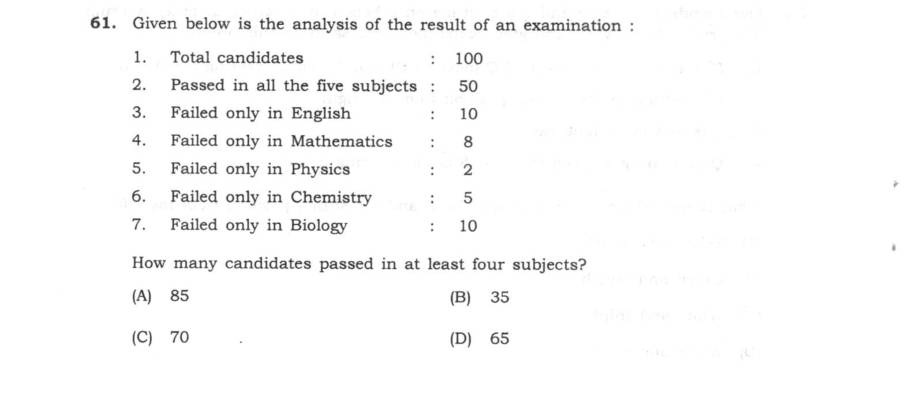
Show answer
Answer: (A)
Official provisional answer key
-
A train passes through a 1·5 km long tunnel in 2 minutes. If the speed of the train
is 60 km per hour, what is the length of the train?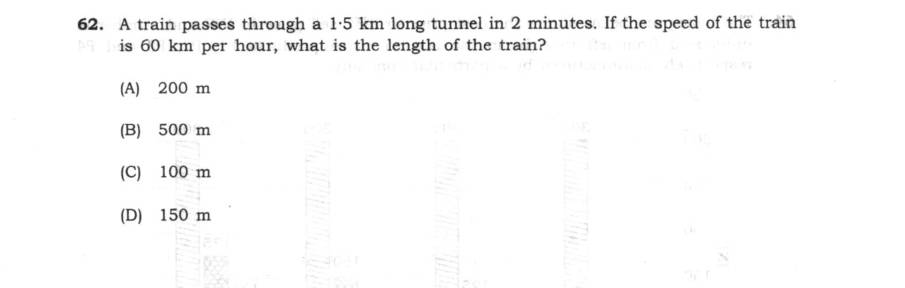
- A 200 m
- B 500 m
- C 100 m
- D 150 m
Show answer
Answer: (B) 500 m
Official provisional answer key
-
The line graph below shows the yearly production output of a tractor manufacturing
company :
Production Figures
E
1100
1000
No. of units produced 800
2014 2015 2016 2017 2018 2019 2020 2021
Year
In which year, the company suffered the lowest rate of increase in production?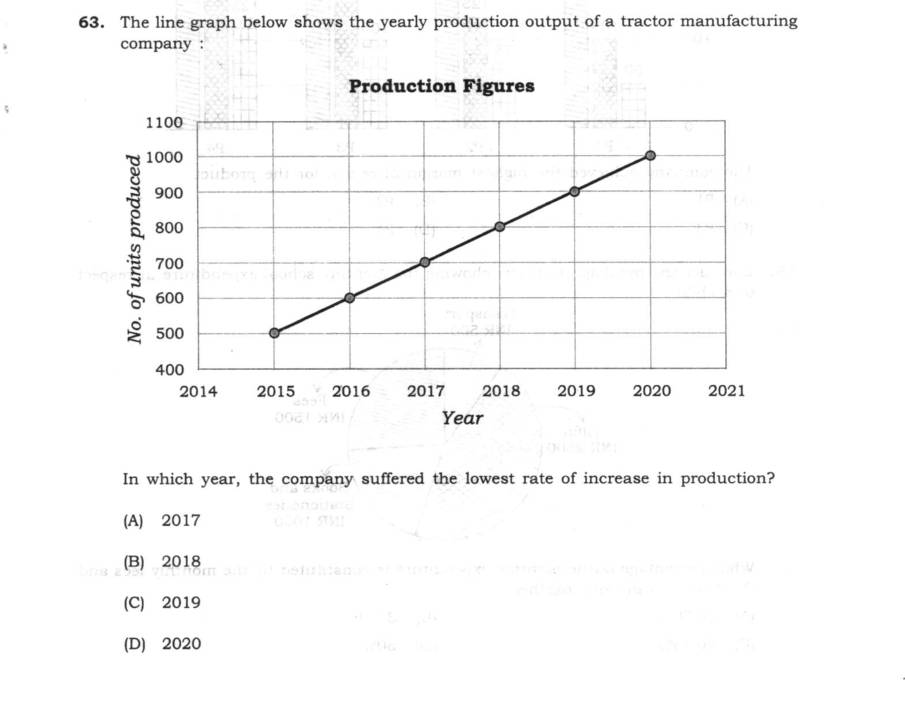
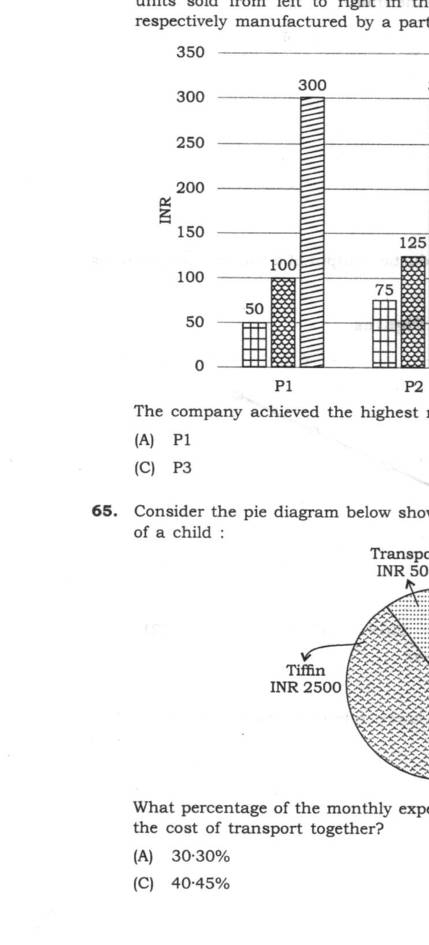
- A 2017 P1
- B 2018 P3 of a child : Transport INR 500 Tiffin INR 2500 the cost of transport together?
- C 2019 30·30% 40·45%
- D 2020 respectively manufactured by a particular company : 300 300 INR P1 P2 The company achieved the highest margin of return for the product
Show answer
Answer: (D) 2020 respectively manufactured by a particular company : 300 300 INR P1 P2 The company achieved the highest margin of return for the product
Official provisional answer key
-
The histogram below shows the cost price in INR, sell price in INR and number of
units sold from left to right in the last FY for 4 products Pl, P2, P3 and P4
300 300
P3 P4
P2
P4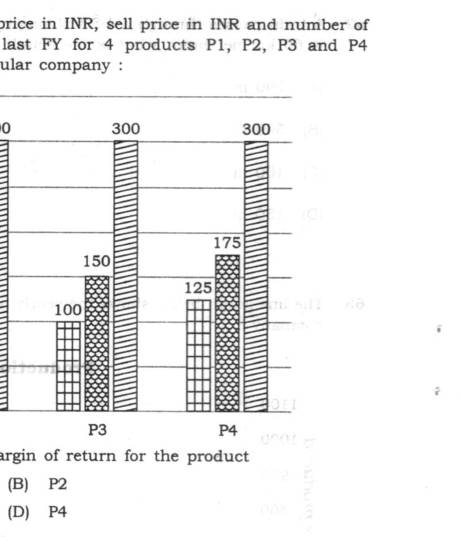
Show answer
Answer: (A)
Official provisional answer key
-
Consider the pie diagram below showing the monthly school expenditure in respect
Fees
INR 1500
Books and
Stationeries
INR 1000
36·36%
D50%
24 IS)AI8V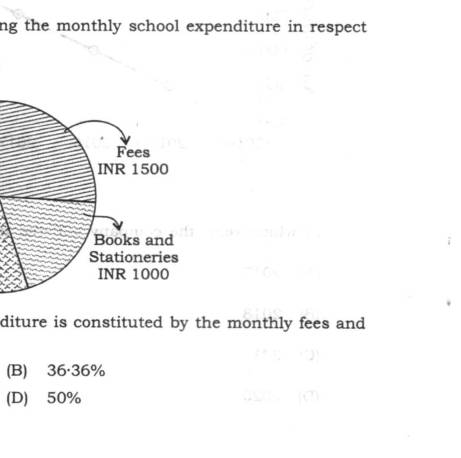
Show answer
Answer: (B)
Official provisional answer key
-
A car travels 100 km from a location P to a location Q. The table below records the
average speed of the car in different segments of the journey :
Distance travelled Average speed (in kmph)
First 20 km 40
Next 30 km 60
Next 10 km 40
Next 40 km 60
What is the average speed of the car for the entire journey from P to Q?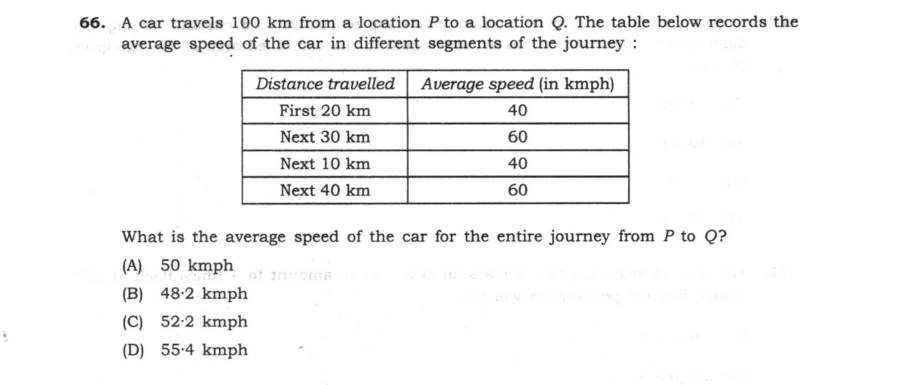
- A 50 kmph
- B (48·2 kmph
- C 52. 2 kmph
- D (55.4 kmph
Show answer
Answer: (A) 50 kmph
Official provisional answer key
-
If the length of a rectangle is increased by 25% and the width is decreased by 20%,
then the area of the rectangle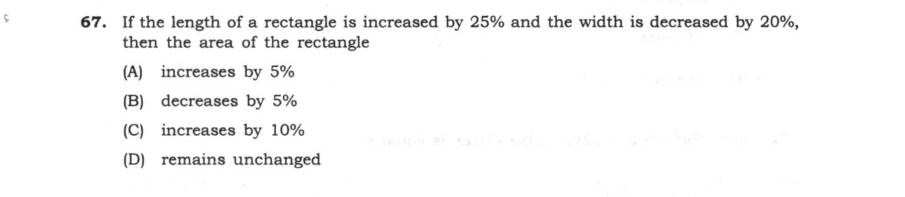
- A increases by 5%
- B decreases by 5%
- C increases by 10%
- D remains unchanged
Show answer
Answer: (D) remains unchanged
Official provisional answer key
-
A's present age is 4 years more than B's age after 6 years. The sum of the present
ages of A and B together is 70 years. What is the present age of B?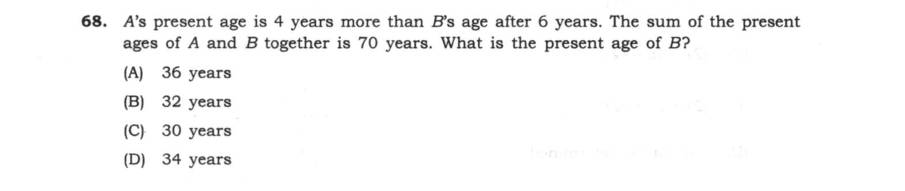
- A 36 years
- B 32 years
- C 30 years
- D (34 years
Show answer
Answer: (C) 30 years
Official provisional answer key
-
A cylinder whose height is $\frac2 }$ of its diameter has the same volume as that of a sphere
of radius 8 cm. The radius of the cylinder is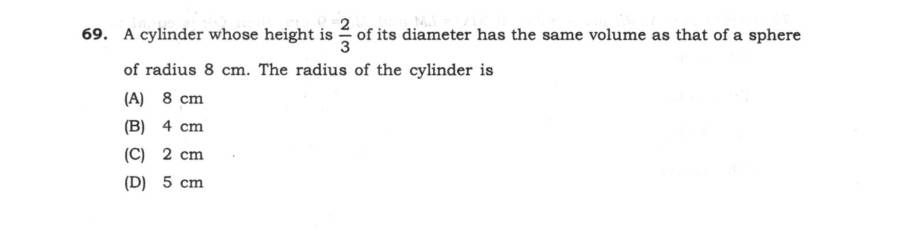
- A 8 cm
- B (B4 cm
- C 2 cm
- D 5 cm
Show answer
Answer: (A) 8 cm
Official provisional answer key
-
The diameters of two given circular plates are respectively 18 cm and 80 cm. The
diameter of a plate which has an area equal to the combined area of the two given
plates is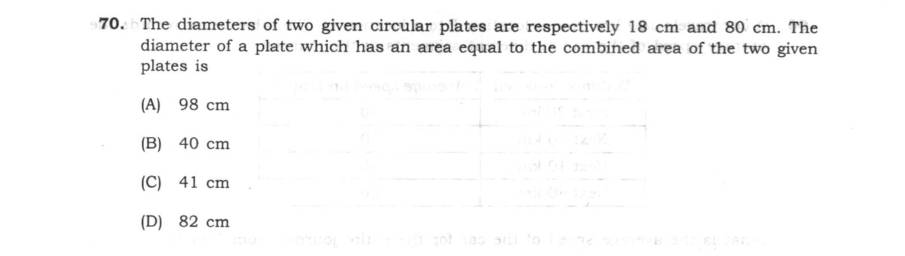
- A 98 cm
- B 40 cm
- C 41 cm
- D 82 cm
Show answer
Answer: (D) 82 cm
Official provisional answer key
-
The time in years required for a sum of money to amount to 4 times itself at 15%
simple interest per annum will be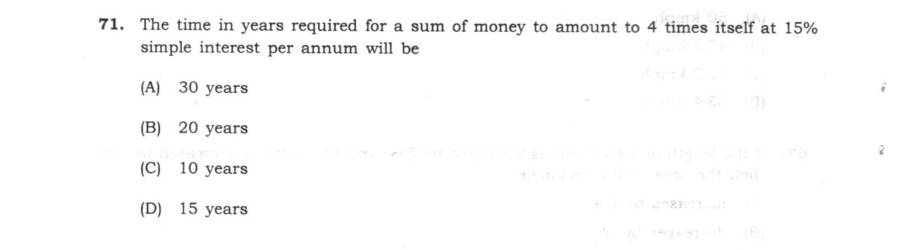
- A 30 years
- B 20 years (Oe
- C 10 years
- D 15 years
Show answer
Answer: (B) 20 years (Oe
Official provisional answer key
-
4x2 +9y^{2 +16z2 +12xy+24yz+16xz is equal to
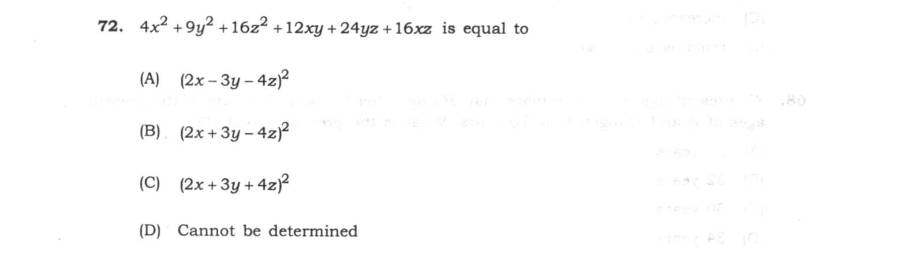
- A (2x-3y-4z)²2
- B (2x+3y-4z)2
- C (2x + 3y + 4z)2
- D Cannot be determined
Show answer
Answer: (C) (2x + 3y + 4z)2
Official provisional answer key
-
ΔPQR and ΔLMN are similar. If 3PQ= LM and MN= 9 cm, then QR is equal to
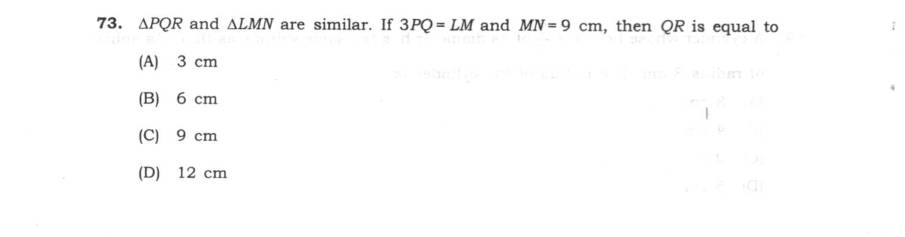
- A 3 cm
- B 6 cm
- C 9 cm
- D D12 cm
Show answer
Answer: (A) 3 cm
Official provisional answer key
-
The HCF of two numbers is 8. Which one of the following can never be their LCM?
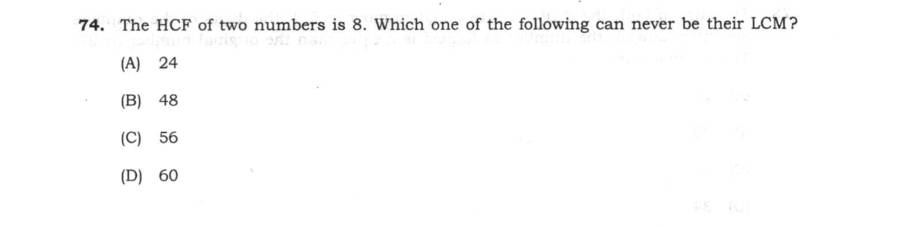
- A 24
- B 48
- C 56
- D 60
Show answer
Answer: (D) 60
Official provisional answer key
-
The radius of a wheel is 21 cm. How many revolutions will it make in
travelling 924 m? [Use π = 22
7
11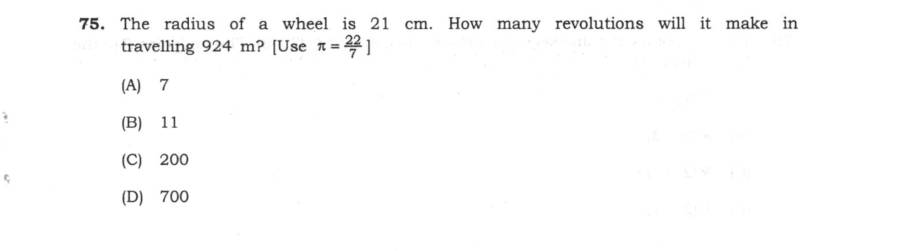
Show answer
Answer: (D)
Official provisional answer key
-
If √3 = 1·7321, then the value of √192 1 $\q48\sqqrt s$
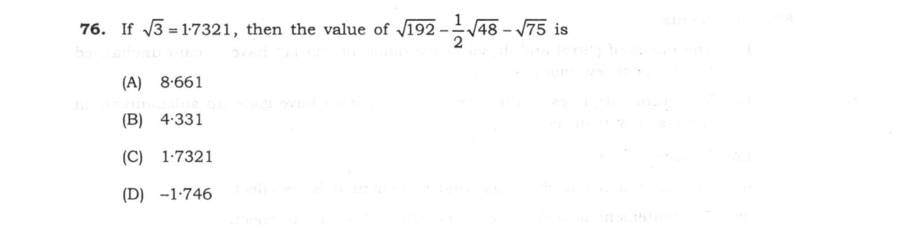
- A 8·661
- B 4·331
- C 1·7321
- D -1·746
Show answer
Answer: (C) 1·7321
Official provisional answer key
-
A student was asked to find the arithmetic mean of the following 12 numbers :
3, 11, 7, 9, 15, 13, 8, 19, 17, 21, 14 and x
He found the arithmetic mean to be 12. The value of x is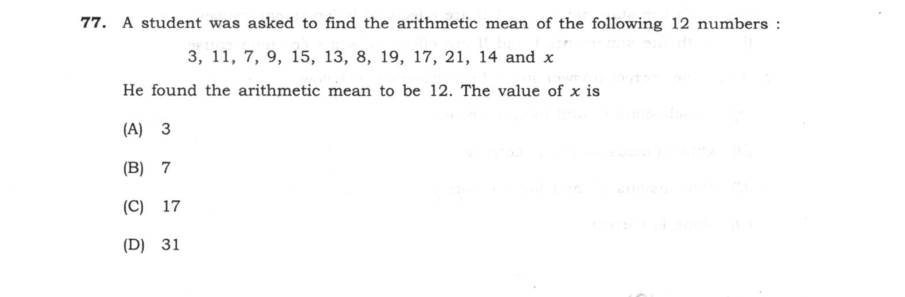
- A 3
- B 7
- C 17
- D (31
Show answer
Answer: (B) 7
Official provisional answer key
-
The sum of both the digits of a two-digit number is 7. If the digits of the numbers
are interchanged, the number so formed is greater than the original number by 27.
The original number is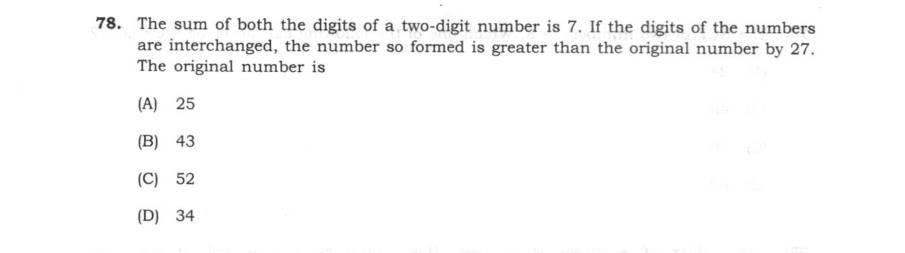
- A 25
- B (B43
- C 52
- D D 34
Show answer
Answer: (A) 25
Official provisional answer key
-
The end points of a line segment AB are P (-5, 4) and Q (7, -8). The midpoint R of the
line segment is
R(1,-2)
(R(2,-3)
(2,-2) 7
(R(2,-1)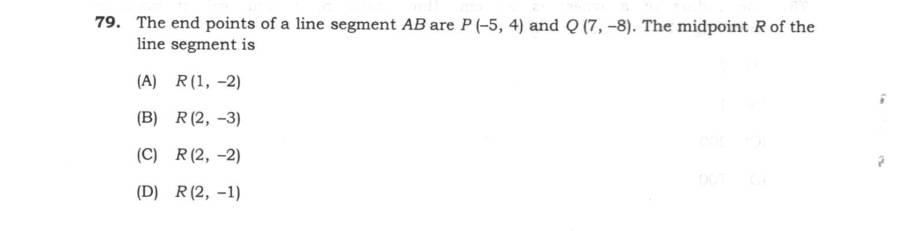
Show answer
Answer: (A)
Official provisional answer key
-
Statements :
I. The prices of petrol and diesel in the domestic market have remain unchanged
for the past few months.
II. The crude oil prices in the international market have gone up substantially in
the last few months.
Conclusions :
(i) The statement I is the cause and statement II is its effect.
(ii) The statement II is the cause and statement I is its effect.
(iii) Both the statements I and II are effects of independent causes.
(iv) Both the statements I and II are effects of some common cause.
Select the correct answer from the options given below.
- A Conclusions (i) and (iv) are correct
- B Only conclusion (ii) is correct
- C Conclusions (ii) and (iii) are correct
- D None is correct (S)A-IEV
Show answer
Answer: (B) Only conclusion (ii) is correct
Official provisional answer key
Frequently asked questions
How many questions are in the APSC CCE Prelims 2023 GS II paper?
The paper has 79 multiple-choice questions. The largest subject is Reasoning with 25 questions.
Where do the answers for the APSC CCE Prelims 2023 GS II paper come from?
Official provisional answer key for 79 questions.
Can I download the original APSC CCE Prelims 2023 GS II question paper PDF?
Yes. The original booklet PDF is linked on this page from the open AxomRank PYQ dataset on GitHub.
More APSC CCE Prelims papers
- APSC CCE Prelims 2025 GS I paper
- APSC CCE Prelims 2025 GS II paper
- APSC CCE Prelims 2024 GS I paper
- APSC CCE Prelims 2024 GS II paper
- APSC CCE Prelims 2023 GS I paper
Sources and corrections
Questions are taken from the original booklet and are part of the open AxomRank PYQ dataset. Spotted a mistake? See how to report a correction.