Reading Comprehension Questions from Assam Exams: 72 Previous Year MCQs with Answers
Every reading comprehension question from 6 real Assam recruitment papers, in one place. Use it to see which facts come up again and again.
Where these questions were asked
| Exam | Questions |
|---|---|
| APSC CCE Prelims | 44 |
| ADRE | 22 |
| Assam Police SI | 6 |
Most-asked subtopics
| Subtopic | Questions |
|---|---|
| Passage on atomic bomb test | 10 |
| Passage details | 10 |
| Passage inference | 9 |
| Word meaning in context | 6 |
| Passage on Okapi | 4 |
| Passage on bicycles | 4 |
| Passage on reality and meaning | 3 |
| Passage on Make in India | 2 |
| Passage on horror films | 2 |
| Passage on parenting | 2 |
| Passage on Ombudsman | 2 |
| Passage on Morris and the thief | 2 |
| Passage on Bhutan | 2 |
| Passage on nationalism | 2 |
| Passage interpretation | 2 |
All 72 questions
-
Read the following passage and answer the questions (133-136) that follow :
The Okapi, a forest mammal of Central Africa, has presented zoologists with a number of difficult
questions since they first learned of its existence in 1900. The first was how to classify it. Because it was
horselike in dimension, and bore patches of striped hide similar to a zebra’s (a relative of the horse),
zoologists first classified it as a member of the horse family. But further studies showed that, despite
Okapis’ coloration and short necks, their closest relatives were giraffes. The Okapi’s rightful place within
the giraffe family is confirmed by its skin-covered horns (in males), two-lobed canine teeth, and long
prehensile tongue.
The vital question concerned the size of the Okapi population. Because Okapis were infrequently
captured by hunters, some zoologists believed that they were rare; however, others theorized that their
habits simply kept them out of sight. It was not until 1985, when zoologists started tracking Okapis by
affixing collars equipped with radio transmitters to briefly captured specimens, that reliable information
about Okapi numbers and habits began to be collected. It turns out that while Okapis are not as rare as
some zoologists suspected, their population is concentrated in an extremely limited chain of forestland
in north-eastern Central Africa, surrounded by savanna.
One reason for their seeming scarcity is that their coloration allows Okapis to camouflage themselves
even at close range. Another is that Okapis do not travel in groups or with other large forest mammals,
and neither frequent open riverbanks nor forage at the borders of clearings, choosing instead to keep to
the forest interior. This is because Okapis, unlike any other animal in the Central African forest, subsist
entirely on leaves: more than one hundred species of plants have been identified as part of their diet, and
about twenty of these are preferred. Okapis never eat one plant to the exclusion of others; even where
preferred foliage is abundant, Okapis will leave much of it uneaten, choosing to move on and sample
other leaves. Because of this, and because of the distribution of their food, Okapis engage in individual
rather than congregated foraging.
But other questions about Okapi behaviour arise. Why, for example, do they prefer to remain
within forested areas when many of their favourite plants are found in the open border between forest
and savanna ? One possibility is that this is a defence against predators; another is that the Okapi was
pushed into the forest by competition with other large, hoofed animals, such as the bushbuck and bongo,
that specialize on the forest edges and graze them more efficiently. Another question is why Okapis are
absent from other nearby forest regions that would seem hospitable to them. Zoologists theorize that
Okapis are relics of an era when forestland was scarce and that they continue to respect those borders
even though available forestland has long since expanded.The word hide in the first paragraph means :
- A smell
- B evade
- C skin
- D land
Show answer
Answer: (C) skin
Official final answer key
-
Read the following passage and answer the questions (133-136) that follow :
The Okapi, a forest mammal of Central Africa, has presented zoologists with a number of difficult
questions since they first learned of its existence in 1900. The first was how to classify it. Because it was
horselike in dimension, and bore patches of striped hide similar to a zebra’s (a relative of the horse),
zoologists first classified it as a member of the horse family. But further studies showed that, despite
Okapis’ coloration and short necks, their closest relatives were giraffes. The Okapi’s rightful place within
the giraffe family is confirmed by its skin-covered horns (in males), two-lobed canine teeth, and long
prehensile tongue.
The vital question concerned the size of the Okapi population. Because Okapis were infrequently
captured by hunters, some zoologists believed that they were rare; however, others theorized that their
habits simply kept them out of sight. It was not until 1985, when zoologists started tracking Okapis by
affixing collars equipped with radio transmitters to briefly captured specimens, that reliable information
about Okapi numbers and habits began to be collected. It turns out that while Okapis are not as rare as
some zoologists suspected, their population is concentrated in an extremely limited chain of forestland
in north-eastern Central Africa, surrounded by savanna.
One reason for their seeming scarcity is that their coloration allows Okapis to camouflage themselves
even at close range. Another is that Okapis do not travel in groups or with other large forest mammals,
and neither frequent open riverbanks nor forage at the borders of clearings, choosing instead to keep to
the forest interior. This is because Okapis, unlike any other animal in the Central African forest, subsist
entirely on leaves: more than one hundred species of plants have been identified as part of their diet, and
about twenty of these are preferred. Okapis never eat one plant to the exclusion of others; even where
preferred foliage is abundant, Okapis will leave much of it uneaten, choosing to move on and sample
other leaves. Because of this, and because of the distribution of their food, Okapis engage in individual
rather than congregated foraging.
But other questions about Okapi behaviour arise. Why, for example, do they prefer to remain
within forested areas when many of their favourite plants are found in the open border between forest
and savanna ? One possibility is that this is a defence against predators; another is that the Okapi was
pushed into the forest by competition with other large, hoofed animals, such as the bushbuck and bongo,
that specialize on the forest edges and graze them more efficiently. Another question is why Okapis are
absent from other nearby forest regions that would seem hospitable to them. Zoologists theorize that
Okapis are relics of an era when forestland was scarce and that they continue to respect those borders
even though available forestland has long since expanded.The function of the third paragraph is to :
- A pose a question about Okapi behaviour
- B rebut a theory about Okapi behaviour
- C counter the assertion that Okapis are rare
- D explain why Okapis appeared to be rare
Show answer
Answer: (D) explain why Okapis appeared to be rare
Official final answer key
-
Read the following passage and answer the questions (133-136) that follow :
The Okapi, a forest mammal of Central Africa, has presented zoologists with a number of difficult
questions since they first learned of its existence in 1900. The first was how to classify it. Because it was
horselike in dimension, and bore patches of striped hide similar to a zebra’s (a relative of the horse),
zoologists first classified it as a member of the horse family. But further studies showed that, despite
Okapis’ coloration and short necks, their closest relatives were giraffes. The Okapi’s rightful place within
the giraffe family is confirmed by its skin-covered horns (in males), two-lobed canine teeth, and long
prehensile tongue.
The vital question concerned the size of the Okapi population. Because Okapis were infrequently
captured by hunters, some zoologists believed that they were rare; however, others theorized that their
habits simply kept them out of sight. It was not until 1985, when zoologists started tracking Okapis by
affixing collars equipped with radio transmitters to briefly captured specimens, that reliable information
about Okapi numbers and habits began to be collected. It turns out that while Okapis are not as rare as
some zoologists suspected, their population is concentrated in an extremely limited chain of forestland
in north-eastern Central Africa, surrounded by savanna.
One reason for their seeming scarcity is that their coloration allows Okapis to camouflage themselves
even at close range. Another is that Okapis do not travel in groups or with other large forest mammals,
and neither frequent open riverbanks nor forage at the borders of clearings, choosing instead to keep to
the forest interior. This is because Okapis, unlike any other animal in the Central African forest, subsist
entirely on leaves: more than one hundred species of plants have been identified as part of their diet, and
about twenty of these are preferred. Okapis never eat one plant to the exclusion of others; even where
preferred foliage is abundant, Okapis will leave much of it uneaten, choosing to move on and sample
other leaves. Because of this, and because of the distribution of their food, Okapis engage in individual
rather than congregated foraging.
But other questions about Okapi behaviour arise. Why, for example, do they prefer to remain
within forested areas when many of their favourite plants are found in the open border between forest
and savanna ? One possibility is that this is a defence against predators; another is that the Okapi was
pushed into the forest by competition with other large, hoofed animals, such as the bushbuck and bongo,
that specialize on the forest edges and graze them more efficiently. Another question is why Okapis are
absent from other nearby forest regions that would seem hospitable to them. Zoologists theorize that
Okapis are relics of an era when forestland was scarce and that they continue to respect those borders
even though available forestland has long since expanded.Okapis stay within the forest interior. The passage relates this to the __________ of the Okapi.
- A scarcity
- B mind
- C culture
- D size
Show answer
Answer: (A) scarcity
Official final answer key
-
Read the following passage and answer the questions (133-136) that follow :
The Okapi, a forest mammal of Central Africa, has presented zoologists with a number of difficult
questions since they first learned of its existence in 1900. The first was how to classify it. Because it was
horselike in dimension, and bore patches of striped hide similar to a zebra’s (a relative of the horse),
zoologists first classified it as a member of the horse family. But further studies showed that, despite
Okapis’ coloration and short necks, their closest relatives were giraffes. The Okapi’s rightful place within
the giraffe family is confirmed by its skin-covered horns (in males), two-lobed canine teeth, and long
prehensile tongue.
The vital question concerned the size of the Okapi population. Because Okapis were infrequently
captured by hunters, some zoologists believed that they were rare; however, others theorized that their
habits simply kept them out of sight. It was not until 1985, when zoologists started tracking Okapis by
affixing collars equipped with radio transmitters to briefly captured specimens, that reliable information
about Okapi numbers and habits began to be collected. It turns out that while Okapis are not as rare as
some zoologists suspected, their population is concentrated in an extremely limited chain of forestland
in north-eastern Central Africa, surrounded by savanna.
One reason for their seeming scarcity is that their coloration allows Okapis to camouflage themselves
even at close range. Another is that Okapis do not travel in groups or with other large forest mammals,
and neither frequent open riverbanks nor forage at the borders of clearings, choosing instead to keep to
the forest interior. This is because Okapis, unlike any other animal in the Central African forest, subsist
entirely on leaves: more than one hundred species of plants have been identified as part of their diet, and
about twenty of these are preferred. Okapis never eat one plant to the exclusion of others; even where
preferred foliage is abundant, Okapis will leave much of it uneaten, choosing to move on and sample
other leaves. Because of this, and because of the distribution of their food, Okapis engage in individual
rather than congregated foraging.
But other questions about Okapi behaviour arise. Why, for example, do they prefer to remain
within forested areas when many of their favourite plants are found in the open border between forest
and savanna ? One possibility is that this is a defence against predators; another is that the Okapi was
pushed into the forest by competition with other large, hoofed animals, such as the bushbuck and bongo,
that specialize on the forest edges and graze them more efficiently. Another question is why Okapis are
absent from other nearby forest regions that would seem hospitable to them. Zoologists theorize that
Okapis are relics of an era when forestland was scarce and that they continue to respect those borders
even though available forestland has long since expanded.Zoologists assume that Okapis are relics and they respect the forestland borders. It means :
- A Okapis are humanoid creatures
- B They are culturally inclusive
- C They communicate with other bordering creatures
- D None of the above
Show answer
Answer: (D) None of the above
Official final answer key
-
Read the following passage and answer the questions (139-142) that follow :
Today, bicycles are elegantly simple machines that are common around the world. Many people ride
bicycles for recreation, whereas others use them as a means of transportation. The first bicycle, called a
draisienne, was invented in Germany in 1818 by Baron Karl de Drais de Sauerbrun. Because it was made
of wood, the draisienne wasn’t very durable nor did it have pedals. Riders moved it by pushing their feet
against the ground.
In 1839, Kirkpatrick Macmillan, a Scottish blacksmith, invented a much better bicycle. Macmillan’s
machine had tyres with iron rims to keep them from getting worn down. He also used foot-operated
cranks, similar to pedals, so his bicycle could be ridden at a quick pace. It didn’t look much like the
modern bicycle, though, because its back wheel was substantially larger than its front wheel. Although
Macmillan’s bicycles could be ridden easily, they were never produced in large numbers.
In 1861, Frenchman Pierre Michaux and his brother Ernest invented a bicycle with an improved
crank mechanism. They called their bicycle a vélocipède, but most people called it a “bone shaker”
because of the jarring effect of the wood and iron frame. Despite the unflattering nickname, the vélocipède
was a hit. After a few years, the Michaux family was making hundreds of the machines annually,
mostly for fun-seeking young people.
Ten years later, James Starley, an English inventor, made several innovations that revolutionized
bicycle design. He made the front wheel many times larger than the back wheel, put a gear on the
pedals to make the bicycle more efficient, and lightened the wheels by using wire spokes. Although this
bicycle was much lighter and less tiring to ride, it was still clumsy, extremely top-heavy, and ridden
mostly for entertainment.
It wasn’t until 1874 that the first truly modern bicycle appeared on the scene. Invented by another
Englishman, H.J. Lawson, the safety bicycle would look familiar to today’s cyclists. The safety bicycle
had equal-sized wheels, which made it much less prone to toppling over. Lawson also attached a chain
to the pedals to drive the rear wheel. By 1893, the safety bicycle had been further improved with air-
filled rubber tyres, a diamond-shaped frame, and easy braking. With the improvements provided by
Lawson, bicycles became extremely popular and useful for transportation. Today, they are built, used,
and enjoyed all over the world.The first person to use a gear system on bicycles was :
- A H.J. Lawson
- B Kirkpatrick Macmillan
- C Pierre Michaux
- D James Starley
Show answer
Answer: (D) James Starley
Official final answer key
-
Read the following passage and answer the questions (139-142) that follow :
Today, bicycles are elegantly simple machines that are common around the world. Many people ride
bicycles for recreation, whereas others use them as a means of transportation. The first bicycle, called a
draisienne, was invented in Germany in 1818 by Baron Karl de Drais de Sauerbrun. Because it was made
of wood, the draisienne wasn’t very durable nor did it have pedals. Riders moved it by pushing their feet
against the ground.
In 1839, Kirkpatrick Macmillan, a Scottish blacksmith, invented a much better bicycle. Macmillan’s
machine had tyres with iron rims to keep them from getting worn down. He also used foot-operated
cranks, similar to pedals, so his bicycle could be ridden at a quick pace. It didn’t look much like the
modern bicycle, though, because its back wheel was substantially larger than its front wheel. Although
Macmillan’s bicycles could be ridden easily, they were never produced in large numbers.
In 1861, Frenchman Pierre Michaux and his brother Ernest invented a bicycle with an improved
crank mechanism. They called their bicycle a vélocipède, but most people called it a “bone shaker”
because of the jarring effect of the wood and iron frame. Despite the unflattering nickname, the vélocipède
was a hit. After a few years, the Michaux family was making hundreds of the machines annually,
mostly for fun-seeking young people.
Ten years later, James Starley, an English inventor, made several innovations that revolutionized
bicycle design. He made the front wheel many times larger than the back wheel, put a gear on the
pedals to make the bicycle more efficient, and lightened the wheels by using wire spokes. Although this
bicycle was much lighter and less tiring to ride, it was still clumsy, extremely top-heavy, and ridden
mostly for entertainment.
It wasn’t until 1874 that the first truly modern bicycle appeared on the scene. Invented by another
Englishman, H.J. Lawson, the safety bicycle would look familiar to today’s cyclists. The safety bicycle
had equal-sized wheels, which made it much less prone to toppling over. Lawson also attached a chain
to the pedals to drive the rear wheel. By 1893, the safety bicycle had been further improved with air-
filled rubber tyres, a diamond-shaped frame, and easy braking. With the improvements provided by
Lawson, bicycles became extremely popular and useful for transportation. Today, they are built, used,
and enjoyed all over the world.Which of the following statements from the passage represents the writer’s opinion ?
- A The safety bicycle would look familiar to today’s cyclists.
- B Two hundred years ago, bicycles didn’t even exist.
- C The Michaux brothers called their bicycle a vélocipède.
- D Macmillan’s machine had tyres with iron rims.
Show answer
Answer: (A) The safety bicycle would look familiar to today’s cyclists.
Official final answer key
-
Read the following passage and answer the questions (139-142) that follow :
Today, bicycles are elegantly simple machines that are common around the world. Many people ride
bicycles for recreation, whereas others use them as a means of transportation. The first bicycle, called a
draisienne, was invented in Germany in 1818 by Baron Karl de Drais de Sauerbrun. Because it was made
of wood, the draisienne wasn’t very durable nor did it have pedals. Riders moved it by pushing their feet
against the ground.
In 1839, Kirkpatrick Macmillan, a Scottish blacksmith, invented a much better bicycle. Macmillan’s
machine had tyres with iron rims to keep them from getting worn down. He also used foot-operated
cranks, similar to pedals, so his bicycle could be ridden at a quick pace. It didn’t look much like the
modern bicycle, though, because its back wheel was substantially larger than its front wheel. Although
Macmillan’s bicycles could be ridden easily, they were never produced in large numbers.
In 1861, Frenchman Pierre Michaux and his brother Ernest invented a bicycle with an improved
crank mechanism. They called their bicycle a vélocipède, but most people called it a “bone shaker”
because of the jarring effect of the wood and iron frame. Despite the unflattering nickname, the vélocipède
was a hit. After a few years, the Michaux family was making hundreds of the machines annually,
mostly for fun-seeking young people.
Ten years later, James Starley, an English inventor, made several innovations that revolutionized
bicycle design. He made the front wheel many times larger than the back wheel, put a gear on the
pedals to make the bicycle more efficient, and lightened the wheels by using wire spokes. Although this
bicycle was much lighter and less tiring to ride, it was still clumsy, extremely top-heavy, and ridden
mostly for entertainment.
It wasn’t until 1874 that the first truly modern bicycle appeared on the scene. Invented by another
Englishman, H.J. Lawson, the safety bicycle would look familiar to today’s cyclists. The safety bicycle
had equal-sized wheels, which made it much less prone to toppling over. Lawson also attached a chain
to the pedals to drive the rear wheel. By 1893, the safety bicycle had been further improved with air-
filled rubber tyres, a diamond-shaped frame, and easy braking. With the improvements provided by
Lawson, bicycles became extremely popular and useful for transportation. Today, they are built, used,
and enjoyed all over the world.Read the following sentence from the fourth paragraph :
Ten years later, James Starley, an English inventor, made several innovations that revolutionized
bicycle design.
As it is used in the sentence, the underlined word revolutionized means :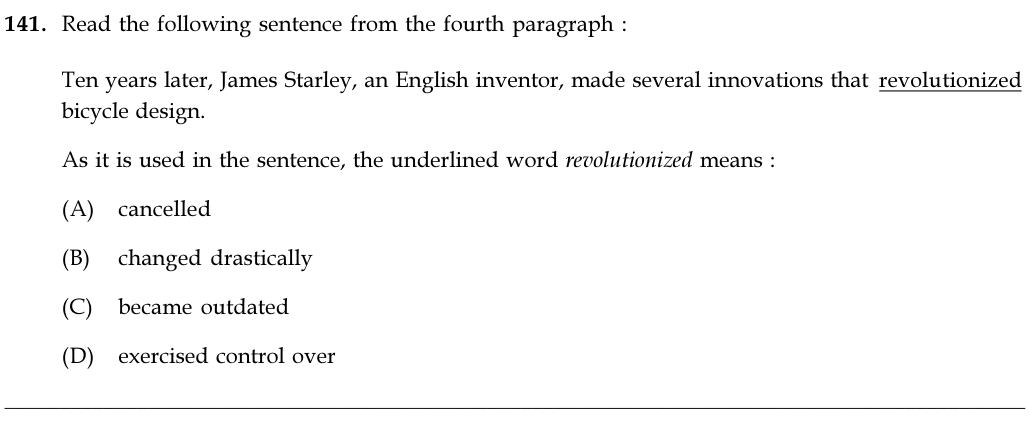
- A cancelled
- B changed drastically
- C became outdated
- D exercised control over
Show answer
Answer: (B) changed drastically
Official final answer key
-
Read the following passage and answer the questions (139-142) that follow :
Today, bicycles are elegantly simple machines that are common around the world. Many people ride
bicycles for recreation, whereas others use them as a means of transportation. The first bicycle, called a
draisienne, was invented in Germany in 1818 by Baron Karl de Drais de Sauerbrun. Because it was made
of wood, the draisienne wasn’t very durable nor did it have pedals. Riders moved it by pushing their feet
against the ground.
In 1839, Kirkpatrick Macmillan, a Scottish blacksmith, invented a much better bicycle. Macmillan’s
machine had tyres with iron rims to keep them from getting worn down. He also used foot-operated
cranks, similar to pedals, so his bicycle could be ridden at a quick pace. It didn’t look much like the
modern bicycle, though, because its back wheel was substantially larger than its front wheel. Although
Macmillan’s bicycles could be ridden easily, they were never produced in large numbers.
In 1861, Frenchman Pierre Michaux and his brother Ernest invented a bicycle with an improved
crank mechanism. They called their bicycle a vélocipède, but most people called it a “bone shaker”
because of the jarring effect of the wood and iron frame. Despite the unflattering nickname, the vélocipède
was a hit. After a few years, the Michaux family was making hundreds of the machines annually,
mostly for fun-seeking young people.
Ten years later, James Starley, an English inventor, made several innovations that revolutionized
bicycle design. He made the front wheel many times larger than the back wheel, put a gear on the
pedals to make the bicycle more efficient, and lightened the wheels by using wire spokes. Although this
bicycle was much lighter and less tiring to ride, it was still clumsy, extremely top-heavy, and ridden
mostly for entertainment.
It wasn’t until 1874 that the first truly modern bicycle appeared on the scene. Invented by another
Englishman, H.J. Lawson, the safety bicycle would look familiar to today’s cyclists. The safety bicycle
had equal-sized wheels, which made it much less prone to toppling over. Lawson also attached a chain
to the pedals to drive the rear wheel. By 1893, the safety bicycle had been further improved with air-
filled rubber tyres, a diamond-shaped frame, and easy braking. With the improvements provided by
Lawson, bicycles became extremely popular and useful for transportation. Today, they are built, used,
and enjoyed all over the world.Macmillan added iron rims to the tyres of his bicycle to :
- A add weight to the bicycle
- B make the tyres last longer
- C make the ride less bumpy
- D make the ride less tiring
Show answer
Answer: (B) make the tyres last longer
Official final answer key
-
Read the following passage and answer the question that follows :
Light pollution is a growing problem worldwide. Like other forms of pollution, light pollution
degrades the quality of the environment. Where it was once possible to look up at the night sky
and see thousands of twinkling stars in the inky blackness, one now sees little more than the
yellow glare of urban sky-glow. When we lose the ability to connect visually with the vastness of
the universe by looking up at the night sky, we lose our connection with something profoundly
important to the human spirit, our sense of wonder.
The passage implies that the most serious damage done by light pollution is to our :- A art history
- B sense of paleness
- C cultural advancement
- D questing spirit
Show answer
Answer: (D) questing spirit
Official final answer key
-
Read the passage and answer the questions (148-150) that follow :
Reality for human beings is not action or feeling but meaning. Humans are symbol using creatures; a
symbol is anything that carries a particular meaning recognised by the people who share culture. A
whistle, a wall of graffiti, a flashing red light, a fist raised in the air—all serve as symbols. We see the
human capacity to create and manipulate symbols in the various ways a simple wink of the eye can
convey interest, understanding, or insult. We are so dependent on our culture’s symbols that we take
them for granted. Often, however, we gain a heightened sense of the importance of a symbol when
someone uses it in an unconventional way. Entering an unfamiliar culture also reminds us of the power
of symbols; culture shock is nothing more than the inability to “read” meaning in one’s surroundings.
We feel lost, unsure of how to act, and sometimes frightened—a consequence of slipping outside the
symbolic web of culture. Culture shock is both what travellers experience and what they inflict on
others by acting in ways that may offend them.How is reality defined as in the passage ?
- A meaning
- B action
- C feeling
- D web
Show answer
Answer: (A) meaning
Official final answer key
-
Read the passage and answer the questions (148-150) that follow :
Reality for human beings is not action or feeling but meaning. Humans are symbol using creatures; a
symbol is anything that carries a particular meaning recognised by the people who share culture. A
whistle, a wall of graffiti, a flashing red light, a fist raised in the air—all serve as symbols. We see the
human capacity to create and manipulate symbols in the various ways a simple wink of the eye can
convey interest, understanding, or insult. We are so dependent on our culture’s symbols that we take
them for granted. Often, however, we gain a heightened sense of the importance of a symbol when
someone uses it in an unconventional way. Entering an unfamiliar culture also reminds us of the power
of symbols; culture shock is nothing more than the inability to “read” meaning in one’s surroundings.
We feel lost, unsure of how to act, and sometimes frightened—a consequence of slipping outside the
symbolic web of culture. Culture shock is both what travellers experience and what they inflict on
others by acting in ways that may offend them.In the context of the passage, which of the following does not serve as a symbol ?
- A whistle
- B graffiti
- C flashing red light
- D culture shock
Show answer
Answer: (D) culture shock
Official final answer key
-
Read the passage and answer the questions (148-150) that follow :
Reality for human beings is not action or feeling but meaning. Humans are symbol using creatures; a
symbol is anything that carries a particular meaning recognised by the people who share culture. A
whistle, a wall of graffiti, a flashing red light, a fist raised in the air—all serve as symbols. We see the
human capacity to create and manipulate symbols in the various ways a simple wink of the eye can
convey interest, understanding, or insult. We are so dependent on our culture’s symbols that we take
them for granted. Often, however, we gain a heightened sense of the importance of a symbol when
someone uses it in an unconventional way. Entering an unfamiliar culture also reminds us of the power
of symbols; culture shock is nothing more than the inability to “read” meaning in one’s surroundings.
We feel lost, unsure of how to act, and sometimes frightened—a consequence of slipping outside the
symbolic web of culture. Culture shock is both what travellers experience and what they inflict on
others by acting in ways that may offend them.In the context of the topic of the passage, when do we feel lost, or frightened ?
- A When we lose in a competition
- B When we slip outside the symbolic web of culture
- C When we cannot locate our action
- D None of the above - o O o -
Show answer
Answer: (B) When we slip outside the symbolic web of culture
Official final answer key
-
Q. 71-80 : Read the passage carefully and answer the questions given below :
At last the bomb was made. The site chosen for the test explosion was the
desert region north of Almogordo, two hundred miles from Los Alamos. The
bomb was taken by road and placed on a gaunt tower, one hundred feet high
and weighing thirty-two tons, erected on the top of a hill. The code name for
it was Zero Hill. Zero hour was 5:30 a.m. on Monday, July 16, 1945.
Oppenheimer himself was at the control centre about nine miles from
Zero Hill. There were a thousand spectators including scientists, government
officials and a strong security force. All not on duty were told to lie down flat,
face and eyes directed towards the ground and with the head away from zero.
At forty-five seconds to zero hour Dr. Joseph L. Mckibban of California
University set in motion a weird master robot which set other robots in
motion. More than five hundred miles of wiring were used to start the bomb.
Electronic impulses were set in motion and relayed messages; electrons
moved into position. Observers stood with coloured film over their eyes and
heads averted.
Overhead two B-29 super fortresses hovered, equipped with recording
instruments to test reactions in the atmosphere. Ten seconds before zero
hour a green flare warned the spectators to keep down. Then came the
blinding flash.
The whole area was suddenly brighter than the brightest day light, and
the bomb was a ball of fire. Even at nine miles, the heat was scorching. Then
came the tremendous roar and the heavy pressure wave, which knocked
down two men outside the control centre. And then came the cloud – the
mushroom cloud, all the colours of the rainbow, ironically beautiful surging
upto over 40,000 feet, over 10,000 feet higher than Everest. The great steel
tower had gone. Lead lined Sherman tanks took scientists towards the huge
sloping crater where it had stood, to see the effects of radiation on the surface
of the earth.Zero Hill was located in
- A Desert region of Almogordo
- B Desert region of Los Alamos
- C Desert region north of Almogordo
- D Desert region south of Almogordo
Show answer
Answer: (C) Desert region north of Almogordo
The passage explicitly locates the site north of Almogordo.
Worked solution by AxomRank (no official key was published)
-
Q. 71-80 : Read the passage carefully and answer the questions given below :
At last the bomb was made. The site chosen for the test explosion was the
desert region north of Almogordo, two hundred miles from Los Alamos. The
bomb was taken by road and placed on a gaunt tower, one hundred feet high
and weighing thirty-two tons, erected on the top of a hill. The code name for
it was Zero Hill. Zero hour was 5:30 a.m. on Monday, July 16, 1945.
Oppenheimer himself was at the control centre about nine miles from
Zero Hill. There were a thousand spectators including scientists, government
officials and a strong security force. All not on duty were told to lie down flat,
face and eyes directed towards the ground and with the head away from zero.
At forty-five seconds to zero hour Dr. Joseph L. Mckibban of California
University set in motion a weird master robot which set other robots in
motion. More than five hundred miles of wiring were used to start the bomb.
Electronic impulses were set in motion and relayed messages; electrons
moved into position. Observers stood with coloured film over their eyes and
heads averted.
Overhead two B-29 super fortresses hovered, equipped with recording
instruments to test reactions in the atmosphere. Ten seconds before zero
hour a green flare warned the spectators to keep down. Then came the
blinding flash.
The whole area was suddenly brighter than the brightest day light, and
the bomb was a ball of fire. Even at nine miles, the heat was scorching. Then
came the tremendous roar and the heavy pressure wave, which knocked
down two men outside the control centre. And then came the cloud – the
mushroom cloud, all the colours of the rainbow, ironically beautiful surging
upto over 40,000 feet, over 10,000 feet higher than Everest. The great steel
tower had gone. Lead lined Sherman tanks took scientists towards the huge
sloping crater where it had stood, to see the effects of radiation on the surface
of the earth.Hover means
- A To remain in the air at one place
- B To move to and fro
- C To circle around
- D To move up and down
Show answer
Answer: (A) To remain in the air at one place
Hover means remain in the air at one location.
Worked solution by AxomRank (no official key was published)
-
Q. 71-80 : Read the passage carefully and answer the questions given below :
At last the bomb was made. The site chosen for the test explosion was the
desert region north of Almogordo, two hundred miles from Los Alamos. The
bomb was taken by road and placed on a gaunt tower, one hundred feet high
and weighing thirty-two tons, erected on the top of a hill. The code name for
it was Zero Hill. Zero hour was 5:30 a.m. on Monday, July 16, 1945.
Oppenheimer himself was at the control centre about nine miles from
Zero Hill. There were a thousand spectators including scientists, government
officials and a strong security force. All not on duty were told to lie down flat,
face and eyes directed towards the ground and with the head away from zero.
At forty-five seconds to zero hour Dr. Joseph L. Mckibban of California
University set in motion a weird master robot which set other robots in
motion. More than five hundred miles of wiring were used to start the bomb.
Electronic impulses were set in motion and relayed messages; electrons
moved into position. Observers stood with coloured film over their eyes and
heads averted.
Overhead two B-29 super fortresses hovered, equipped with recording
instruments to test reactions in the atmosphere. Ten seconds before zero
hour a green flare warned the spectators to keep down. Then came the
blinding flash.
The whole area was suddenly brighter than the brightest day light, and
the bomb was a ball of fire. Even at nine miles, the heat was scorching. Then
came the tremendous roar and the heavy pressure wave, which knocked
down two men outside the control centre. And then came the cloud – the
mushroom cloud, all the colours of the rainbow, ironically beautiful surging
upto over 40,000 feet, over 10,000 feet higher than Everest. The great steel
tower had gone. Lead lined Sherman tanks took scientists towards the huge
sloping crater where it had stood, to see the effects of radiation on the surface
of the earth.The bomb exploded
- A emitting heat, sound and heavy pressure wave
- B emitting cloud and cloudburst
- C without creating much physical disturbances
- D creating a lot of physical and mental disturbances
Show answer
Answer: (A) emitting heat, sound and heavy pressure wave
The passage describes heat, a tremendous roar and a pressure wave.
Worked solution by AxomRank (no official key was published)
-
Q. 71-80 : Read the passage carefully and answer the questions given below :
At last the bomb was made. The site chosen for the test explosion was the
desert region north of Almogordo, two hundred miles from Los Alamos. The
bomb was taken by road and placed on a gaunt tower, one hundred feet high
and weighing thirty-two tons, erected on the top of a hill. The code name for
it was Zero Hill. Zero hour was 5:30 a.m. on Monday, July 16, 1945.
Oppenheimer himself was at the control centre about nine miles from
Zero Hill. There were a thousand spectators including scientists, government
officials and a strong security force. All not on duty were told to lie down flat,
face and eyes directed towards the ground and with the head away from zero.
At forty-five seconds to zero hour Dr. Joseph L. Mckibban of California
University set in motion a weird master robot which set other robots in
motion. More than five hundred miles of wiring were used to start the bomb.
Electronic impulses were set in motion and relayed messages; electrons
moved into position. Observers stood with coloured film over their eyes and
heads averted.
Overhead two B-29 super fortresses hovered, equipped with recording
instruments to test reactions in the atmosphere. Ten seconds before zero
hour a green flare warned the spectators to keep down. Then came the
blinding flash.
The whole area was suddenly brighter than the brightest day light, and
the bomb was a ball of fire. Even at nine miles, the heat was scorching. Then
came the tremendous roar and the heavy pressure wave, which knocked
down two men outside the control centre. And then came the cloud – the
mushroom cloud, all the colours of the rainbow, ironically beautiful surging
upto over 40,000 feet, over 10,000 feet higher than Everest. The great steel
tower had gone. Lead lined Sherman tanks took scientists towards the huge
sloping crater where it had stood, to see the effects of radiation on the surface
of the earth.Electronic impulses
- A were not effective
- B relayed messages
- C warned the spectators
- D greeted the spectators
Show answer
Answer: (B) relayed messages
Electronic impulses relayed messages according to the passage.
Worked solution by AxomRank (no official key was published)
-
Q. 71-80 : Read the passage carefully and answer the questions given below :
At last the bomb was made. The site chosen for the test explosion was the
desert region north of Almogordo, two hundred miles from Los Alamos. The
bomb was taken by road and placed on a gaunt tower, one hundred feet high
and weighing thirty-two tons, erected on the top of a hill. The code name for
it was Zero Hill. Zero hour was 5:30 a.m. on Monday, July 16, 1945.
Oppenheimer himself was at the control centre about nine miles from
Zero Hill. There were a thousand spectators including scientists, government
officials and a strong security force. All not on duty were told to lie down flat,
face and eyes directed towards the ground and with the head away from zero.
At forty-five seconds to zero hour Dr. Joseph L. Mckibban of California
University set in motion a weird master robot which set other robots in
motion. More than five hundred miles of wiring were used to start the bomb.
Electronic impulses were set in motion and relayed messages; electrons
moved into position. Observers stood with coloured film over their eyes and
heads averted.
Overhead two B-29 super fortresses hovered, equipped with recording
instruments to test reactions in the atmosphere. Ten seconds before zero
hour a green flare warned the spectators to keep down. Then came the
blinding flash.
The whole area was suddenly brighter than the brightest day light, and
the bomb was a ball of fire. Even at nine miles, the heat was scorching. Then
came the tremendous roar and the heavy pressure wave, which knocked
down two men outside the control centre. And then came the cloud – the
mushroom cloud, all the colours of the rainbow, ironically beautiful surging
upto over 40,000 feet, over 10,000 feet higher than Everest. The great steel
tower had gone. Lead lined Sherman tanks took scientists towards the huge
sloping crater where it had stood, to see the effects of radiation on the surface
of the earth.The spectators included
- A scientists, government officials and a strong security force.
- B scientists, artists and a strong security force.
- C scientists, a strong security force and footballers.
- D scientists, technicians and a strong security force.
Show answer
Answer: (A) scientists, government officials and a strong security force.
The passage lists scientists, government officials and a security force.
Worked solution by AxomRank (no official key was published)
-
Q. 71-80 : Read the passage carefully and answer the questions given below :
At last the bomb was made. The site chosen for the test explosion was the
desert region north of Almogordo, two hundred miles from Los Alamos. The
bomb was taken by road and placed on a gaunt tower, one hundred feet high
and weighing thirty-two tons, erected on the top of a hill. The code name for
it was Zero Hill. Zero hour was 5:30 a.m. on Monday, July 16, 1945.
Oppenheimer himself was at the control centre about nine miles from
Zero Hill. There were a thousand spectators including scientists, government
officials and a strong security force. All not on duty were told to lie down flat,
face and eyes directed towards the ground and with the head away from zero.
At forty-five seconds to zero hour Dr. Joseph L. Mckibban of California
University set in motion a weird master robot which set other robots in
motion. More than five hundred miles of wiring were used to start the bomb.
Electronic impulses were set in motion and relayed messages; electrons
moved into position. Observers stood with coloured film over their eyes and
heads averted.
Overhead two B-29 super fortresses hovered, equipped with recording
instruments to test reactions in the atmosphere. Ten seconds before zero
hour a green flare warned the spectators to keep down. Then came the
blinding flash.
The whole area was suddenly brighter than the brightest day light, and
the bomb was a ball of fire. Even at nine miles, the heat was scorching. Then
came the tremendous roar and the heavy pressure wave, which knocked
down two men outside the control centre. And then came the cloud – the
mushroom cloud, all the colours of the rainbow, ironically beautiful surging
upto over 40,000 feet, over 10,000 feet higher than Everest. The great steel
tower had gone. Lead lined Sherman tanks took scientists towards the huge
sloping crater where it had stood, to see the effects of radiation on the surface
of the earth.Who was at the control tower ?
- A Oppenheimer
- B McKibbon
- C both Oppenheimer and McKibbon
- D Government officials
Show answer
Answer: (A) Oppenheimer
Oppenheimer is explicitly placed at the control centre; the passage does not say Mckibban was there.
Worked solution by AxomRank (no official key was published)
-
Q. 71-80 : Read the passage carefully and answer the questions given below :
At last the bomb was made. The site chosen for the test explosion was the
desert region north of Almogordo, two hundred miles from Los Alamos. The
bomb was taken by road and placed on a gaunt tower, one hundred feet high
and weighing thirty-two tons, erected on the top of a hill. The code name for
it was Zero Hill. Zero hour was 5:30 a.m. on Monday, July 16, 1945.
Oppenheimer himself was at the control centre about nine miles from
Zero Hill. There were a thousand spectators including scientists, government
officials and a strong security force. All not on duty were told to lie down flat,
face and eyes directed towards the ground and with the head away from zero.
At forty-five seconds to zero hour Dr. Joseph L. Mckibban of California
University set in motion a weird master robot which set other robots in
motion. More than five hundred miles of wiring were used to start the bomb.
Electronic impulses were set in motion and relayed messages; electrons
moved into position. Observers stood with coloured film over their eyes and
heads averted.
Overhead two B-29 super fortresses hovered, equipped with recording
instruments to test reactions in the atmosphere. Ten seconds before zero
hour a green flare warned the spectators to keep down. Then came the
blinding flash.
The whole area was suddenly brighter than the brightest day light, and
the bomb was a ball of fire. Even at nine miles, the heat was scorching. Then
came the tremendous roar and the heavy pressure wave, which knocked
down two men outside the control centre. And then came the cloud – the
mushroom cloud, all the colours of the rainbow, ironically beautiful surging
upto over 40,000 feet, over 10,000 feet higher than Everest. The great steel
tower had gone. Lead lined Sherman tanks took scientists towards the huge
sloping crater where it had stood, to see the effects of radiation on the surface
of the earth.It is implied in the passage that the spectators were told to
- A lie down flat, face and eyes directed towards the ground and with the head away from zero.
- B cover their eyes with coloured films and keep their head averted.
- C lie down flat, face and eyes directed towards the ground and with the head towards zero.
- D cover their heads with coloured films and eyes closed.
Show answer
Answer: (A) lie down flat, face and eyes directed towards the ground and with the head away from zero.
The instruction in the passage specifies heads away from zero.
Worked solution by AxomRank (no official key was published)
-
Q. 71-80 : Read the passage carefully and answer the questions given below :
At last the bomb was made. The site chosen for the test explosion was the
desert region north of Almogordo, two hundred miles from Los Alamos. The
bomb was taken by road and placed on a gaunt tower, one hundred feet high
and weighing thirty-two tons, erected on the top of a hill. The code name for
it was Zero Hill. Zero hour was 5:30 a.m. on Monday, July 16, 1945.
Oppenheimer himself was at the control centre about nine miles from
Zero Hill. There were a thousand spectators including scientists, government
officials and a strong security force. All not on duty were told to lie down flat,
face and eyes directed towards the ground and with the head away from zero.
At forty-five seconds to zero hour Dr. Joseph L. Mckibban of California
University set in motion a weird master robot which set other robots in
motion. More than five hundred miles of wiring were used to start the bomb.
Electronic impulses were set in motion and relayed messages; electrons
moved into position. Observers stood with coloured film over their eyes and
heads averted.
Overhead two B-29 super fortresses hovered, equipped with recording
instruments to test reactions in the atmosphere. Ten seconds before zero
hour a green flare warned the spectators to keep down. Then came the
blinding flash.
The whole area was suddenly brighter than the brightest day light, and
the bomb was a ball of fire. Even at nine miles, the heat was scorching. Then
came the tremendous roar and the heavy pressure wave, which knocked
down two men outside the control centre. And then came the cloud – the
mushroom cloud, all the colours of the rainbow, ironically beautiful surging
upto over 40,000 feet, over 10,000 feet higher than Everest. The great steel
tower had gone. Lead lined Sherman tanks took scientists towards the huge
sloping crater where it had stood, to see the effects of radiation on the surface
of the earth.B-29 superfortresses and Sherman tanks are used to
- A check the effect of the bomb on the ground and air respectively.
- B check effect of radiation on the ground and air respectively.
- C check effect of radiation in the air and ground respectively.
- D check the effect of the bomb on the great steel tower.
Show answer
Answer: (C) check effect of radiation in the air and ground respectively.
Aircraft tested atmospheric reactions; tanks carried scientists to examine surface radiation.
Worked solution by AxomRank (no official key was published)
-
Q. 71-80 : Read the passage carefully and answer the questions given below :
At last the bomb was made. The site chosen for the test explosion was the
desert region north of Almogordo, two hundred miles from Los Alamos. The
bomb was taken by road and placed on a gaunt tower, one hundred feet high
and weighing thirty-two tons, erected on the top of a hill. The code name for
it was Zero Hill. Zero hour was 5:30 a.m. on Monday, July 16, 1945.
Oppenheimer himself was at the control centre about nine miles from
Zero Hill. There were a thousand spectators including scientists, government
officials and a strong security force. All not on duty were told to lie down flat,
face and eyes directed towards the ground and with the head away from zero.
At forty-five seconds to zero hour Dr. Joseph L. Mckibban of California
University set in motion a weird master robot which set other robots in
motion. More than five hundred miles of wiring were used to start the bomb.
Electronic impulses were set in motion and relayed messages; electrons
moved into position. Observers stood with coloured film over their eyes and
heads averted.
Overhead two B-29 super fortresses hovered, equipped with recording
instruments to test reactions in the atmosphere. Ten seconds before zero
hour a green flare warned the spectators to keep down. Then came the
blinding flash.
The whole area was suddenly brighter than the brightest day light, and
the bomb was a ball of fire. Even at nine miles, the heat was scorching. Then
came the tremendous roar and the heavy pressure wave, which knocked
down two men outside the control centre. And then came the cloud – the
mushroom cloud, all the colours of the rainbow, ironically beautiful surging
upto over 40,000 feet, over 10,000 feet higher than Everest. The great steel
tower had gone. Lead lined Sherman tanks took scientists towards the huge
sloping crater where it had stood, to see the effects of radiation on the surface
of the earth.The beauty of the mushroom cloud is ironical because
- A It knocked down two men outside the control centre.
- B Of the devastating nature of the bomb.
- C The bomb destroyed the steel tower.
- D Clouds are not devastating.
Show answer
Answer: (B) Of the devastating nature of the bomb.
The cloud's beauty contrasts ironically with the bomb's destructive nature.
Worked solution by AxomRank (no official key was published)
-
Q. 71-80 : Read the passage carefully and answer the questions given below :
At last the bomb was made. The site chosen for the test explosion was the
desert region north of Almogordo, two hundred miles from Los Alamos. The
bomb was taken by road and placed on a gaunt tower, one hundred feet high
and weighing thirty-two tons, erected on the top of a hill. The code name for
it was Zero Hill. Zero hour was 5:30 a.m. on Monday, July 16, 1945.
Oppenheimer himself was at the control centre about nine miles from
Zero Hill. There were a thousand spectators including scientists, government
officials and a strong security force. All not on duty were told to lie down flat,
face and eyes directed towards the ground and with the head away from zero.
At forty-five seconds to zero hour Dr. Joseph L. Mckibban of California
University set in motion a weird master robot which set other robots in
motion. More than five hundred miles of wiring were used to start the bomb.
Electronic impulses were set in motion and relayed messages; electrons
moved into position. Observers stood with coloured film over their eyes and
heads averted.
Overhead two B-29 super fortresses hovered, equipped with recording
instruments to test reactions in the atmosphere. Ten seconds before zero
hour a green flare warned the spectators to keep down. Then came the
blinding flash.
The whole area was suddenly brighter than the brightest day light, and
the bomb was a ball of fire. Even at nine miles, the heat was scorching. Then
came the tremendous roar and the heavy pressure wave, which knocked
down two men outside the control centre. And then came the cloud – the
mushroom cloud, all the colours of the rainbow, ironically beautiful surging
upto over 40,000 feet, over 10,000 feet higher than Everest. The great steel
tower had gone. Lead lined Sherman tanks took scientists towards the huge
sloping crater where it had stood, to see the effects of radiation on the surface
of the earth.A synonym and antonym for the word Scorching would be
- A Searing, Soothing
- B Searing, Burning
- C Soothing, Cooling
- D Soothing, Heating
Show answer
Answer: (A) Searing, Soothing
Searing is a synonym and soothing the contrasting antonym among the options.
Worked solution by AxomRank (no official key was published)
-
According to the author, why is 'friction' essential for intellectual development?
It makes the Internet faster and more efficient
It reduces the amount of time spent on social media
It involves encountering opposing viewpoints that challenge our thinking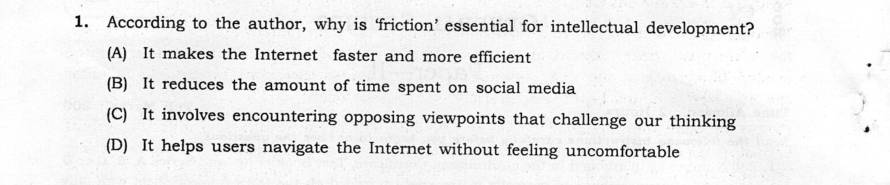
Show answer
Answer: (C)
Official provisional answer key
-
What, according to the author, is the long-term effect of digital 'echo chamber'?
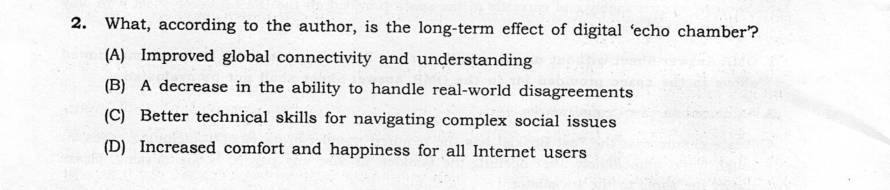
- A Improved global connectivity and understanding
- B A decrease in the ability to handle real-world disagreements
- C Better technical skills for navigating complex social issues
- D Increased comfort and happiness for all Internet users
Show answer
Answer: (B) A decrease in the ability to handle real-world disagreements
Official provisional answer key
-
Read the following passage carefully and answer Question Nos. 3 and 4 :
An ecological footprint is more than just a measurement; it is the mark we leave on the
planet every day through our choices—what we eat, how we travel, and the wastes we create.
Currently, many people use natural resources faster than the Earth can replenish them,
a process that leads to deforestation, water scarcity, and rising greenhouse gas emissions.
We do not merely inherit this planet from our ancestors; we are borrowing it from our
children. Small changes, like switching to reusable water bottles or walking instead of
driving, are not just 'nice ideas'—they are necessary steps to ensure the Earth remains
habitable for future generations.What is the primary message regarding the 'ecological footprint'?
It is a permanent mark that cannot be reduced
It is only relevant to large industrial factories
It is a scientific term used only for measuring soil quality
Show answer
Answer: (B)
Official provisional answer key
-
Read the following passage carefully and answer Question Nos. 3 and 4 :
An ecological footprint is more than just a measurement; it is the mark we leave on the
planet every day through our choices—what we eat, how we travel, and the wastes we create.
Currently, many people use natural resources faster than the Earth can replenish them,
a process that leads to deforestation, water scarcity, and rising greenhouse gas emissions.
We do not merely inherit this planet from our ancestors; we are borrowing it from our
children. Small changes, like switching to reusable water bottles or walking instead of
driving, are not just 'nice ideas'—they are necessary steps to ensure the Earth remains
habitable for future generations.Why does the author mention that we 'borrow' the Earth from our children?
To suggest that the Earth is a financial asset
To explain why children should be in charge of environmental laws
To highlight our displacement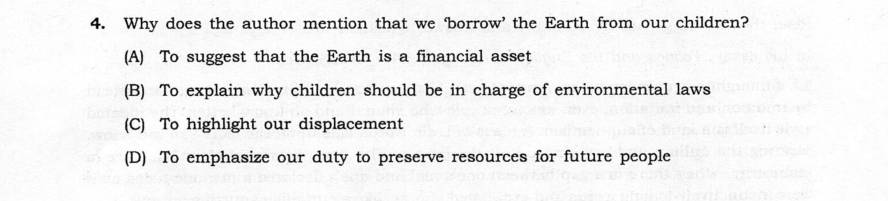
Show answer
Answer: (D)
Official provisional answer key
-
Read the following passage carefully and answer Question Nos. 5 and 6 :
The open-plan office of Vertex Design' was usually a hum of collaborative energy, but today,
the silence was heavy. Damodar, a senior architect, stood by the window, staring at the
printed blueprints of the new community centre. Across the room sat Seema, a junior
designer whose hands hovered tentatively over her keyboard.
Earlier that morning, Damodar had discovered a critical measurement error in the structural
supports—an error that originated from Seema's workstation. Instead of pulling her aside,
Damodar had pointed it out during the all-hands briefing, his voice booming with a mix of
frustration and disbelief. "We aren't here to play around with 'estimates', Seema. This could
have cost us the contract."
Seema hadn't defended herself. She hadn't mentioned that she had worked forty-eight hours
straight to meet Damodar's last-minute deadlines nor that she had flagged the specific
measurement for his review three days prior in an e-mail he never opened. Now, the team
uncomfortable with Damodar's public outburst. By the afternoon, the project was at
a standstill, not because of the error-which was easily fixable-—but because the bridge of
trust between the leader and his team had collapsed.In terms of interpersonal communication, Damodar's behaviour is best described as

- A assertive and transparent
- B directly reactive and damaging to a junior's psychological safety
- C constructive and focussed on excellence
- D passive-aggressive and indirect
Show answer
Answer: (B) directly reactive and damaging to a junior's psychological safety
Official provisional answer key
-
Read the following passage carefully and answer Question Nos. 5 and 6 :
The open-plan office of Vertex Design' was usually a hum of collaborative energy, but today,
the silence was heavy. Damodar, a senior architect, stood by the window, staring at the
printed blueprints of the new community centre. Across the room sat Seema, a junior
designer whose hands hovered tentatively over her keyboard.
Earlier that morning, Damodar had discovered a critical measurement error in the structural
supports—an error that originated from Seema's workstation. Instead of pulling her aside,
Damodar had pointed it out during the all-hands briefing, his voice booming with a mix of
frustration and disbelief. "We aren't here to play around with 'estimates', Seema. This could
have cost us the contract."
Seema hadn't defended herself. She hadn't mentioned that she had worked forty-eight hours
straight to meet Damodar's last-minute deadlines nor that she had flagged the specific
measurement for his review three days prior in an e-mail he never opened. Now, the team
uncomfortable with Damodar's public outburst. By the afternoon, the project was at
a standstill, not because of the error-which was easily fixable-—but because the bridge of
trust between the leader and his team had collapsed.What does bridge of trust' metaphor imply?

- A Damodar literally designs bridges as an architect
- B Communication is a physical structure that requires steel
- C Professional relationships require a stable foundation to function
- D Damodar and Seema are working on a bridge-building project
Show answer
Answer: (C) Professional relationships require a stable foundation to function
Official provisional answer key
-
Read the following passage carefully and answer Question Nos. 7 and 8 :
In his essay, Politics and the English Language (1946) George Orwell writes—
"... if thought corrupts language, language can also corrupt thought. A bad usage can spread
by tradition and imitation, even among people who should and do know better. The inflated
style itself is a kind of euphemism. A mass of Latin words falls upon the facts like soft snow,
blurring the outline and covering up all the details. The great enemy of clear language is
insincerity. When there is a gap between one's real and one's declared aims, one turns as it
were instinctively to long words and exhausted idioms, like a cuttlefish spurting out ink."What is Orwell's primary argument regarding the relationship between language and
thought?
Poorly used language can actually degrade a person's ability to think clearly
Latin words are superior for describing complex political facts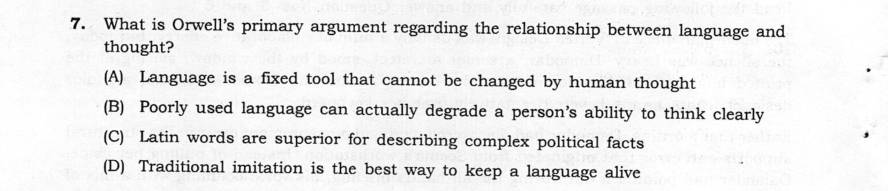
Show answer
Answer: (B)
Official provisional answer key
-
Read the following passage carefully and answer Question Nos. 7 and 8 :
In his essay, Politics and the English Language (1946) George Orwell writes—
"... if thought corrupts language, language can also corrupt thought. A bad usage can spread
by tradition and imitation, even among people who should and do know better. The inflated
style itself is a kind of euphemism. A mass of Latin words falls upon the facts like soft snow,
blurring the outline and covering up all the details. The great enemy of clear language is
insincerity. When there is a gap between one's real and one's declared aims, one turns as it
were instinctively to long words and exhausted idioms, like a cuttlefish spurting out ink."According to Orwell, why does a writer instinctively' turn to long words and
exhausted idioms?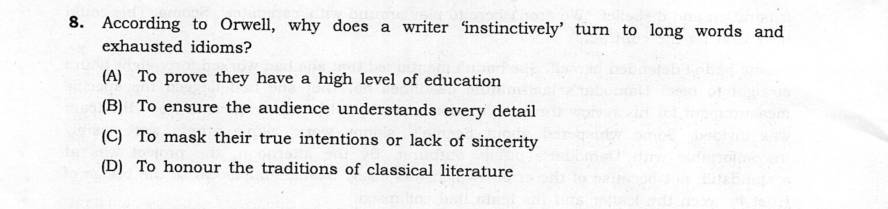
- A To prove they have a high level of education
- B To ensure the audience understands every detail
- C To mask their true intentions or lack of sincerity
- D To honour the traditions of classical literature
Show answer
Answer: (C) To mask their true intentions or lack of sincerity
Official provisional answer key
-
Read the following passage carefully and answer Question Nos. 9 and 10 :
Before we can develop a really effective program to prevent auto accidents, we will have to
learn far more than now about why such accidents happen. The National Safety Council,
while pointing out that most accidents result from a combination of causes, and that few
accidents are investigated carefully enough to determine exactly what their underlying
causes were, estimates that in about 80% of accidents, the most important single factor
is the driver himself. Bad weather, poor road conditions and defects in cars do cause some
accidents, but generally speaking, such circumstances appear to be of minor significance
compared with the mental and physical condition of the driver. And recent research indicates
that the driver's physical condition is of less importance than his personality and his
emotional state. Many, if not most, accidents, this research suggest are the result of
wayward impulses and motivations of faculty judgements and attitudes of poorly controlled
aggressiveness and competitiveness. Nearly two-thirds of the drivers involved in accidents
were speeding, driving while under the influence of alcohol, disregarding stoplights or signs,
or otherwise violating the law, according to the Safety Council. The pertinent question is why
people drive so fast, drive after drinking, take risks in passing, or, in general, commit
dangerous, careless, illegal, impulsive, or unfriendly acts when they get behind the wheel.The author's reference to the National Safety Council serves to

- A provide a historical account of accident prevention strategies
- B present statistical authority to support the argument regarding driver responsibility
- C criticise the lack of proper investigation into accidents
- D highlighting government inefficiency in traffic management
Show answer
Answer: (B) present statistical authority to support the argument regarding driver responsibility
Official provisional answer key
-
Read the following passage carefully and answer Question Nos. 9 and 10 :
Before we can develop a really effective program to prevent auto accidents, we will have to
learn far more than now about why such accidents happen. The National Safety Council,
while pointing out that most accidents result from a combination of causes, and that few
accidents are investigated carefully enough to determine exactly what their underlying
causes were, estimates that in about 80% of accidents, the most important single factor
is the driver himself. Bad weather, poor road conditions and defects in cars do cause some
accidents, but generally speaking, such circumstances appear to be of minor significance
compared with the mental and physical condition of the driver. And recent research indicates
that the driver's physical condition is of less importance than his personality and his
emotional state. Many, if not most, accidents, this research suggest are the result of
wayward impulses and motivations of faculty judgements and attitudes of poorly controlled
aggressiveness and competitiveness. Nearly two-thirds of the drivers involved in accidents
were speeding, driving while under the influence of alcohol, disregarding stoplights or signs,
or otherwise violating the law, according to the Safety Council. The pertinent question is why
people drive so fast, drive after drinking, take risks in passing, or, in general, commit
dangerous, careless, illegal, impulsive, or unfriendly acts when they get behind the wheel.The phrase wayward impulses' refers to

- A sudden, uncontrolled and unpredictable urges
- B carefully controlled and disciplined actions
- C socially acceptable behavioural patterns
- D rational and well-thought-out decisions
Show answer
Answer: (A) sudden, uncontrolled and unpredictable urges
Official provisional answer key
-
Read the following passage carefully and answer Question Nos. 11 and 12 :
The mind receives myriad impressions—trivial, fantastic, evanescent or engraved with the
sharpness of steel. From all sides they come, an incessant shower of innumerable atoms;
and as they fall, as they shape themselves into the life of Monday or Tuesday, the accent
falls differently from of old; the moment of importance came not here but there; so that,
if a writer were a free man and not a slave, if he could write what he chose, not what he
must, if he could base his work upon his own feeling and not upon convention, there would
and perhaps not a single button sewn on as the Bond Street tailors would have it. Life is
not a series of gig lamps symmetrically arranged; life is a luminous halo, a semi-transparent
envelope surrounding us from the beginning of consciousness to the end. Is it not the task
of the novelist to convey this varying, this unknown and uncircumscribed spirit, whatever
aberration or complexity it may display, with as little mixture of the alien and external as
possible? We are not pleading merely for courage and sincerity; we are suggesting that
the proper stuff of fiction is a little other than custom would have us believe it.What does the mind do, according to the writer?
Experience Record
Receive (D)All of these
Show answer
Answer: (D)
Official provisional answer key
-
Read the following passage carefully and answer Question Nos. 11 and 12 :
The mind receives myriad impressions—trivial, fantastic, evanescent or engraved with the
sharpness of steel. From all sides they come, an incessant shower of innumerable atoms;
and as they fall, as they shape themselves into the life of Monday or Tuesday, the accent
falls differently from of old; the moment of importance came not here but there; so that,
if a writer were a free man and not a slave, if he could write what he chose, not what he
must, if he could base his work upon his own feeling and not upon convention, there would
and perhaps not a single button sewn on as the Bond Street tailors would have it. Life is
not a series of gig lamps symmetrically arranged; life is a luminous halo, a semi-transparent
envelope surrounding us from the beginning of consciousness to the end. Is it not the task
of the novelist to convey this varying, this unknown and uncircumscribed spirit, whatever
aberration or complexity it may display, with as little mixture of the alien and external as
possible? We are not pleading merely for courage and sincerity; we are suggesting that
the proper stuff of fiction is a little other than custom would have us believe it.What does the term 'gig lamps' mean?

- A Oil lamps
- B Disco lights
- C Old-fashioned term for spectacles or eyeglasses
- D Lights used in carriages
Show answer
Answer: (C) Old-fashioned term for spectacles or eyeglasses
Official provisional answer key
-
Different kinds of pesticides, like insecticides, fungicides, herbicides, rodenticides,
molluscicides, nematicides, necessitate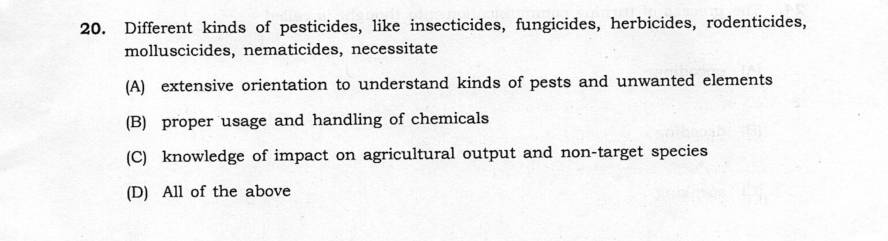
- A extensive orientation to understand kinds of pests and unwanted elements
- B proper usage and handling of chemicals
- C knowledge of impact on agricultural output and non-target species
- D All of the above
Show answer
Answer: (D) All of the above
Official provisional answer key
-
A synonym of the word, 'rampant' is

- A rife
- B fort
- C bridled
- D limited
Show answer
Answer: (A) rife
Official provisional answer key
-
What does the adage, "if little is good, a lot more will be better" indicate?

- A Proper measurements are important
- B Less usage will be more effective
- C More usage will be more effective
- D None of the above
Show answer
Answer: (C) More usage will be more effective
Official provisional answer key
-
Which of the following expresses the central idea of the passage?

- A Gender inequality appears in different and interconnected forms
- B Gender inequality is uniform across all societies
- C Economic inequality is the only form of gender inequality
- D Gender inequality is declining in modern times
Show answer
Answer: (A) Gender inequality appears in different and interconnected forms
Official provisional answer key
-
Read the following passage carefully and answer Question Nos. 26, 27 and 28 :
Inequality between women and men can appear in many different forms—it has many faces.
Gender disparity is, in fact, not one affliction but a multitude of problems. Sometimes the
different asymmetries are quite unrelated to each other. Indeed, there may be no significant
inequality in one sphere but a great deal of inequality in another. For example, Japan has no
particular gender bias in nutrition or health care or school education, but men do seem to
have considerable relative advantage in securing high leadership positions in administration
or business.
gender inequality of other kinds. Consequential analysis can then be critically important
even within the large corpus of gender relations in general, in order to examine and
scrutinize how the different aspects of gender inequality relate to each other. For while
gender inequality has many faces, these are not independent (like those in the austere image
of Brahma in early Indian iconography). Rather, they speak to each other and sometimes
strongly encourage one another. For example, when women lack decisional power within
the family, which amounts to deprivation of women's effective agency, this can also adversely
affect their own well-being. The two kinds of deprivation may not only move together—What does the author mean by stating that different aspects of gender inequality
'speak to each other?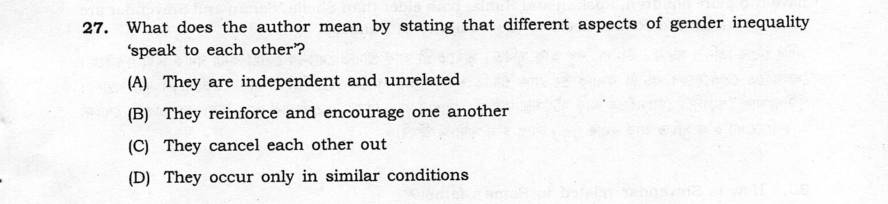
- A They are independent and unrelated
- B They reinforce and encourage one another
- C They cancel each other out
- D They occur only in similar conditions
Show answer
Answer: (B) They reinforce and encourage one another
Official provisional answer key
-
Read the following passage carefully and answer Question Nos. 26, 27 and 28 :
Inequality between women and men can appear in many different forms—it has many faces.
Gender disparity is, in fact, not one affliction but a multitude of problems. Sometimes the
different asymmetries are quite unrelated to each other. Indeed, there may be no significant
inequality in one sphere but a great deal of inequality in another. For example, Japan has no
particular gender bias in nutrition or health care or school education, but men do seem to
have considerable relative advantage in securing high leadership positions in administration
or business.
gender inequality of other kinds. Consequential analysis can then be critically important
even within the large corpus of gender relations in general, in order to examine and
scrutinize how the different aspects of gender inequality relate to each other. For while
gender inequality has many faces, these are not independent (like those in the austere image
of Brahma in early Indian iconography). Rather, they speak to each other and sometimes
strongly encourage one another. For example, when women lack decisional power within
the family, which amounts to deprivation of women's effective agency, this can also adversely
affect their own well-being. The two kinds of deprivation may not only move together—The term 'effective agency' in the passage refers to

- A legal authority granted by the State
- B the ability to make meaningful decisions and act upon them
- C representation in political institutions
- D economic independence alone
Show answer
Answer: (B) the ability to make meaningful decisions and act upon them
Official provisional answer key
-
"His own English was by no means without blemish." This means

- A the teacher made mistakes in English
- B the students made mistakes in English
- C the teacher's English was good
- D the students understood what the teacher was saying
Show answer
Answer: (A) the teacher made mistakes in English
Official provisional answer key
-
The author says that if the medium of education was Gujarati instead of English,
many things would happen. Which of the following claims is the author not making?
He would have learnt faster
His Gujarati vocabulary would have been richer
(C)His English would have improved
His dress would not have changed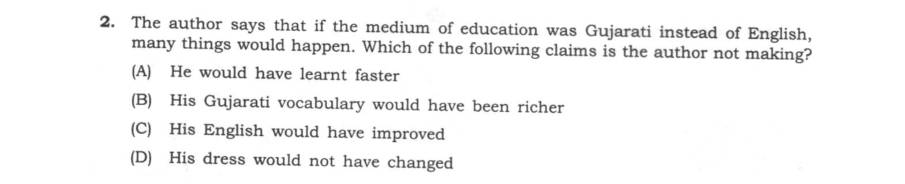
Show answer
Answer: (A)
Official provisional answer key
-
Why was everything plain sailing during the first three years?

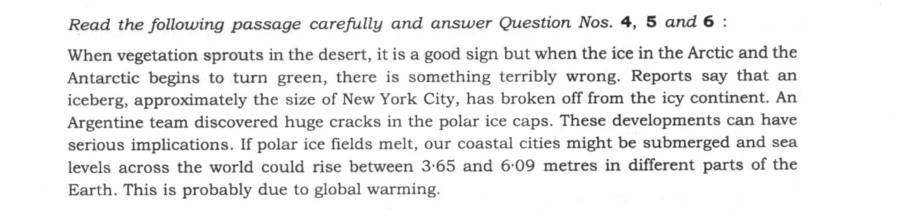
- A The schoolmaster was well-trained
- B The medium of teaching was the mother tongue
- C The syllabus was easy
- D There were only a few subjects Read the following passage carefully and answer Question Nos. 4, 5 and 6 : When vegetation sprouts in the desert, it is a good sign but when the ice in the Arctic and the Antarctic begins to turn green, there is something terribly wrong. Reports say that an iceberg, approximately the size of New York City, has broken off from the icy continent. An Argentine team discovered huge cracks in the polar ice caps. These developments can have serious implications. If polar ice fields melt, our coastal cities might be submerged and sea levels across the world could rise between 3·65 and 6·09 metres in different parts of the Earth. This is probably due to global warming.
Show answer
Answer: (B) The medium of teaching was the mother tongue
Official provisional answer key
-
What do you think is the intention of the author?

- A To describe strange phenomenon in nature
- B To report findings of the research teams working in the polar regions
- C To make us aware of the dangers of global warming
- D To compare developments in deserts and polar regions caused by global warming
Show answer
Answer: (C) To make us aware of the dangers of global warming
Official provisional answer key
-
Polar ice caps develop huge cracks because

- A of the movement of the Earth
- B of the breaking off of the icebergs
- C of the crowding of cities like New York
- D of rising temperature
Show answer
Answer: (D) of rising temperature
Official provisional answer key
-
When ice turns green in the Arctic and the Antarctic
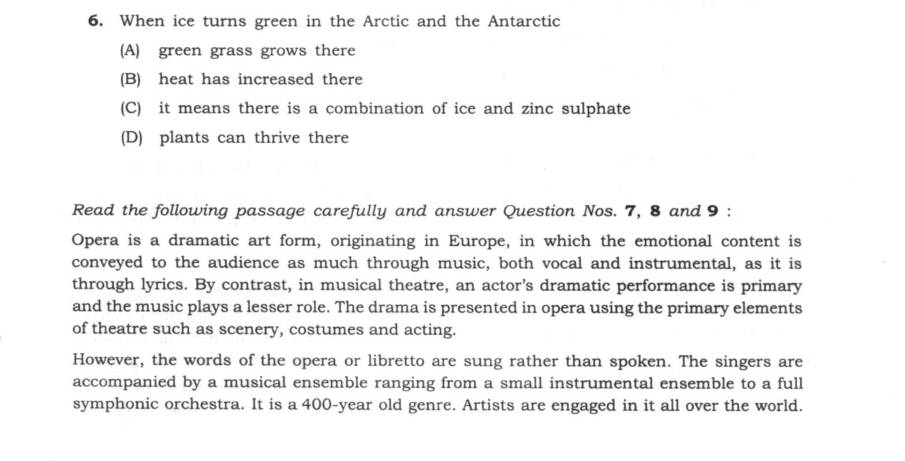

- A green grass grows there
- B heat has increased there
- C it means there is a combination of ice and zinc sulphate
- D plants can thrive there Read the following passage carefully and answer Question Nos. 7, 8 and 9 : Opera is a dramatic art form, originating in Europe, in which the emotional content is conveyed to the audience as much through music, both vocal and instrumental, as it is through lyrics. By contrast, in musical theatre, an actor's dramatic performance is primary and the music plays a lesser role. The drama is presented in opera using the primary elements of theatre such as scenery, costumes and acting. However, the words of the opera or libretto are sung rather than spoken. The singers are accompanied by a musical ensemble ranging from a small instrumental ensemble to a full symphonic orchestra. It is a 400-year old genre. Artists are engaged in it all over the world. Composers, singers and directors have used this art form to tell stories. Italy is the birthplace of the opera. In the 16th century, the Florentine poets, musicians and writers cultivated this form of dramatic singing. In India, we have an equivalent of the opera. It is known as Natya Sangeet.
Show answer
Answer: (B) heat has increased there
Official provisional answer key
-
Opera is an art form that
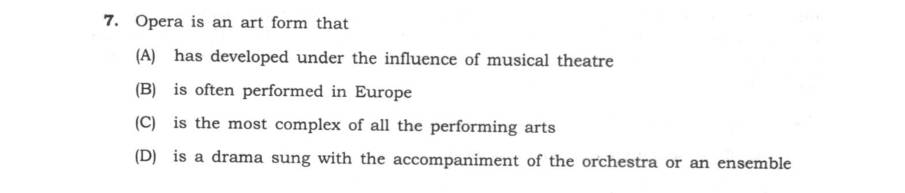
- A has developed under the influence of musical theatre
- B is often performed in Europe
- C is the most complex of all the performing arts
- D is a drama sung with the accompaniment of the orchestra or an ensemble
Show answer
Answer: (D) is a drama sung with the accompaniment of the orchestra or an ensemble
Official provisional answer key
-
Natya Sangeet means

- A music and drama together
- B only drama
- C only singing
- D prose compositions
Show answer
Answer: (A) music and drama together
Official provisional answer key
-
Musical theatre is different from opera because

- A drama in opera is more important than in musical theatre
- B musical theatre relies above all on music
- C the actor's skill is of prime importance in musical theatre
- D musical theatre uses a larger orchestra
Show answer
Answer: (C) the actor's skill is of prime importance in musical theatre
Official provisional answer key
-
Families are choosing home service because

- A it is cost-effective
- B it is convenient and transparent
- C it is mostly automated
- D it is an urban phenomenon
Show answer
Answer: (B) it is convenient and transparent
Official provisional answer key
-
Read the following passage carefully and answer Question Nos. 10, 11 and 12 :
These days we are all getting accustomed to getting home services. Particularly the cities
have seen the growth of home services. Home services provide us with health care, child
care, grooming, servicing of appliances, and preparation of meals and so many other
tasks of daily life. We have gradually adapted to taking convenience service for most of our
needs. The days of keeping a house by the family themselves are slowly evaporating in the
cities. A plethora of services is on offer and many families are opting for the convenience.
The industry has grown by leaps and bounds in India. Gone are the days of browsing
through phone books or relying on neighbours to find someone to fix your leaking tap or
install your AC after a move. Today on-demand services are transforming how we maintain
our homes, making the process faster, simpler and more conveniently reliable. The home
services have become easy and transparent too. We can now download a variety of
applications and book services at any hour and for any task. Online platforms have built
up a variety of services at competitive prices; removing hidden costs and haggling.
A feature that makes these services outstanding is the transparency. Customer reviews
and ratings have become a part of building trust and attracting repeat consumers.
It remains to be seen how far these service providers can execute their promise of
professionalism and trusted service.One of the ways to keep growing the business of home services

- A is to build trust and professionalism
- B is to keep calling customers
- C is to offer gifts and schemes
- D is to send untrained personnel
Show answer
Answer: (A) is to build trust and professionalism
Official provisional answer key
-
Read the following passage carefully and answer Question Nos. 10, 11 and 12 :
These days we are all getting accustomed to getting home services. Particularly the cities
have seen the growth of home services. Home services provide us with health care, child
care, grooming, servicing of appliances, and preparation of meals and so many other
tasks of daily life. We have gradually adapted to taking convenience service for most of our
needs. The days of keeping a house by the family themselves are slowly evaporating in the
cities. A plethora of services is on offer and many families are opting for the convenience.
The industry has grown by leaps and bounds in India. Gone are the days of browsing
through phone books or relying on neighbours to find someone to fix your leaking tap or
install your AC after a move. Today on-demand services are transforming how we maintain
our homes, making the process faster, simpler and more conveniently reliable. The home
services have become easy and transparent too. We can now download a variety of
applications and book services at any hour and for any task. Online platforms have built
up a variety of services at competitive prices; removing hidden costs and haggling.
A feature that makes these services outstanding is the transparency. Customer reviews
and ratings have become a part of building trust and attracting repeat consumers.
It remains to be seen how far these service providers can execute their promise of
professionalism and trusted service.'A plethora of services' means

- A one or two services
- B a dyad of services
- C a triad of services
- D a bunch of services
Show answer
Answer: (D) a bunch of services
Official provisional answer key
-
What is the main objective of the Make in India' campaign?

- A The main objective is to ensure growth and valuable employment creation in the country with the help of top investors
- B The main objective is to ensure solid growth and valuable employment creation in the country with the help of top investors
- C The main objective is to ensure solid growth and valuable employment creation in the country with the help of investors
- D The main objective is to ensure solid growth and valuable employment creation in the country with the help of foreign investors
Show answer
Answer: (B) The main objective is to ensure solid growth and valuable employment creation in the country with the help of top investors
Official provisional answer key
-
An outcome of the Make in India' campaign is

- A manufacturing hubs in neighbouring countries
- B to focus only on digitalisation
- C creation of smart cities in India
- D to lay down strict and rigid guidelines to start a business
Show answer
Answer: (C) creation of smart cities in India
Official provisional answer key
-
Read the following passage carefully and answer Question Nos. 3 and 4 :
Since almost the beginning of cinema, we have had scary films. Of all the genres that exist,
horror is perhaps one of the most conventional. Many horror films rely on specific plot
devices, also called tropes, to make their audience frightened. When a trope is used too much,
it can become a cliché. But when used well, it can really make us jump out of our skin. Here
are some of the most used, and perhaps abused, clichés in horror films.
No matter what kind of house it is, the basement is a scary place in horror films. That's
usually where something is hiding or where the evil psychopath has hidden their tools.
Basements are always dark and often damp. You can only reach them by a narrow staircase.
And basements are always creepy, even when there isn't anything down there.
In older horror films, when protagonists were in desperation, it was difficult or impossible for
them to call for help or call the police. Mobile phones have made that situation a bit less
believable now. What's the solution to maintain suspense? No phone coverage! If you're a hero
in a horror film, it's almost certain that at a key moment, just when you absolutely need to
are making the call. Or both.
Directors of horror films love uninhabited places. This could be an abandoned hospital, a
scary empty house or a ghost town. There's something about lonely, empty places. What was
it like when people lived there? Why did they leave? May be it's also that they are so quiet,
which can be very scary too. Of course, abandoned places are also handy for horror film
directors in that it's more believable that you will have no phone coverage there either.
The hero has been driving for hours. It's night-time and it's beginning to rain. Suddenly he
sees a person on the side of the road. May be the company will keep him awake? In horror
films, giving anybody a ride is asking for trouble. The hero always does it, and it always ends
badly.
This horror film cliché was especially popular with horror films of the late 20th century. It
starts with a group of teenagers all enjoying themselves, and it ends with everyone dead
except one girl. At the beginning, the girl is usually innocent, shy and not particularly strong.
By the end, she has become the toughest and most resourceful person in the world. The last
girl almost always wins in the end.Why do horror film directors find abandoned places handy?
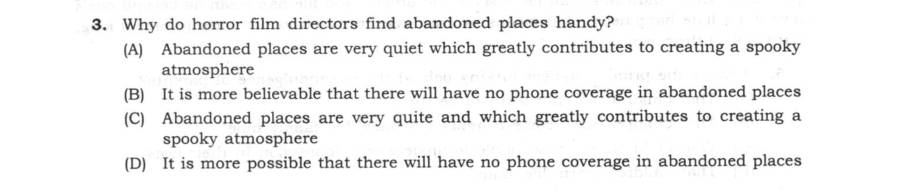
- A Abandoned places are very quiet which greatly contributes to creating a spooky atmosphere
- B It is more believable that there will have no phone coverage in abandoned places
- C Abandoned places are very quite and which greatly contributes to creating a spooky atmosphere
- D It is more possible that there will have no phone coverage in abandoned places
Show answer
Answer: (A) Abandoned places are very quiet which greatly contributes to creating a spooky atmosphere
Official provisional answer key
-
Read the following passage carefully and answer Question Nos. 3 and 4 :
Since almost the beginning of cinema, we have had scary films. Of all the genres that exist,
horror is perhaps one of the most conventional. Many horror films rely on specific plot
devices, also called tropes, to make their audience frightened. When a trope is used too much,
it can become a cliché. But when used well, it can really make us jump out of our skin. Here
are some of the most used, and perhaps abused, clichés in horror films.
No matter what kind of house it is, the basement is a scary place in horror films. That's
usually where something is hiding or where the evil psychopath has hidden their tools.
Basements are always dark and often damp. You can only reach them by a narrow staircase.
And basements are always creepy, even when there isn't anything down there.
In older horror films, when protagonists were in desperation, it was difficult or impossible for
them to call for help or call the police. Mobile phones have made that situation a bit less
believable now. What's the solution to maintain suspense? No phone coverage! If you're a hero
in a horror film, it's almost certain that at a key moment, just when you absolutely need to
are making the call. Or both.
Directors of horror films love uninhabited places. This could be an abandoned hospital, a
scary empty house or a ghost town. There's something about lonely, empty places. What was
it like when people lived there? Why did they leave? May be it's also that they are so quiet,
which can be very scary too. Of course, abandoned places are also handy for horror film
directors in that it's more believable that you will have no phone coverage there either.
The hero has been driving for hours. It's night-time and it's beginning to rain. Suddenly he
sees a person on the side of the road. May be the company will keep him awake? In horror
films, giving anybody a ride is asking for trouble. The hero always does it, and it always ends
badly.
This horror film cliché was especially popular with horror films of the late 20th century. It
starts with a group of teenagers all enjoying themselves, and it ends with everyone dead
except one girl. At the beginning, the girl is usually innocent, shy and not particularly strong.
By the end, she has become the toughest and most resourceful person in the world. The last
girl almost always wins in the end.Horror film as a genre

- A has rarely made into a cinematic expression
- B had become popular since the previous century
- C has always been considered as a cinematic subject
- D has relied on scientific fiction
Show answer
Answer: (C) has always been considered as a cinematic subject
Official provisional answer key
-
Read the following passage carefully and answer Question Nos. 5 and 6 :
Too many parents these days can't say no. As a result, they find themselves raising 'children'
who respond greedily to the advertisements aimed right at them. Even getting what they want
doesn't satisfy some kids; they only want more. Now, a growing number of psychologists,
educators and parents think it's time to stop the madness and start teaching kids about
struggle to set limits has never been tougher—and the stakes have never been higher. One
recent study of adults who were overindulged as children, paints a discouraging picture of
their future : when given too much too soon, they grow up to be adults who have difficulty
coping with life's disappointments. They also have a distorted sense of entitlement that gets in
the way of success in the workplace and in relationships.
Psychologists say that parents who overindulge their kids set them up to be more vulnerable
to future anxiety and depression. Today's parents themselves raised on values of thrift and
self-sacrifice, grew up in a culture where 'no' was a household word. Today's kids want much
more, partly because there is so much more to want. By every measure, parents are shelling
out record amounts. In the heat of the buying blitz, even parents who desperately need to say
no find themselves reaching for their credit cards.
Today's parents aren't equipped to deal with the problem. Many even wear the same designer
clothes as their kids and listen to the same music. And they work more hours; at the end of a
long week, it's tempting to buy peace with yes' and not mar precious family time with conflict.
Anxiety about the future is another factor. Experts agree : too much love won't spoil a child.
Too few limits will.
What parents need to find, is a balance between the advantages of an affluent society and the
critical life lessons that come from waiting, saving and working hard to achieve goals. That
search for balance has to start early. Children need limits on their behaviour because they
feel better and more secure when they live within a secured structure.
Older children learn self-control by watching how others, especially parents act. Learning
how to overcome challenges is essential to becoming a successful adult. Few parents ask kids
to do chores. They think their kids are already overburdened by social and academic
pressures. Every individual can be of service to others, and life has meaning beyond one's
own immediate happiness. That means parents eager to teach values have to take a long,
hard look at their own.What is the primary danger lurking behind the overindulgence of parents?
That children will not learn to be thrifty
That children are susceptible to anxiety and depression in their lives
That children learn life skills'
Show answer
Answer: (C)
Official provisional answer key
-
Read the following passage carefully and answer Question Nos. 5 and 6 :
Too many parents these days can't say no. As a result, they find themselves raising 'children'
who respond greedily to the advertisements aimed right at them. Even getting what they want
doesn't satisfy some kids; they only want more. Now, a growing number of psychologists,
educators and parents think it's time to stop the madness and start teaching kids about
struggle to set limits has never been tougher—and the stakes have never been higher. One
recent study of adults who were overindulged as children, paints a discouraging picture of
their future : when given too much too soon, they grow up to be adults who have difficulty
coping with life's disappointments. They also have a distorted sense of entitlement that gets in
the way of success in the workplace and in relationships.
Psychologists say that parents who overindulge their kids set them up to be more vulnerable
to future anxiety and depression. Today's parents themselves raised on values of thrift and
self-sacrifice, grew up in a culture where 'no' was a household word. Today's kids want much
more, partly because there is so much more to want. By every measure, parents are shelling
out record amounts. In the heat of the buying blitz, even parents who desperately need to say
no find themselves reaching for their credit cards.
Today's parents aren't equipped to deal with the problem. Many even wear the same designer
clothes as their kids and listen to the same music. And they work more hours; at the end of a
long week, it's tempting to buy peace with yes' and not mar precious family time with conflict.
Anxiety about the future is another factor. Experts agree : too much love won't spoil a child.
Too few limits will.
What parents need to find, is a balance between the advantages of an affluent society and the
critical life lessons that come from waiting, saving and working hard to achieve goals. That
search for balance has to start early. Children need limits on their behaviour because they
feel better and more secure when they live within a secured structure.
Older children learn self-control by watching how others, especially parents act. Learning
how to overcome challenges is essential to becoming a successful adult. Few parents ask kids
to do chores. They think their kids are already overburdened by social and academic
pressures. Every individual can be of service to others, and life has meaning beyond one's
own immediate happiness. That means parents eager to teach values have to take a long,
hard look at their own.Limits should be set on children's behaviour so that

- A they learn to deal with setbacks in life
- B they feel they are not missing out on anything
- C they learn the sacrifices made by their parents
- D they feel they are safe in a durable structure such as the family
Show answer
Answer: (D) they feel they are safe in a durable structure such as the family
Official provisional answer key
-
Read the following passage carefully and answer Question Nos. 7 and 8 :
The Scandinavian countries are much admired all over the world for their enlightened social
policies. Sweden has evolved an excellent system for protecting the individual citizen from
high-handed or incompetent public officers. The Swedish were the first to recognise that
public officials like civil servants, police officers, health inspectors or tax collectors can
make mistakes or act over-zealously in the belief that they are serving the public. As long ago
as 1809, the Swedish Parliament introduced a scheme to safeguard the interest of the
who is suitably qualified to investigate private grievances against the State. The official title of
the person is 'Justice Ombudsman' but Swedish commonly refer to him as the 'JO' or
be made in writing, the Ombudsman receives an average of 1200 letters a year. He has eight
lawyer assistants to help him, and he examines every single letter in detail. There is nothing
secretive about the Ombudsman's work, for his correspondence is open to public inspection.
If a citizen's complaint is justified, the Ombudsman will act on his behalf. The action he takes
varies according to the nature of the complaint. He may gently reprimand an official or even
suggest to the Parliament that the law needs to be altered.Why did Sweden introduce the institution of Ombudsman?
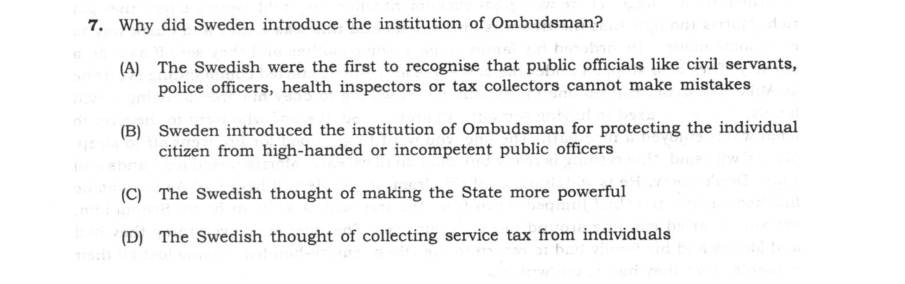
- A The Swedish were the first to recognise that public officials like civil servants, police officers, health inspectors or tax collectors cannot make mistakes
- B Sweden introduced the institution of Ombudsman for protecting the individual citizen from high-handed or incompetent public officers
- C The Swedish thought of making the State more powerful
- D The Swedish thought of collecting service tax from individuals
Show answer
Answer: (B) Sweden introduced the institution of Ombudsman for protecting the individual citizen from high-handed or incompetent public officers
Official provisional answer key
-
Read the following passage carefully and answer Question Nos. 7 and 8 :
The Scandinavian countries are much admired all over the world for their enlightened social
policies. Sweden has evolved an excellent system for protecting the individual citizen from
high-handed or incompetent public officers. The Swedish were the first to recognise that
public officials like civil servants, police officers, health inspectors or tax collectors can
make mistakes or act over-zealously in the belief that they are serving the public. As long ago
as 1809, the Swedish Parliament introduced a scheme to safeguard the interest of the
who is suitably qualified to investigate private grievances against the State. The official title of
the person is 'Justice Ombudsman' but Swedish commonly refer to him as the 'JO' or
be made in writing, the Ombudsman receives an average of 1200 letters a year. He has eight
lawyer assistants to help him, and he examines every single letter in detail. There is nothing
secretive about the Ombudsman's work, for his correspondence is open to public inspection.
If a citizen's complaint is justified, the Ombudsman will act on his behalf. The action he takes
varies according to the nature of the complaint. He may gently reprimand an official or even
suggest to the Parliament that the law needs to be altered.A critical feature of the Ombudsman is

- A he works alone without assistants
- B his work is subject to public scrutiny
- C he listens to oral complaints, alone
- D he only concentrates on major issues
Show answer
Answer: (B) his work is subject to public scrutiny
Official provisional answer key
-
Read the following passage carefully and answer Question Nos. 9 and 10 :
Mike and Morris lived in the same village. While Morris owned the largest jewellery shop in
the village, Mike was a poor farmer. Both had large families with many sons, daughters-
in-law and grandchildren. One fine day, Mike, tired of not being able to feed his family,
decided to leave the village and move to the city where he was certain to earn enough to
feed everyone. Along with his family, he left the village for the city. At night, they stopped
under a large tree. There was a stream running nearby where they could freshen up
themselves. He told his sons to clear the area below the tree, he told his wife to fetch water
and he instructed his daughters-in-law to make up the fire and started cutting wood from
the tree himself. They didn't know that in the branches of the tree, there was a thief
hiding. He watched as Mike's family worked together and also noticed that they had
nothing to cook. Mike's wife also thought the same and asked her husband, "Everything is
ready but what shall we eat?" Mike raised his hands to heaven and said, "Don't worry. He
is watching all of this from above. He will help us." The thief got worried as he had seen
that the family was large and worked well together. Taking advantage of the fact that they
did not know he was hiding in the branches, he decided to make a quick escape. He
climbed down safely when they were not looking and ran for his life. But, he left behind
the bundle of stolen jewels and money which dropped into Mike's lap. Mike opened it and
jumped with joy when he saw the contents. The family gathered all their belongings and
returned to the village. There was great excitement when they told everyone how they got
rich. Morris thought that the tree was miraculous and this was a nice and quick way to
earn some money. He ordered his family to pack some clothes and they set off as if on a
journey. They also stopped under the same tree and Morris started commanding everyone
as Mike had done. But no one in his family was willing to obey his orders. Being a rich
family, they were used to having servants all around. So, the one who went to the river to
fetch water enjoyed a nice bath. The one who went to get wood for fire went off to sleep.
Morris'wife said, "Everything is ready but what shall we eat?" Morris raised his hands and
said, "Don't worry. He is watching all of this from above. He will help us." As soon as he
finished saying, the thief jumped down from the tree with a knife in hand. Seeing him,
everyone started running around to save their lives. The thief stole everything they had
and Morris and his family had to return to the village empty-handed, having lost all their
valuables that they had taken with them.According to the passage, why did Morris and his family decide to rest under the
thief's tree?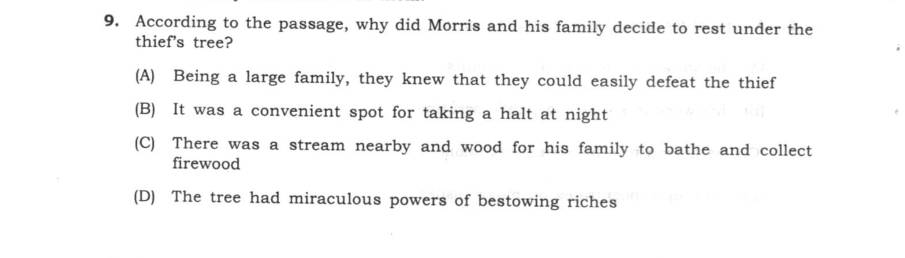
- A Being a large family, they knew that they could easily defeat the thief
- B It was a convenient spot for taking a halt at night
- C There was a stream nearby and wood for his family to bathe and collect firewood
- D The tree had miraculous powers of bestowing riches
Show answer
Answer: (D) The tree had miraculous powers of bestowing riches
Official provisional answer key
-
Read the following passage carefully and answer Question Nos. 9 and 10 :
Mike and Morris lived in the same village. While Morris owned the largest jewellery shop in
the village, Mike was a poor farmer. Both had large families with many sons, daughters-
in-law and grandchildren. One fine day, Mike, tired of not being able to feed his family,
decided to leave the village and move to the city where he was certain to earn enough to
feed everyone. Along with his family, he left the village for the city. At night, they stopped
under a large tree. There was a stream running nearby where they could freshen up
themselves. He told his sons to clear the area below the tree, he told his wife to fetch water
and he instructed his daughters-in-law to make up the fire and started cutting wood from
the tree himself. They didn't know that in the branches of the tree, there was a thief
hiding. He watched as Mike's family worked together and also noticed that they had
nothing to cook. Mike's wife also thought the same and asked her husband, "Everything is
ready but what shall we eat?" Mike raised his hands to heaven and said, "Don't worry. He
is watching all of this from above. He will help us." The thief got worried as he had seen
that the family was large and worked well together. Taking advantage of the fact that they
did not know he was hiding in the branches, he decided to make a quick escape. He
climbed down safely when they were not looking and ran for his life. But, he left behind
the bundle of stolen jewels and money which dropped into Mike's lap. Mike opened it and
jumped with joy when he saw the contents. The family gathered all their belongings and
returned to the village. There was great excitement when they told everyone how they got
rich. Morris thought that the tree was miraculous and this was a nice and quick way to
earn some money. He ordered his family to pack some clothes and they set off as if on a
journey. They also stopped under the same tree and Morris started commanding everyone
as Mike had done. But no one in his family was willing to obey his orders. Being a rich
family, they were used to having servants all around. So, the one who went to the river to
fetch water enjoyed a nice bath. The one who went to get wood for fire went off to sleep.
Morris'wife said, "Everything is ready but what shall we eat?" Morris raised his hands and
said, "Don't worry. He is watching all of this from above. He will help us." As soon as he
finished saying, the thief jumped down from the tree with a knife in hand. Seeing him,
everyone started running around to save their lives. The thief stole everything they had
and Morris and his family had to return to the village empty-handed, having lost all their
valuables that they had taken with them.The thief had left back the bag of jewellery behind on the tree because
Mike's prayer to God was granted
Mike spotted the thief on the tree
Mike lit a fire that threatened to burn the tree
Show answer
Answer: (C)
Official provisional answer key
-
Read the following passage carefully and answer Question Nos. 11 and 12 :
Elections were in the air of the world's youngest democracy when I arrived in Thimphu. This
was for a by-election in the capital city, that dominated the conversation at dinners, even in
Thimphu's most fun night-spot Mojo Park (the best music in town). Bhutan has taken to
democracy with ease ever since 2008 when the first proper elections were held, a process
India has helped out with, sending officials from the Election Commission travelling to check
arrangements, explain electronic voting machine (EVM) technology and procedures. However,
there are many things uniquely Bhutanese :
Monks and nuns in this deeply religious Buddhist majority are not allowed to vote, so as to
avoid mixing religion and politics. All voters must wear their national dress on polling day,
but no one candidate, campaigner or voter—is allowed to wear the Kabney silk and Gyentag,
a scarf of honour, for men and women respectively, bestowed only by the King, Patang—the
ceremonial sword, or any other sign of rank or royal patronage to avoid a misuse of influence.
And, in deference to the environment, no posters can be put up on any public property,
including trees, and are mostly restricted to a community billboard for all. May be a thing or
two the world's largest democracy could learn from the youngest?
While polygamy is practised in some parts, so is polyandry, and divorce settlements are equal
and even-handed. Even so, Bhutanese women lag behind in one place that it counts :
Parliament. In the last National Assembly Elections, 3/4ths of the 47 seats had only male
candidates (nine had females), and four women were elected as MPs, "Misogyny plays only
one part of it", explains the only leader of a party (DCT) Lily Wangchuk, who runs a hotel in
downtown Thimphu. "Women just don't vote for women, and the lack of women role models in
modern Bhutan becomes a vicious cycle."
While Bhutan's government and people tell you they are devoted to preserving the country
and its beauty, it is plain to see Bhutan is changing everyday in little ways. Less youngsters
adhere to the traditional and once mandatory national dress (Goh and Kira), more and more
buildings now get permission to rise above the originally regulated two stories, and glass and
granite are seen more in Thimphu where once only wood and paint were allowed. Some
modernities are welcome, and the abundance of hydropower electricity means many Bhutanese
(including the very dashing US-educated Prime Minister Tshering Tobgay) drive hybrid cars.
The countryside is still pristine, and not covered with the plastic waste ubiquitous in India,
even as Bhutan explores more 'non-wood' uses for its 70% forest cover that is also mandated
in the Constitution.Bhutan aims to conserve its pristine environment by

- A encouraging glass and granite in place of wood
- B allowing election posters on any public property or any tree
- C encouraging fuel-based energy
- D not penalising plastic waste
Show answer
Answer: (A) encouraging glass and granite in place of wood
Official provisional answer key
-
Read the following passage carefully and answer Question Nos. 11 and 12 :
Elections were in the air of the world's youngest democracy when I arrived in Thimphu. This
was for a by-election in the capital city, that dominated the conversation at dinners, even in
Thimphu's most fun night-spot Mojo Park (the best music in town). Bhutan has taken to
democracy with ease ever since 2008 when the first proper elections were held, a process
India has helped out with, sending officials from the Election Commission travelling to check
arrangements, explain electronic voting machine (EVM) technology and procedures. However,
there are many things uniquely Bhutanese :
Monks and nuns in this deeply religious Buddhist majority are not allowed to vote, so as to
avoid mixing religion and politics. All voters must wear their national dress on polling day,
but no one candidate, campaigner or voter—is allowed to wear the Kabney silk and Gyentag,
a scarf of honour, for men and women respectively, bestowed only by the King, Patang—the
ceremonial sword, or any other sign of rank or royal patronage to avoid a misuse of influence.
And, in deference to the environment, no posters can be put up on any public property,
including trees, and are mostly restricted to a community billboard for all. May be a thing or
two the world's largest democracy could learn from the youngest?
While polygamy is practised in some parts, so is polyandry, and divorce settlements are equal
and even-handed. Even so, Bhutanese women lag behind in one place that it counts :
Parliament. In the last National Assembly Elections, 3/4ths of the 47 seats had only male
candidates (nine had females), and four women were elected as MPs, "Misogyny plays only
one part of it", explains the only leader of a party (DCT) Lily Wangchuk, who runs a hotel in
downtown Thimphu. "Women just don't vote for women, and the lack of women role models in
modern Bhutan becomes a vicious cycle."
While Bhutan's government and people tell you they are devoted to preserving the country
and its beauty, it is plain to see Bhutan is changing everyday in little ways. Less youngsters
adhere to the traditional and once mandatory national dress (Goh and Kira), more and more
buildings now get permission to rise above the originally regulated two stories, and glass and
granite are seen more in Thimphu where once only wood and paint were allowed. Some
modernities are welcome, and the abundance of hydropower electricity means many Bhutanese
(including the very dashing US-educated Prime Minister Tshering Tobgay) drive hybrid cars.
The countryside is still pristine, and not covered with the plastic waste ubiquitous in India,
even as Bhutan explores more 'non-wood' uses for its 70% forest cover that is also mandated
in the Constitution.One glaring reason that the representation of women in the Bhutanese Parliament
is poor is
- A that polygamy persists
- B that misogyny persists
- C that women do not vote for women and therefore there are hardly any role models
- D that men only vote for men
Show answer
Answer: (C) that women do not vote for women and therefore there are hardly any role models
Official provisional answer key
-
Read the following passage carefully and answer Question Nos. 13 and 14 :
The development of nationalism in the third world countries, as is well-known, followed a very
different trajectory from that in the advanced capitalist countries. In the latter it was a part of
the process of the emergence of the bourgeois order in opposition of feudalism, while in the
former it was a part of the anti-colonial struggle. The impact of colonialism, though it differed
unifying supra-local economic structures through the introduction of market relations. The
struggle against colonialism, consequently, took the form of a national struggle in each
instance in which people belonging to different tribes or linguistic communities participated.
And the colonial power in each instance attempted to break this emerging national unity by
splitting people. The modus operandi of this splitting was not just through political
manipulation as happened for instance in Angola, South Africa and a host of other countries;
an important part of this modus operandi was through the nurturing of a historiography that
just denied the existence of any overarching national consciousness. The national struggle,
the national movement were given a tribal or religious character, they were portrayed as being
no more than the movement of the dominant tribe or the dominant religious group for the
achievement of narrow sectional ends. But the important point in this colonialism, while, on
the one hand, it objectively created the condition for the coming into being of a national
consciousness at a supra-tribal, supra-local and supra-religious level, on the other hand it
sought deliberately to subvert this very consciousness by using the same forces which it has
objectively undermined.How did nationalism originate in the third world countries?

- A As a struggle against feudalism
- B As a vehement opposition to colonialism
- C To advocate capitalistic movement
- D To strengthen localism
Show answer
Answer: (B) As a vehement opposition to colonialism
Official provisional answer key
-
Read the following passage carefully and answer Question Nos. 13 and 14 :
The development of nationalism in the third world countries, as is well-known, followed a very
different trajectory from that in the advanced capitalist countries. In the latter it was a part of
the process of the emergence of the bourgeois order in opposition of feudalism, while in the
former it was a part of the anti-colonial struggle. The impact of colonialism, though it differed
unifying supra-local economic structures through the introduction of market relations. The
struggle against colonialism, consequently, took the form of a national struggle in each
instance in which people belonging to different tribes or linguistic communities participated.
And the colonial power in each instance attempted to break this emerging national unity by
splitting people. The modus operandi of this splitting was not just through political
manipulation as happened for instance in Angola, South Africa and a host of other countries;
an important part of this modus operandi was through the nurturing of a historiography that
just denied the existence of any overarching national consciousness. The national struggle,
the national movement were given a tribal or religious character, they were portrayed as being
no more than the movement of the dominant tribe or the dominant religious group for the
achievement of narrow sectional ends. But the important point in this colonialism, while, on
the one hand, it objectively created the condition for the coming into being of a national
consciousness at a supra-tribal, supra-local and supra-religious level, on the other hand it
sought deliberately to subvert this very consciousness by using the same forces which it has
objectively undermined.The rise of nationalism was sought to be broken by the colonial powers by
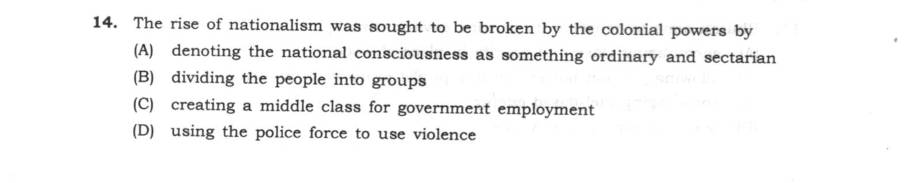
- A denoting the national consciousness as something ordinary and sectarian
- B dividing the people into groups
- C creating a middle class for government employment
- D using the police force to use violence
Show answer
Answer: (A) denoting the national consciousness as something ordinary and sectarian
Official provisional answer key
-
Direction : Each of the questions (Question Nos. 65 to 70) is based on the passage given below.
The questions are to be answered on the basis of what is stated or implied in the passage. Choose
the most appropriate response that accurately and completely answers the question.
Lionel Messi could not believe it. Frankly, few could. Against the US four days ago, his divine left
foot had made the ball overcome a wall of defenders and curl and dip past a diving goalkeeper to
magically settle in the top left corner of the goal. It was not as much a free kick from 25 yards, but
a laser-guided missile. On Sunday night, in the penalty shootout of the Copa America final against
Chile, he hit it over from less than half that distance with nothing but the thick New Jersey air to
beat. The resultant 4–2 loss meant Argentina’s title drought, dating back to 1993, would continue.
It also ensured that Messi, one of the most decorated club footballers of all time, would not get that
one trophy with the national team he so covets. It will remain that way as Messi, later, announced
his retirement from international football.
His teammates have said it was a heat-of-the-moment decision and he would reconsider. Messi’s
unhappiness with the Argentine Federation, which is teetering on the brink of collapse, may also
have influenced his decision. Therefore, a return to sky blue-and-white, with the World Cup just
two years away, cannot be implausible. Nevertheless, if Sunday was his final appearance for
Albiceleste, what legacy does he leave behind? It is easy to brand him as an underachiever, given
his 28–0 club vs. country record at the senior level. But the picture is more complex. For one,
modern-day football has very limited scope for independent, individual flair. Two, what that
number does not show is both as a player and a captain, Messi has been instrumental in Argentina
making it to three major finals in the last two years, including the 2014 World Cup.
What remains unquestionable is Messi’s unimpeachable genius. His unparalleled vision, deft
touch, and nimble footwork have often proved to be the lifeline of his teams, be it at Barcelona or
Argentina. Yes, he may have missed that crucial penalty, but it is important to remember that
football is a team sport. It is equally about collective endeavour as it is about individual brilliance.
Clearly, the margin between an underachiever and a GOAT is very, very slim. It, therefore, depends
on how you want to remember Messi : Through his last miss or his last hit, that free kick.What does the author mean to say when he comments, “Lionel Messi could not believe it”?
- A Lionel Messi could not believe that he could not score a goal of a free kick during the penalty shootout
- B Lionel Messi could not believe that he had overcome a wall of defenders to score a goal from 25 yards
- C Lionel Messi could not believe that the football that he kicked from 25 yards hit the goals like a missile
- D Lionel Messi could not believe the ball that he kicked curved and settled in the top left corner of the goal
Show answer
Answer: (A) Lionel Messi could not believe that he could not score a goal of a free kick during the penalty shootout
Official final answer key
-
Direction : Each of the questions (Question Nos. 65 to 70) is based on the passage given below.
The questions are to be answered on the basis of what is stated or implied in the passage. Choose
the most appropriate response that accurately and completely answers the question.
Lionel Messi could not believe it. Frankly, few could. Against the US four days ago, his divine left
foot had made the ball overcome a wall of defenders and curl and dip past a diving goalkeeper to
magically settle in the top left corner of the goal. It was not as much a free kick from 25 yards, but
a laser-guided missile. On Sunday night, in the penalty shootout of the Copa America final against
Chile, he hit it over from less than half that distance with nothing but the thick New Jersey air to
beat. The resultant 4–2 loss meant Argentina’s title drought, dating back to 1993, would continue.
It also ensured that Messi, one of the most decorated club footballers of all time, would not get that
one trophy with the national team he so covets. It will remain that way as Messi, later, announced
his retirement from international football.
His teammates have said it was a heat-of-the-moment decision and he would reconsider. Messi’s
unhappiness with the Argentine Federation, which is teetering on the brink of collapse, may also
have influenced his decision. Therefore, a return to sky blue-and-white, with the World Cup just
two years away, cannot be implausible. Nevertheless, if Sunday was his final appearance for
Albiceleste, what legacy does he leave behind? It is easy to brand him as an underachiever, given
his 28–0 club vs. country record at the senior level. But the picture is more complex. For one,
modern-day football has very limited scope for independent, individual flair. Two, what that
number does not show is both as a player and a captain, Messi has been instrumental in Argentina
making it to three major finals in the last two years, including the 2014 World Cup.
What remains unquestionable is Messi’s unimpeachable genius. His unparalleled vision, deft
touch, and nimble footwork have often proved to be the lifeline of his teams, be it at Barcelona or
Argentina. Yes, he may have missed that crucial penalty, but it is important to remember that
football is a team sport. It is equally about collective endeavour as it is about individual brilliance.
Clearly, the margin between an underachiever and a GOAT is very, very slim. It, therefore, depends
on how you want to remember Messi : Through his last miss or his last hit, that free kick.When Messi missed the penalty shot, what result did that ensure?
- A It brought criticism for Messi from all around the world
- B It deprived his national football team of the Copa America Cup
- C It made Lionel Messi so dejected that he had to announce retirement from football
- D It cost Argentina its chance of winning the FIFA World Cup CWT–2025/P–I/301-A 32
Show answer
Answer: (B) It deprived his national football team of the Copa America Cup
Official final answer key
-
Direction : Each of the questions (Question Nos. 65 to 70) is based on the passage given below.
The questions are to be answered on the basis of what is stated or implied in the passage. Choose
the most appropriate response that accurately and completely answers the question.
Lionel Messi could not believe it. Frankly, few could. Against the US four days ago, his divine left
foot had made the ball overcome a wall of defenders and curl and dip past a diving goalkeeper to
magically settle in the top left corner of the goal. It was not as much a free kick from 25 yards, but
a laser-guided missile. On Sunday night, in the penalty shootout of the Copa America final against
Chile, he hit it over from less than half that distance with nothing but the thick New Jersey air to
beat. The resultant 4–2 loss meant Argentina’s title drought, dating back to 1993, would continue.
It also ensured that Messi, one of the most decorated club footballers of all time, would not get that
one trophy with the national team he so covets. It will remain that way as Messi, later, announced
his retirement from international football.
His teammates have said it was a heat-of-the-moment decision and he would reconsider. Messi’s
unhappiness with the Argentine Federation, which is teetering on the brink of collapse, may also
have influenced his decision. Therefore, a return to sky blue-and-white, with the World Cup just
two years away, cannot be implausible. Nevertheless, if Sunday was his final appearance for
Albiceleste, what legacy does he leave behind? It is easy to brand him as an underachiever, given
his 28–0 club vs. country record at the senior level. But the picture is more complex. For one,
modern-day football has very limited scope for independent, individual flair. Two, what that
number does not show is both as a player and a captain, Messi has been instrumental in Argentina
making it to three major finals in the last two years, including the 2014 World Cup.
What remains unquestionable is Messi’s unimpeachable genius. His unparalleled vision, deft
touch, and nimble footwork have often proved to be the lifeline of his teams, be it at Barcelona or
Argentina. Yes, he may have missed that crucial penalty, but it is important to remember that
football is a team sport. It is equally about collective endeavour as it is about individual brilliance.
Clearly, the margin between an underachiever and a GOAT is very, very slim. It, therefore, depends
on how you want to remember Messi : Through his last miss or his last hit, that free kick.What tone does the author employ when discussing Lionel Messi’s career and achievements
in the passage?- A Appreciative and celebratory
- B Critical and judgemental
- C Analytical and objective
- D Emotional and empathetic
Show answer
Answer: (C) Analytical and objective
Official final answer key
-
Direction : Each of the questions (Question Nos. 65 to 70) is based on the passage given below.
The questions are to be answered on the basis of what is stated or implied in the passage. Choose
the most appropriate response that accurately and completely answers the question.
Lionel Messi could not believe it. Frankly, few could. Against the US four days ago, his divine left
foot had made the ball overcome a wall of defenders and curl and dip past a diving goalkeeper to
magically settle in the top left corner of the goal. It was not as much a free kick from 25 yards, but
a laser-guided missile. On Sunday night, in the penalty shootout of the Copa America final against
Chile, he hit it over from less than half that distance with nothing but the thick New Jersey air to
beat. The resultant 4–2 loss meant Argentina’s title drought, dating back to 1993, would continue.
It also ensured that Messi, one of the most decorated club footballers of all time, would not get that
one trophy with the national team he so covets. It will remain that way as Messi, later, announced
his retirement from international football.
His teammates have said it was a heat-of-the-moment decision and he would reconsider. Messi’s
unhappiness with the Argentine Federation, which is teetering on the brink of collapse, may also
have influenced his decision. Therefore, a return to sky blue-and-white, with the World Cup just
two years away, cannot be implausible. Nevertheless, if Sunday was his final appearance for
Albiceleste, what legacy does he leave behind? It is easy to brand him as an underachiever, given
his 28–0 club vs. country record at the senior level. But the picture is more complex. For one,
modern-day football has very limited scope for independent, individual flair. Two, what that
number does not show is both as a player and a captain, Messi has been instrumental in Argentina
making it to three major finals in the last two years, including the 2014 World Cup.
What remains unquestionable is Messi’s unimpeachable genius. His unparalleled vision, deft
touch, and nimble footwork have often proved to be the lifeline of his teams, be it at Barcelona or
Argentina. Yes, he may have missed that crucial penalty, but it is important to remember that
football is a team sport. It is equally about collective endeavour as it is about individual brilliance.
Clearly, the margin between an underachiever and a GOAT is very, very slim. It, therefore, depends
on how you want to remember Messi : Through his last miss or his last hit, that free kick.According to the passage, Lionel Messi’s decision to retire from the international football was
perhaps influenced by- A his unhappiness with the Argentine Federation
- B the defeat in the Copa America final
- C the heat of the moment
- D the desire to focus on his club career
Show answer
Answer: (A) his unhappiness with the Argentine Federation
Official final answer key
-
Direction : Each of the questions (Question Nos. 65 to 70) is based on the passage given below.
The questions are to be answered on the basis of what is stated or implied in the passage. Choose
the most appropriate response that accurately and completely answers the question.
Lionel Messi could not believe it. Frankly, few could. Against the US four days ago, his divine left
foot had made the ball overcome a wall of defenders and curl and dip past a diving goalkeeper to
magically settle in the top left corner of the goal. It was not as much a free kick from 25 yards, but
a laser-guided missile. On Sunday night, in the penalty shootout of the Copa America final against
Chile, he hit it over from less than half that distance with nothing but the thick New Jersey air to
beat. The resultant 4–2 loss meant Argentina’s title drought, dating back to 1993, would continue.
It also ensured that Messi, one of the most decorated club footballers of all time, would not get that
one trophy with the national team he so covets. It will remain that way as Messi, later, announced
his retirement from international football.
His teammates have said it was a heat-of-the-moment decision and he would reconsider. Messi’s
unhappiness with the Argentine Federation, which is teetering on the brink of collapse, may also
have influenced his decision. Therefore, a return to sky blue-and-white, with the World Cup just
two years away, cannot be implausible. Nevertheless, if Sunday was his final appearance for
Albiceleste, what legacy does he leave behind? It is easy to brand him as an underachiever, given
his 28–0 club vs. country record at the senior level. But the picture is more complex. For one,
modern-day football has very limited scope for independent, individual flair. Two, what that
number does not show is both as a player and a captain, Messi has been instrumental in Argentina
making it to three major finals in the last two years, including the 2014 World Cup.
What remains unquestionable is Messi’s unimpeachable genius. His unparalleled vision, deft
touch, and nimble footwork have often proved to be the lifeline of his teams, be it at Barcelona or
Argentina. Yes, he may have missed that crucial penalty, but it is important to remember that
football is a team sport. It is equally about collective endeavour as it is about individual brilliance.
Clearly, the margin between an underachiever and a GOAT is very, very slim. It, therefore, depends
on how you want to remember Messi : Through his last miss or his last hit, that free kick.Which of the following can be inferred from the passage?
- A Lionel Messi’s retirement from international football was solely influenced by his missed penalty in the Copa America final
- B Lionel Messi’s legacy as a football player is defined by his individual achievements rather than his contributions to the teams he played for
- C Lionel Messi’s individual brilliance as a football player is acknowledged, but it is important to remember that football is a team sport
- D Lionel Messi’s retirement from international football marks the end of his football career altogether
Show answer
Answer: (C) Lionel Messi’s individual brilliance as a football player is acknowledged, but it is important to remember that football is a team sport
Official final answer key
-
Direction : Each of the questions (Question Nos. 65 to 70) is based on the passage given below.
The questions are to be answered on the basis of what is stated or implied in the passage. Choose
the most appropriate response that accurately and completely answers the question.
Lionel Messi could not believe it. Frankly, few could. Against the US four days ago, his divine left
foot had made the ball overcome a wall of defenders and curl and dip past a diving goalkeeper to
magically settle in the top left corner of the goal. It was not as much a free kick from 25 yards, but
a laser-guided missile. On Sunday night, in the penalty shootout of the Copa America final against
Chile, he hit it over from less than half that distance with nothing but the thick New Jersey air to
beat. The resultant 4–2 loss meant Argentina’s title drought, dating back to 1993, would continue.
It also ensured that Messi, one of the most decorated club footballers of all time, would not get that
one trophy with the national team he so covets. It will remain that way as Messi, later, announced
his retirement from international football.
His teammates have said it was a heat-of-the-moment decision and he would reconsider. Messi’s
unhappiness with the Argentine Federation, which is teetering on the brink of collapse, may also
have influenced his decision. Therefore, a return to sky blue-and-white, with the World Cup just
two years away, cannot be implausible. Nevertheless, if Sunday was his final appearance for
Albiceleste, what legacy does he leave behind? It is easy to brand him as an underachiever, given
his 28–0 club vs. country record at the senior level. But the picture is more complex. For one,
modern-day football has very limited scope for independent, individual flair. Two, what that
number does not show is both as a player and a captain, Messi has been instrumental in Argentina
making it to three major finals in the last two years, including the 2014 World Cup.
What remains unquestionable is Messi’s unimpeachable genius. His unparalleled vision, deft
touch, and nimble footwork have often proved to be the lifeline of his teams, be it at Barcelona or
Argentina. Yes, he may have missed that crucial penalty, but it is important to remember that
football is a team sport. It is equally about collective endeavour as it is about individual brilliance.
Clearly, the margin between an underachiever and a GOAT is very, very slim. It, therefore, depends
on how you want to remember Messi : Through his last miss or his last hit, that free kick.Which of the following statements is supported by the passage?
- A Messi has never won a major international trophy with Argentina.
- B Messi’s individual brilliance outweighs the importance of collective endeavour in football.
- C Messi’s missed penalty in the Copa America final was the sole reason for Argentina’s loss.
- D Messi’s retirement from the international football is irreversible.
Show answer
Answer: (A) Messi has never won a major international trophy with Argentina.
Official final answer key
Sources and corrections
From the open AxomRank PYQ dataset. Each question links back to its paper. See how to report a correction.