Communication & Interpersonal Skills Questions from Assam Exams: 34 Previous Year MCQs with Answers
Every communication & interpersonal skills question from 3 real Assam recruitment papers, in one place. Use it to see which facts come up again and again.
Where these questions were asked
| Exam | Questions |
|---|---|
| APSC CCE Prelims | 34 |
Most-asked subtopics
| Subtopic | Questions |
|---|---|
| Interpersonal communication | 14 |
| Active listening | 2 |
| Non-verbal communication | 2 |
| Personal presentation | 1 |
| Sociolinguistic context | 1 |
| Courtesy in communication | 1 |
| Rapport building | 1 |
| Bullying and empathy | 1 |
| Accountability in communication | 1 |
| Cross-cultural communication | 1 |
| Personal space | 1 |
| Emotional intelligence | 1 |
| Interpersonal skills | 1 |
| Self-awareness | 1 |
| Self-esteem | 1 |
All 34 questions
-
Which of the following is an active act?
Hearing Listening
Sleeping None of these
Show answer
Answer: (B)
Official provisional answer key
-
When a colleague brings personal problems to the meeting, you should
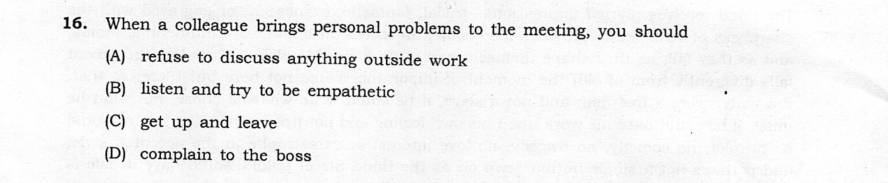
- A refuse to discuss anything outside work
- B listen and try to be empathetic
- C get up and leave
- D complain to the boss
Show answer
Answer: (B) listen and try to be empathetic
Official provisional answer key
-
All communication events have a/an
source resource
start end
Show answer
Answer: (A)
Official provisional answer key
-
Letter, e-mail and telephone are examples of
channel message
feedback ()encoding
Show answer
Answer: (A)
Official provisional answer key
-
Traffic lights are a form of
verbal communication
non-verbal communication
olfactory communication
ll of the above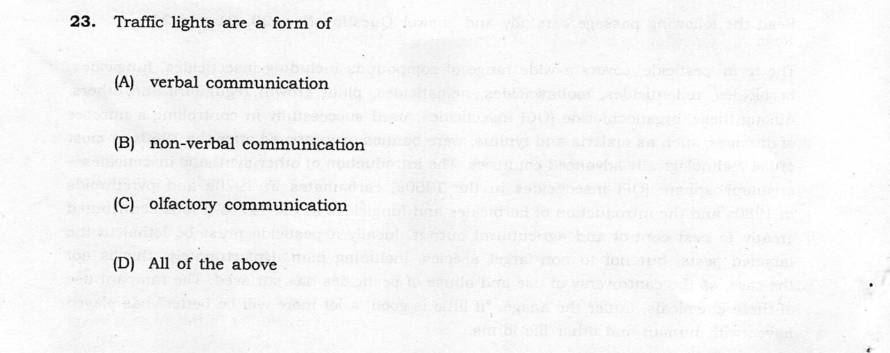
Show answer
Answer: (B)
Official provisional answer key
-
The process of turning communication into thought is called
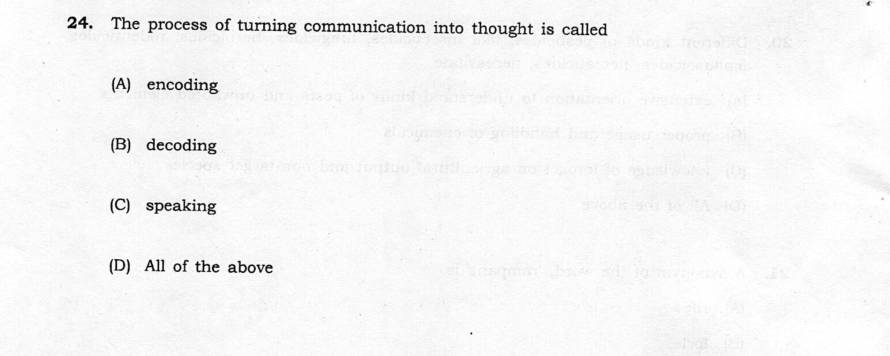
- A encoding
- B decoding
- C speaking
- D ()All of the above
Show answer
Answer: (B) decoding
Official provisional answer key
-
'Clothes maketh a man' means
s p p n 'e n (
by dressing in a certain way, we can shape our behaviour and the way we perform
we can exert little control over our appearance
we want to draw unwarranted attention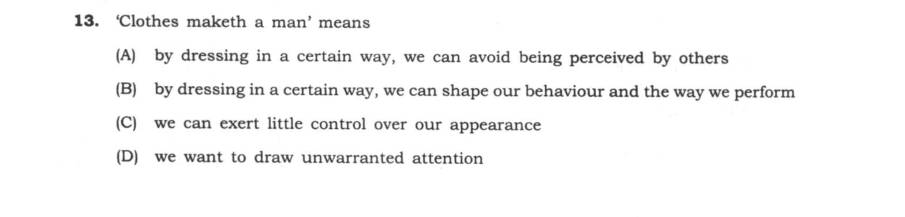
Show answer
Answer: (B)
Official provisional answer key
-
A teenager will speak to his grandmother and to his friend
- A in the same way
- B on any topic which might be considered taboo
- C ignoring grammar and propriety
- D using a different sociolinguistic strategy
Show answer
Answer: (D) using a different sociolinguistic strategy
Official provisional answer key
-
While communicating, you should
- A use adorned style of language
- B (be courteous
- C use the acerbic effect of your message
- D not control your emotions
Show answer
Answer: (B) (be courteous
Official provisional answer key
-
Rapport building and facilitating is
- A part of mentoring
- B part of beguiling the innocent
- C inhibiting the learner
- D misaligning of expectations
Show answer
Answer: (A) part of mentoring
Official provisional answer key
-
The willingness to listen and learn helps us to
cut another person to size
resolve differences
polarize people
prejudge people
Show answer
Answer: (B)
Official provisional answer key
-
Ridiculing a vulnerable person is to
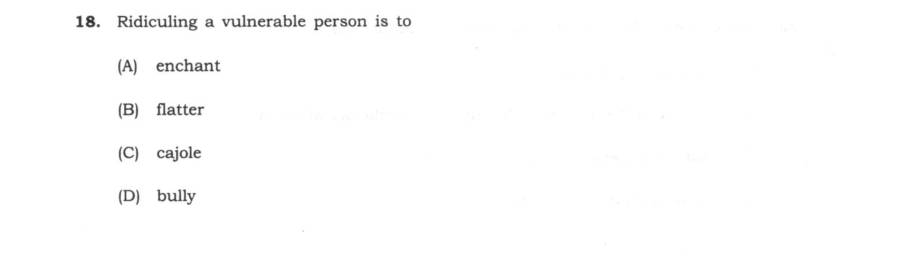
- A enchant
- B (flatter
- C cajole
- D bully
Show answer
Answer: (D) bully
Official provisional answer key
-
While admitting a serious lapse, you should not
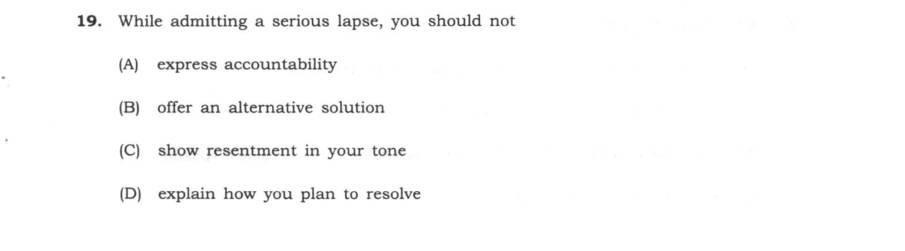
- A express accountability
- B offer an alternative solution
- C show resentment in your tone
- D explain how you plan to resolve
Show answer
Answer: (C) show resentment in your tone
Official provisional answer key
-
In a multicultural environment, a strong regional accent may
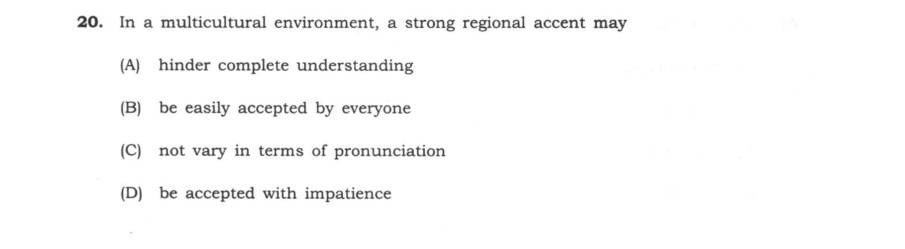
- A hinder complete understanding
- B be easily accepted by everyone
- C not vary in terms of pronunciation
- D be accepted with impatience
Show answer
Answer: (A) hinder complete understanding
Official provisional answer key
-
The universal gesture that conveys the same meaning in all societies is
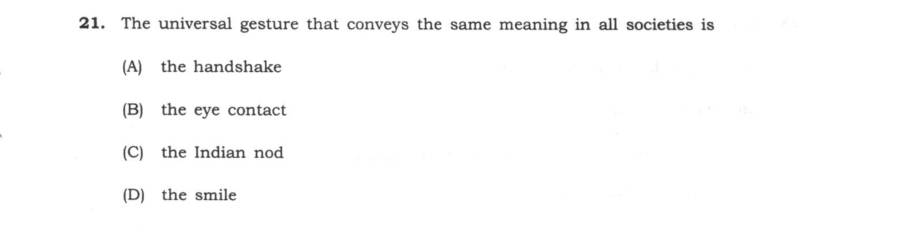
- A the handshake
- B (the eye contact
- C the Indian nod
- D the smile
Show answer
Answer: (D) the smile
Official provisional answer key
-
The concept of space and territoriality is influenced by
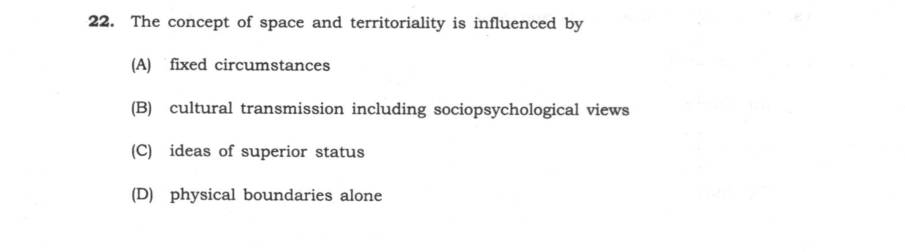
- A fixedcircumstances
- B cultural transmission including sociopsychological views
- C ideas of superior status
- D physical boundaries alone
Show answer
Answer: (B) cultural transmission including sociopsychological views
Official provisional answer key
-
Emotional intelligence is
blend of watching, sympathizing and communicating
critically watching human language
to be emotionally charged up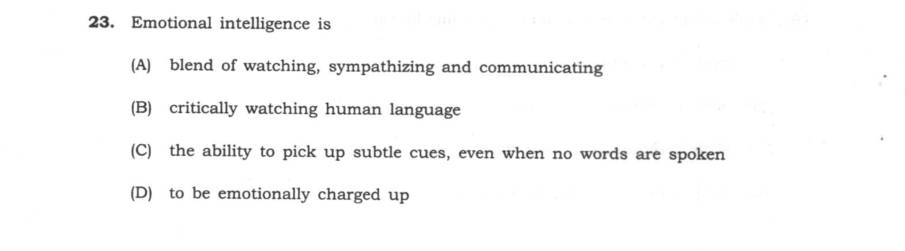
Show answer
Answer: (C)
Official provisional answer key
-
Interpersonal skills involve
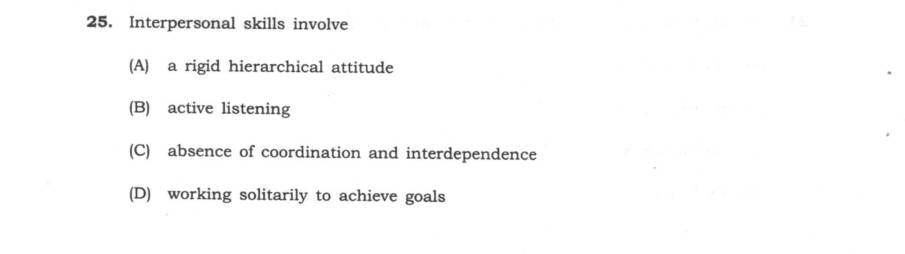
- A a rigid hierarchical attitude
- B active listening
- C absence of coordination and interdependence
- D working solitarily to achieve goals
Show answer
Answer: (B) active listening
Official provisional answer key
-
Sometimes the fear of not being perfect may stem from
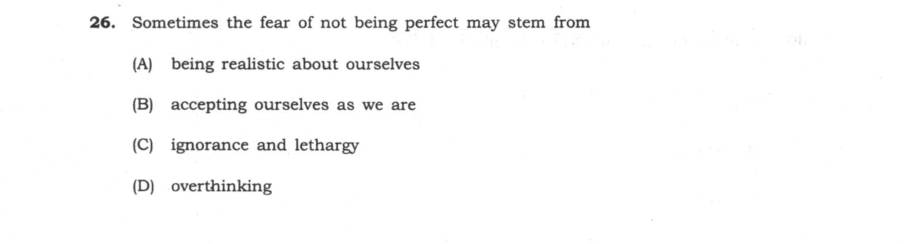
- A being realistic about ourselves
- B accepting ourselves as we are
- C ()ignorance and lethargy
- D (overthinking
Show answer
Answer: (C) ()ignorance and lethargy
Official provisional answer key
-
A sense of one's own worth needs
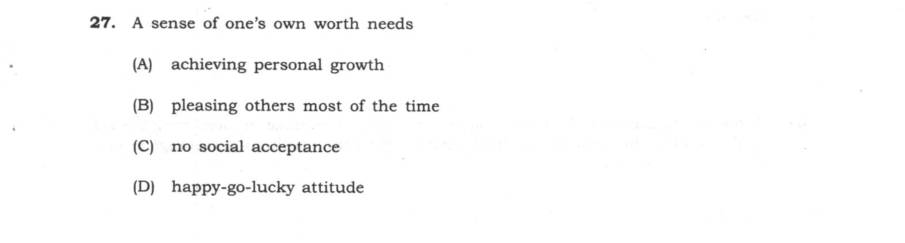
- A achieving personal growth
- B pleasing others most of the time
- C no social acceptance
- D happy-go-lucky attitude
Show answer
Answer: (A) achieving personal growth
Official provisional answer key
-
Small talk is a
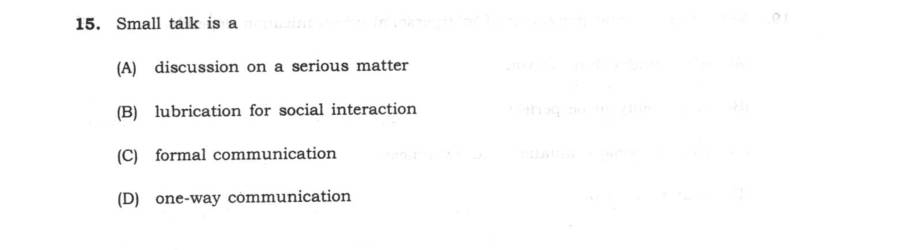
- A discussion on a serious matter
- B lubrication for social interaction
- C (formal communication
- D one-way communication
Show answer
Answer: (B) lubrication for social interaction
Official provisional answer key
-
If we want a continuing harmonious relationship in our negotiations, we will adopt
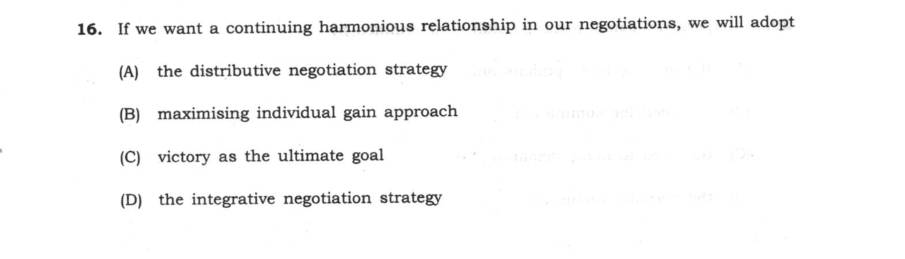
- A the distributive negotiation strategy
- B maximising individual gain approach
- C (victory as the ultimate goal
- D the integrative negotiation strategy
Show answer
Answer: (D) the integrative negotiation strategy
Official provisional answer key
-
Empathy is
to give advice
to try to change someone else's emotions
feeling sorry for someone
putting yourself in someone else's shoes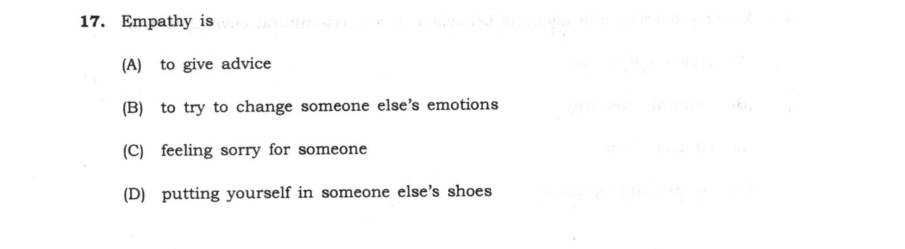
Show answer
Answer: (D)
Official provisional answer key
-
While communicating negative messages, it is important to
- A use a buffer writing in the beginning
- B use the me attitude
- C blame someone specifically
- D apologise profusely
Show answer
Answer: (A) use a buffer writing in the beginning
Official provisional answer key
-
Self-esteem, a vital ingredient of interpersonal communication depends on
- A what others think of you
- B your ability to be perfect
- C your personal evaluation and awareness
- D your success only
Show answer
Answer: (C) your personal evaluation and awareness
Official provisional answer key
-
Interpersonal communication skill is determined by
- A the need to give opinions only
- B the need for domination
- C the need to make demands
- D the need for inclusion
Show answer
Answer: (D) the need for inclusion
Official provisional answer key
-
Valuing diversity and adapting behaviour in a cross-cultural environment is
- A religious tolerance
- B (cultural sensitivity
- C ethnocentrism
- D cultural appropriation
Show answer
Answer: (B) (cultural sensitivity
Official provisional answer key
-
Listening requires
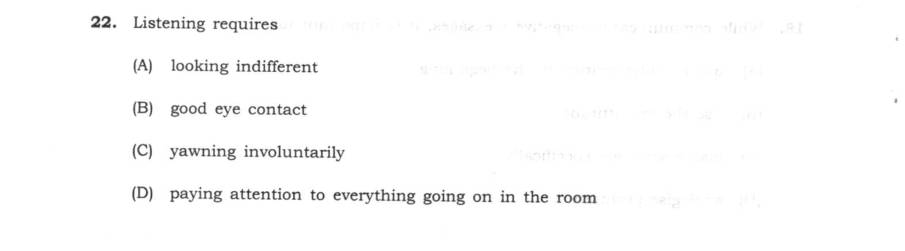
- A looking indifferent
- B good eye contact
- C yawning involuntarily
- D paying attention to everything going on in the room
Show answer
Answer: (B) good eye contact
Official provisional answer key
-
While communicating in a group, you should
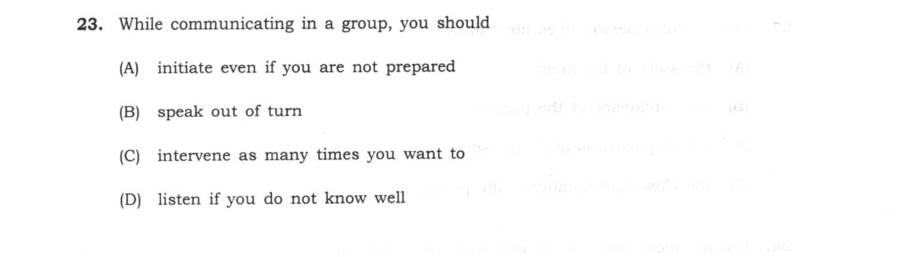
- A initiate even if you are not prepared
- B speak out of turn
- C intervene as many times you want to
- D listen if you do not know well
Show answer
Answer: (D) listen if you do not know well
Official provisional answer key
-
Feedback is crucial as it ensures
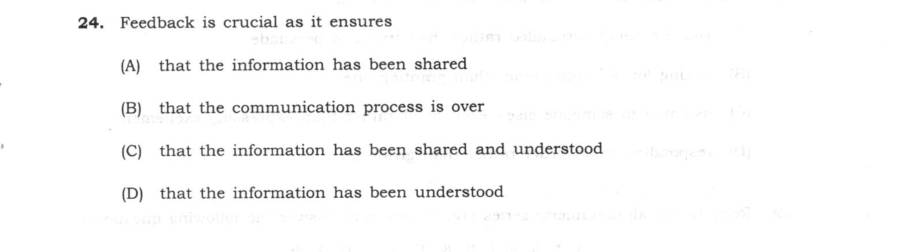
- A that the information has been shared
- B that the communication process is over
- C that the information has been shared and understood
- D that the information has been understood
Show answer
Answer: (C) that the information has been shared and understood
Official provisional answer key
-
Perceptions are largely not
biased
negative
dependent on the person's knowledge, attitude and beliefs
the truth and how things exist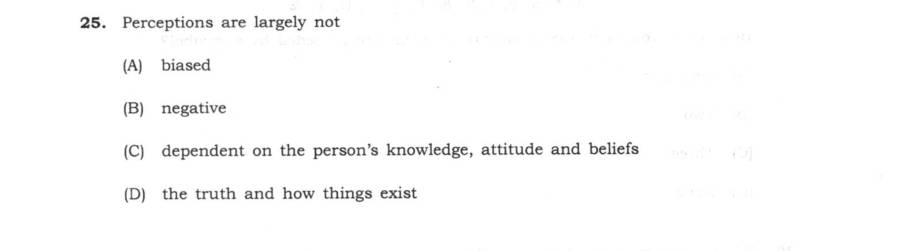
Show answer
Answer: (D)
Official provisional answer key
-
A barrier in communication can be
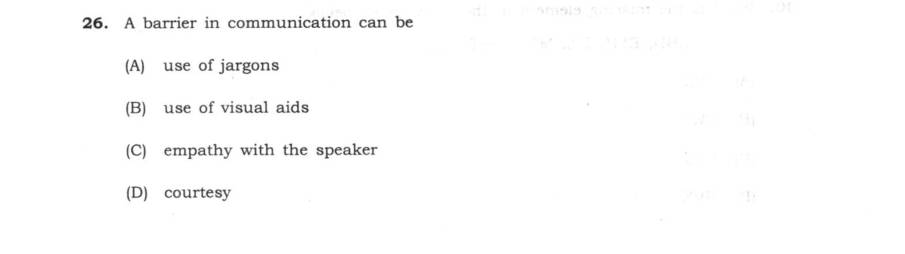
- A use of jargons
- B use of visual aids
- C empathy with the speaker
- D courtesy
Show answer
Answer: (A) use of jargons
Official provisional answer key
-
The gait of a person does not convey
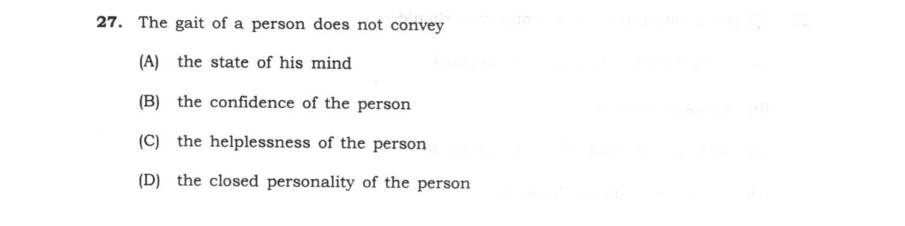
- A the state of his mind
- B the confidence of the person
- C the helplessness of the person
- D the closed personality of the person
Show answer
Answer: (D) the closed personality of the person
Official provisional answer key
-
You are most likely to pat and shake hands when
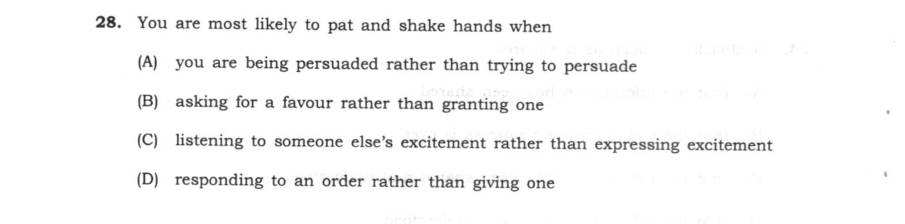
- A you are being persuaded rather than trying to persuade
- B asking for a favour rather than granting one
- C listening to someone else's excitement rather than expressing excitement
- D responding to an order rather than giving one
Show answer
Answer: (B) asking for a favour rather than granting one
Official provisional answer key
Sources and corrections
From the open AxomRank PYQ dataset. Each question links back to its paper. See how to report a correction.