ADRE 2024 Grade III Graduate Question Paper with Answers (150 Questions)
Grade III Paper IV: Graduate. Every question is typed out below with its four options. Tap Show answer to check yourself, so you can use the page as a practice test.
About this paper
| Exam | ADRE (Assam Direct Recruitment Exam) |
|---|---|
| Year | 2024 |
| Conducted by | SLRC Assam |
| Questions | 150 |
| Original PDF | Question booklet (PDF) |
Where the answers come from
- Official final answer key: 150 questions
Subject-wise questions
| Subject | Questions | Share |
|---|---|---|
| English | 35 | 23% |
| Mathematics | 33 | 22% |
| General Awareness | 24 | 16% |
| Reasoning | 17 | 11% |
| Art & Culture | 14 | 9% |
| Geography | 13 | 9% |
| History | 6 | 4% |
| Polity | 3 | 2% |
| Economy | 3 | 2% |
| Science | 2 | 1% |
All 150 questions with answers
-
Which of the following countries does not exist presently ?
- A Switzerland
- B Czechoslovakia
- C Germany
- D Poland
Show answer
Answer: (B) Czechoslovakia
Official final answer key
-
Which state is the official sponsor of Hockey team of India ?
- A Punjab
- B Odisha
- C Haryana
- D Uttar Pradesh
Show answer
Answer: (B) Odisha
Official final answer key
-
What would replace # in the sets ?
{5, 120, 3}, {9, 630, 5}, {9, 810, #}- A 8
- B 7
- C 6
- D 4
Show answer
Answer: (C) 6
Official final answer key
-
What should correctly replace @ in the grid ?
13 450 30
21 @ 8
32 782 23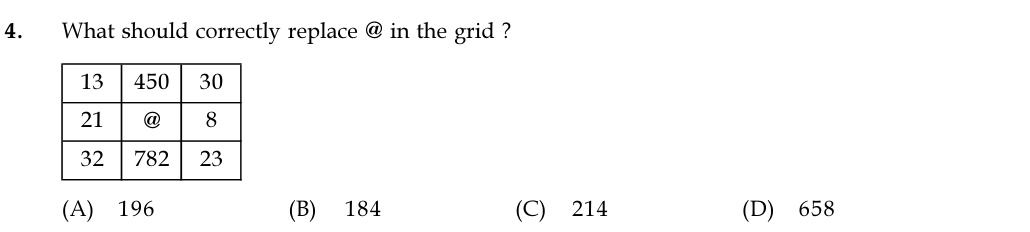
- A 196
- B 184
- C 214
- D 658
Show answer
Answer: (B) 184
Official final answer key
-
From the Constitution of which country, the concept of residual powers in the Constitution of
India has been borrowed ?- A Belgium
- B Canada
- C France
- D Switzerland
Show answer
Answer: (B) Canada
Official final answer key
-
Who amongst the following is a wrestler ?
- A Baichung Bhutia
- B Lovlina Borgohain
- C Sushil Kumar
- D Karnam Malleshwari
Show answer
Answer: (C) Sushil Kumar
Official final answer key
-
Which of the following travellers had visited Kamrupa Kingdom ?
- A Fa Hien
- B Hiuen Tsang
- C Al Biruni
- D Marco Polo
Show answer
Answer: (B) Hiuen Tsang
Official final answer key
-
Identify the water reflection of the given figure.
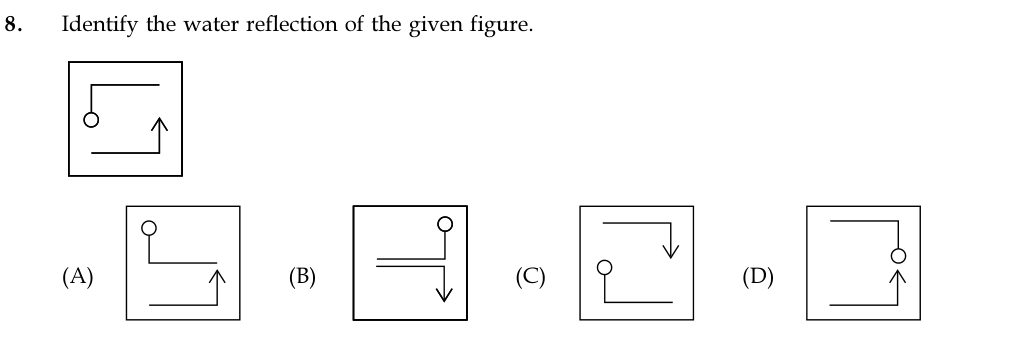
Show answer
Answer: (C)
Official final answer key
-
The remainder when −46 is divided by 3 is :
- A −2
- B −1
- C 1
- D 2
Show answer
Answer: (D) 2
Official final answer key
-
The product of the mean and the median of the data set 1, 0, −5, 3, 0, −2, 4, 6, −4, 1, 2 is :
5 7 6 9
- A 12
- B 13
- C 11
- D 14
Show answer
Answer: (C) 11
Official final answer key
-
(16 + 16)²
16% of is :
16 × 16
- A 0.16
- B 0.32
- C 0.48
- D 0.64
Show answer
Answer: (D) 0.64
Official final answer key
-
Name the Mughal emperor whose army was defeated at the Battle of Saraighat.
- A Aurangzeb
- B Shah Jahan
- C Babur
- D Humayun
Show answer
Answer: (A) Aurangzeb
Official final answer key
-
Which of the following is NOT an Assamese novel ?
- A Adha Lekha Dostabez
- B Deu Langkhui
- C Xekh Pristha
- D Ontorip
Show answer
Answer: All options are accepted
Official key 'G': question found ambiguous, all options treated as correct
Official final answer key
-
Three numbers A, B and C are such that the HCF of A and B is same as the HCF of B and C. If the
LCM of A and B is three times the LCM of B and C, then the ratio C : A is :- A 1 : 9
- B 3 : 1
- C 9 : 1
- D 1 : 3
Show answer
Answer: (D) 1 : 3
Official final answer key
-
Who amongst the following has been awarded the Gyanpith Award in 2024 ?
- A Gulzar
- B Arup Kumar Dutta
- C Ratan Thiyem
- D Nilamani Phukan
Show answer
Answer: (A) Gulzar
Official final answer key
-
Yesterday just after sunrise Rajiv met Samir and was talking, when Rajiv noticed that Samir’s
shadow was seen towards the right of Rajiv. Which direction was Samir facing ?- A South
- B East
- C West
- D North
Show answer
Answer: (D) North
Official final answer key
-
Which Hindi poet is known for “Madhushala” and “Agneepath” ?
- A Ramdhari Singh Dinkar
- B Haribansh Rai Bachchan
- C Sumitranandan Pant
- D Maithili Sharan Gupt
Show answer
Answer: (B) Haribansh Rai Bachchan
Official final answer key
-
The product of two binary numbers 101 and 10 expressed in binary numbers is :
- A 1001
- B 1010
- C 1100
- D 1110
Show answer
Answer: (B) 1010
Official final answer key
-
Kalbelia is a folk dance form of which region of India ?
- A Kumaon region
- B Chota Nagpur region
- C Konkan region
- D Thar desert region
Show answer
Answer: (D) Thar desert region
Official final answer key
-
The average of 9 observations was 9, that of the first 5 being 10 and that of the last 5 being 8. What
was the fifth observation ?- A 8
- B 7
- C 9
- D 10
Show answer
Answer: (C) 9
Official final answer key
-
Which of the following colours is NOT seen on the Olympic flag ?
- A Green
- B Yellow
- C Orange
- D Black
Show answer
Answer: (C) Orange
Official final answer key
-
A metal sphere of radius 24 cm is cut into 8 equal pieces and one piece is melted in the form of a
sphere. The radius of the new sphere is :- A 12 cm
- B 8 cm
- C 15 cm
- D 10 cm
Show answer
Answer: (A) 12 cm
Official final answer key
-
In Assamese literature, who is known as the “Dhwani Kabi” ?
- A Binanda Chandra Barua
- B Ananda Chandra Agarwalla
- C Mahendranath Deka Phukan
- D Mafijuddin Ahmed Hazarika
Show answer
Answer: (A) Binanda Chandra Barua
Official final answer key
-
Rearrange the following components to form a correct sentence.
(i) where no man had
(ii) here we are strolling
(iii) ever set foot before
(iv) on the surface of the moon- A (i) - (ii) - (iii) - (iv)
- B (ii) - (iii) - (i) - (iv)
- C (ii) - (iv) - (i) - (iii)
- D (i) - (iv) - (iii) - (ii)
Show answer
Answer: (C) (ii) - (iv) - (i) - (iii)
Official final answer key
-
Which country are Kira and Gho the national dress of ?
- A Nepal
- B Cambodia
- C Bhutan
- D Vietnam
Show answer
Answer: (C) Bhutan
Official final answer key
-
Which of the following is NOT a non-metallic mineral ?
- A Silica
- B Limestone
- C Bauxite
- D Dolomite
Show answer
Answer: (C) Bauxite
Official final answer key
-
Which of the following is correct ?
- A Volcano cannot exist underwater.
- B Sea does not have any water current.
- C Almost 70% of earth surface is filled with water.
- D Land mass is almost half of earth’s surface.
Show answer
Answer: (C) Almost 70% of earth surface is filled with water.
Official final answer key
-
Which present region of India did King Lalitaditya (Muktapida) have his empire in ?
- A Northeast India
- B Kashmir region
- C The Kutch area
- D The Deccan region
Show answer
Answer: (B) Kashmir region
Official final answer key
-
Identify the pair which does not follow the common pattern.
- A 6 : OXYGEN
- B 5 : ARGON
- C 7 : CADMIUM
- D 8 : BROMINE
Show answer
Answer: (D) 8 : BROMINE
Official final answer key
-
Who amongst the following has not won the Jnanpith Award ?
- A Birendranath Dutta
- B Nilamani Phukan
- C Hiren Bhattacharyya
- D Mamoni Roisom Goswami
Show answer
Answer: (A) Birendranath Dutta · (C) Hiren Bhattacharyya
Official key accepts multiple options: A,C
Official final answer key
-
1 + 2 2 + 3 3
Find the value of 1 + .
2 + 6 3 + 4 2
1 1 3 3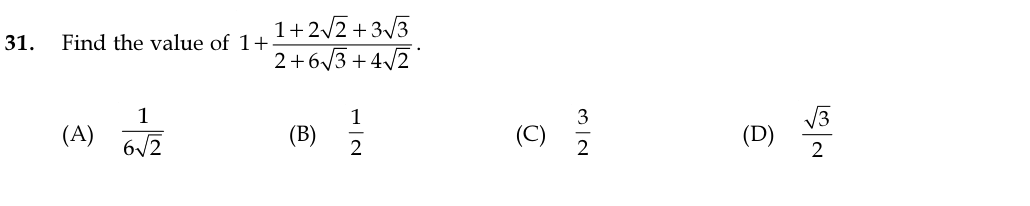
- A 6 2
- B 2
- C 2
Show answer
Answer: (C) 2
Official final answer key
-
Which Assamese movie is based on Bhabendra Nath Saikia’s novel, Ontorip ?
- A Pratidhwani
- B Krishnachura
- C Barua’r Xonxaar
- D Agnisnan
Show answer
Answer: (D) Agnisnan
Official final answer key
-
(1% of 1)+(2% of 2)+(3% of 3)=?
- A 0.06
- B 0.6
- C 0.41
- D 0.14
Show answer
Answer: (D) 0.14
Official final answer key
-
A curved waterbody formed when a river changes its course to take a shorter path is known as :
- A Archipelago
- B Isthmus
- C Oxbow lake
- D Delta
Show answer
Answer: (C) Oxbow lake
Official final answer key
-
A cone has a base radius of 4 cm and height of 9 cm. The volume of the cone is :
- A 36π cm³
- B 48π cm³
- C 13π cm³
- D 24π cm³
Show answer
Answer: (B) 48π cm³
Official final answer key
-
In which city is Dalal Street located ?
- A Kolkata
- B Chennai
- C Hyderabad
- D Mumbai
Show answer
Answer: (D) Mumbai
Official final answer key
-
Simplify : 51 + 134 + 5 42 + 16 + 9

- A 15
- B 12
- C 8
- D 16
Show answer
Answer: (C) 8
Official final answer key
-
a 4 6a + 2b
If = then the value of is :
b 3 4a − 2b
- A 3
- B 4
- C 5
- D 6
Show answer
Answer: (A) 3
Official final answer key
-
If cosθ=, then the value of sinθ is :
5 12 12 13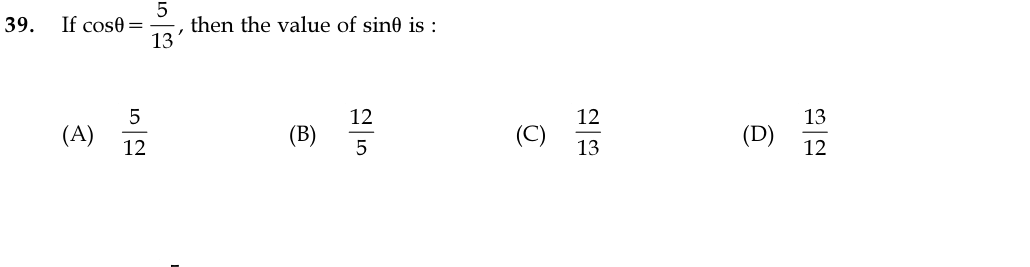
- A 12
- B 5
- C 13
- D 12
Show answer
Answer: (C) 13
Official final answer key
-
As per the diagram, which zone represents married nurse who should be sent for training ?
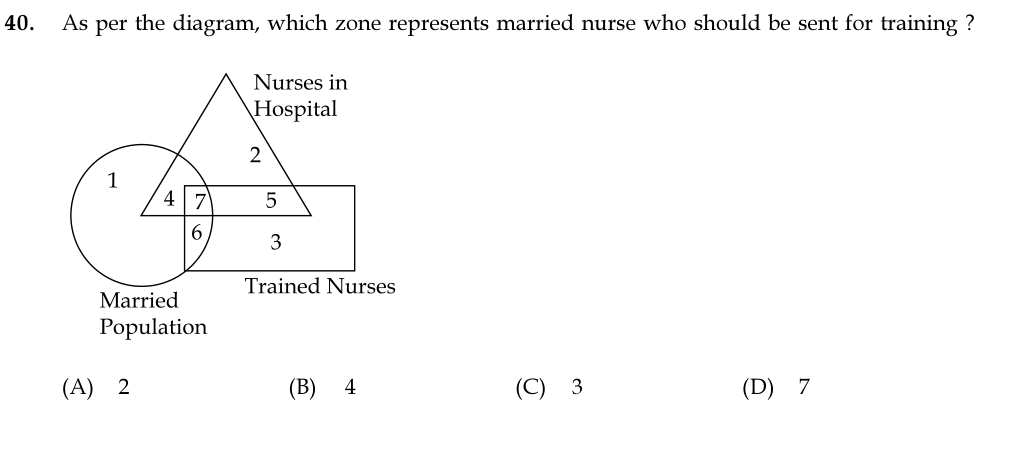
- A 2
- B 4
- C 3
- D 7
Show answer
Answer: (B) 4
Official final answer key
-
The value of 0.09 + 1.69 is :

- A 1.78
- B 1.6
- C 1.33
- D 1.5
Show answer
Answer: (B) 1.6
Official final answer key
-
Identify the sport related to (Major) Dhyan Chand.
- A Football
- B Wrestling
- C Boxing
- D Hockey
Show answer
Answer: (D) Hockey
Official final answer key
-
Identify the incorrect term in the series.
{5, 8, 13, 20, 31, 40, 53}- A 13
- B 31
- C 20
- D 40
Show answer
Answer: (B) 31
Official final answer key
-
A sector of angle 308 is cut out from a circular disc of radius 6 cm. The area of the cut sector in cm²
units is :- A 3π
- B 4π
- C 5π
- D 6π
Show answer
Answer: (A) 3π
Official final answer key
-
Which of the following countries is the farthest from Andaman and Nicobar Islands ?
- A Myanmar
- B Indonesia
- C Vietnam
- D Malaysia
Show answer
Answer: (C) Vietnam
Official final answer key
-
Which State is the Dandiya Raas a popular folk dance of ?
- A Rajasthan
- B Gujarat
- C Odisha
- D Maharashtra
Show answer
Answer: (B) Gujarat
Official final answer key
-
A person moves from P to Q in a semi-circular path and then comes back to P by the shortest route,
which is 4 km. The total path covered by the person in the entire journey is :- A (4π+2) km
- B (2π+4) km
- C (π+2) km
- D (2π+2) km
Show answer
Answer: (B) (2π+4) km
Official final answer key
-
Sagor Dekhisa, a collection of Assamese poems was written by :
- A Devakanta Barua
- B Navakanta Barua
- C Banikanta Kakati
- D Rajanikanta Bordoloi
Show answer
Answer: (A) Devakanta Barua
Official final answer key
-
The longest diagonal that can be found in a regular cube of side 1 cm is :

- A 2 cm
- B 2 cm
- C 3 cm
- D 3 cm
Show answer
Answer: (D) 3 cm
Official final answer key
-
Which of the following is different from the rest ?
- A Samaveda
- B Rigveda
- C Yajurveda
- D Ayurveda
Show answer
Answer: (D) Ayurveda
Official final answer key
-
Two bells A and B are rung such that the bell A rings at every 30 minutes and the bell B rings at
every 25 minutes. If both the bells start ringing simultaneously at 6 am, then the very next
simultaneous ring will be at the time :- A 8 : 00 am
- B 8 : 30 am
- C 9 : 00 am
- D 9 : 30 am
Show answer
Answer: (B) 8 : 30 am
Official final answer key
-
A + B means A is to the North of B; A%B means A is to the East of B; A−B means A is to the West
of B; then in (Neptune % Saturn + Uranus − Jupiter) Uranus is in which direction with respect to
Neptune ?- A South - West
- B North - East
- C North - West
- D South - East
Show answer
Answer: (A) South - West
Official final answer key
-
Who played the title role in the 1969 version of Dr. Bezbaruah ?
- A Nipon Goswami
- B Biju Phukan
- C Dwipen Baruah
- D Brojen Baruah
Show answer
Answer: (D) Brojen Baruah
Official final answer key
-
Which word would substitute the marked portion - “The Zebra stripes on roads are for crossing by
people who are walking.” ?
- A Pedestrian
- B Pediatrician
- C Pollination
- D Postulation
Show answer
Answer: (A) Pedestrian
Official final answer key
-
Which of the following is a State of the United States of America ?
- A Hawai
- B Fiji
- C Papua New Guinea
- D Solomon Island
Show answer
Answer: (A) Hawai
Official final answer key
-
Fill in the blank.
January was the __________ month last year.- A Cold
- B Colder
- C Coldest
- D Cool
Show answer
Answer: (C) Coldest
Official final answer key
-
Which two countries does the Gobi Desert touch ?
- A Sudan and Egypt
- B Saudi Arabia and Iraq
- C Turkmenistan and Uzbekistan
- D China and Mongolia
Show answer
Answer: (D) China and Mongolia
Official final answer key
-
The population of a town increases at the rate of 10% every year. If the present population of the
town is 10,000, then after 3 years the population of the town would be :- A 13,310
- B 15,310
- C 13,510
- D 13,000
Show answer
Answer: (A) 13,310
Official final answer key
-
Which sport did P.T. Usha play ?
- A Athletics
- B Badminton
- C Table Tennis
- D Cricket
Show answer
Answer: (A) Athletics
Official final answer key
-
Which word would you replace for the underlined word to reverse the meaning of the
sentence ?
“Food in this hotel is worse than that provided at our hostel.”
- A good
- B better
- C best
- D excellent
Show answer
Answer: (B) better
Official final answer key
-
The addition of two binary numbers 11 and 10, when represented in binary system is :
- A 101
- B 110
- C 010
- D 111
Show answer
Answer: (A) 101
Official final answer key
-
Which of the following is best depicted by the diagram ?
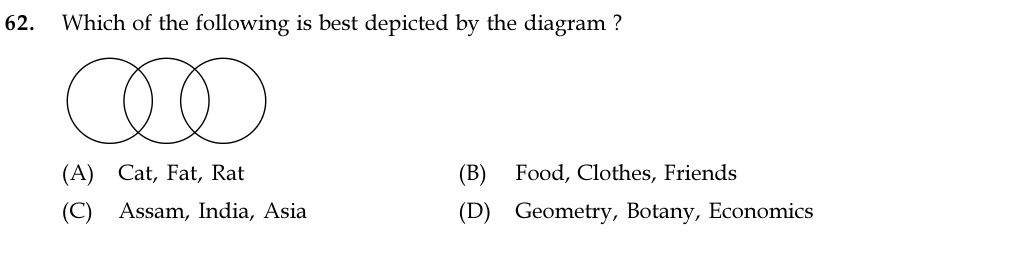
- A Cat, Fat, Rat
- B Food, Clothes, Friends
- C Assam, India, Asia
- D Geometry, Botany, Economics
Show answer
Answer: (A) Cat, Fat, Rat
Official final answer key
-
On which island hillock is the Umananda Temple situated ?
- A Bhasmachal
- B Sandhyachal
- C Nilachal
- D Chitrachal
Show answer
Answer: (A) Bhasmachal
Official final answer key
-
Identify the proper noun in the following list.
- A High mountain
- B Black car
- C Deep sea
- D Pacific Ocean
Show answer
Answer: (D) Pacific Ocean
Official final answer key
-
Which of the following is a part of Mahabharata ?
- A Upanishads
- B Puranas
- C Vedas
- D Gita
Show answer
Answer: (D) Gita
Official final answer key
-
The primary raw material used by the Assam Bio Refinery Private Limited is :
- A Bamboo
- B Water Hyacinth
- C Sugarcane waste
- D Banana plants
Show answer
Answer: (A) Bamboo
Official final answer key
-
The least natural number which when divided by 2 gives remainder 1, when divided by 3 gives
remainder 2 and when divided by 4 gives remainder 3, is :- A 23
- B 17
- C 31
- D 11
Show answer
Answer: (D) 11
Official final answer key
-
Which of the following is an Assamese jewellery item worn in the ears ?
- A Golpata
- B Horinsokua
- C Jonbiri
- D Thuriya
Show answer
Answer: (D) Thuriya
Official final answer key
-
A political and legal process by which a legislative body or other legally constituted tribunal initiates
charges against a public official for misconduct is termed as :- A Impeachment
- B Re-election
- C Enforcement
- D Enactment
Show answer
Answer: (A) Impeachment
Official final answer key
-
The three angles of a triangle are in the ratio of 1 : 3 : 5. The largest angle of the triangle is :
- A 708
- B 908
- C 1208
- D 1008
Show answer
Answer: (D) 1008
Official final answer key
-
Toyota has its headquarters in :
- A China
- B South Korea
- C Singapore
- D Japan
Show answer
Answer: (D) Japan
Official final answer key
-
If Pn represents the product of the natural numbers from 1 to n, then P₁+P₂+P₃+P₄ is :
- A 23
- B 33
- C 37
- D 31
Show answer
Answer: (B) 33
Official final answer key
-
Which country controls the Suez Canal ?
- A Turkey
- B Israel
- C Egypt
- D France
Show answer
Answer: (C) Egypt
Official final answer key
-
Which of the following does saliva in our mouth help to breakdown ?
- A Starch
- B Protein
- C Vitamins
- D Fat
Show answer
Answer: (A) Starch
Official final answer key
-
Which Continents does the Mediterranean Sea lie between ?
- A Asia and Europe
- B Europe and Africa
- C North America and Africa
- D South America and Africa
Show answer
Answer: All options are accepted
Official key 'G': question found ambiguous, all options treated as correct
Official final answer key
-
If SATURN is coded as TZUTSM, then how will URANUS be coded by same plan ?
- A TSZOTT
- B VQBMVR
- C VQBOUS
- D VSBOVT
Show answer
Answer: (B) VQBMVR
Official final answer key
-
Which of the following is a collective noun for ships ?
- A pack
- B herd
- C swarm
- D fleet
Show answer
Answer: (D) fleet
Official final answer key
-
A tank can be filled by 6 pipes in 80 minutes. How long will it take to fill the tank by 8 pipes ?
- A 45 min
- B 60 min
- C 48 min
- D 70 min
Show answer
Answer: (B) 60 min
Official final answer key
-
Grandmother was cooking at a picnic, attended by her son and daughter-in-law, with their four
sons and their wives and one son and two daughters to each of the sons. How many ladies were
there at the picnic ?- A 8
- B 12
- C 14
- D 10
Show answer
Answer: (C) 14
Official final answer key
-
“The invigilator could not detect that the two boys were exchanging notes under his nose.” What
is the meaning of the marked portion ?
- A With due permission
- B Right in front
- C With active help
- D In small pieces of paper
Show answer
Answer: (B) Right in front
Official final answer key
-
For which sport was T. Ao the captain of Indian team ?
- A Badminton
- B Hockey
- C Football
- D Volleyball
Show answer
Answer: (C) Football
Official final answer key
-
72 toffees were distributed to some boys in a group. Each boy in the group got twice as many of
the toffees as the number of boys. The number of boys in the group is :- A 6
- B 7
- C 8
- D 9
Show answer
Answer: (A) 6
Official final answer key
-
Identify the correctly spelt word.
- A Conservation
- B Consarvation
- C Conservetion
- D Conservasion
Show answer
Answer: (A) Conservation
Official final answer key
-
The Civil wars termed as the Wars of the Roses was fought for which throne ?
- A British throne
- B French throne
- C Russian throne
- D Spanish throne
Show answer
Answer: (A) British throne
Official final answer key
-
Which of the following statements is correct ?
- A Sikkim shares border with Assam.
- B Sikkim lies towards the west of Assam.
- C Assam shares borders with Sikkim and Meghalaya.
- D Bangladesh and Sikkim touch the borders of Assam.
Show answer
Answer: (B) Sikkim lies towards the west of Assam.
Official final answer key
-
Which country did the martial art Taekwondo originate in ?
- A Thailand
- B China
- C Korea
- D Vietnam
Show answer
Answer: (C) Korea
Official final answer key
-
Which of the following is incorrectly matched ?
- A Class I lever : Pliers
- B Class II lever : Nail cutter
- C Class III lever : Nutcracker
- D Class II lever : Bottle opener
Show answer
Answer: (C) Class III lever : Nutcracker
Official final answer key
-
As on 1st of January, 2024, who is the President of Ukraine ?
- A Joe Biden
- B Vladimir Putin
- C Valerii Zaluzhn
- D Volodymyr Zelenskyy
Show answer
Answer: (D) Volodymyr Zelenskyy
Official final answer key
-
The Padmanabhaswami Temple is in which city ?
- A Bengaluru
- B Chennai
- C Madurai
- D Thiruvananthapuram
Show answer
Answer: (D) Thiruvananthapuram
Official final answer key
-
Who has won the highest number of gold medals in the Olympic Games ?
- A Mark Spitz
- B Michael Phelps
- C Jesse Owens
- D Paavo Nurmi
Show answer
Answer: (B) Michael Phelps
Official final answer key
-
To which emperor was Chanakya the royal advisor ?
- A Samudragupta
- B Ashoka
- C Chandragupta Maurya
- D Skandagupta
Show answer
Answer: (C) Chandragupta Maurya
Official final answer key
-
Which of the following countries does the Mediterrean Sea not touch ?
- A Spain
- B Portugal
- C Lebanon
- D France
Show answer
Answer: (B) Portugal
Official final answer key
-
Consider the five numbers given here :
(i) 736 (ii) 269 (iii) 958 (iv) 219 (v) 793
Arrange the digits of each number in descending order. What would be the difference between
the highest number and the lowest one ?
- A 222
- B 716
- C 618
- D 12
Show answer
Answer: (A) 222
Official final answer key
-
Near which place, a statue of Jongal Balahu has been erected ?
- A Raha
- B Dibrugarh
- C Dhuburi
- D Karimganj
Show answer
Answer: (A) Raha
Official final answer key
-
Who of the following is NOT a Lawn Tennis player ?
- A Leander Paes
- B Vijay Amritraj
- C Mahesh Bhupathi
- D Pullela Gopichand
Show answer
Answer: (D) Pullela Gopichand
Official final answer key
-
Which of the following is a stringed musical instrument of Assam ?
- A Dogor
- B Xutuli
- C Kaaliya
- D Tokari
Show answer
Answer: (D) Tokari
Official final answer key
-
A six-faced die is made in such a way that the sum of the dots on the opposite faces are always
equal. Which of the following pairs is not opposite facing pair of the die ?- A 1, 4
- B 2, 5
- C 1, 6
- D 3, 4
Show answer
Answer: (A) 1, 4
Official final answer key
-
Identify the correct definition of verb.
- A Naming words
- B Things description words
- C Action words
- D Joining words
Show answer
Answer: (C) Action words
Official final answer key
-
Which of the following is an example of Indirect Tax of India ?
- A Gift Tax
- B Income Tax
- C Goods and Services Tax
- D Capital Gains Tax
Show answer
Answer: (C) Goods and Services Tax
Official final answer key
-
Mark the correct word as synonym of “affluent”.
- A Meeting
- B Discussion
- C Wealthy
- D Poverty
Show answer
Answer: (C) Wealthy
Official final answer key
-
Who wrote Pride and Prejudice ?
- A Jane Austen
- B Barbara Cartland
- C Agatha Christie
- D Virginia Woolfe
Show answer
Answer: (A) Jane Austen
Official final answer key
-
If sinθ=cosθ then the value of 1+tanθ is :

- A 1
- B 2
- C 0
- D 2
Show answer
Answer: (B) 2
Official final answer key
-
The product of the roots of the quadratic equation 2x²−5x+6=0 is :
- A 2
- B 3
- C 5
- D 6
Show answer
Answer: (B) 3
Official final answer key
-
Which is the odd one out of the list ?
- A Chapters
- B Preface
- C Index
- D Book
Show answer
Answer: (D) Book
Official final answer key
-
At a class test for 50 students, the average score was found to be 45.5 out of 100. Upon checking,
it was found that an incorrect data-entry had occurred where 85 was incorrectly entered as 58.
What should be the correct class average ?- A 54.50
- B 46.04
- C 46.40
- D 55.40
Show answer
Answer: (B) 46.04
Official final answer key
-
Siachen in Ladakh is an example of :
- A Cold desert
- B Glacier
- C Plateau
- D Snow mountain
Show answer
Answer: (B) Glacier
Official final answer key
-
Which of the following mountain ranges is in Jammu and Kashmir region ?
- A Pir Panjal range
- B Satpura range
- C Dhauladhar range
- D Mishimi Hills
Show answer
Answer: (A) Pir Panjal range
Official final answer key
-
The sum of the roots of the quadratic equation 2x²−5x+3=0 is :
3 5
- A 2
- B 2
- C 2
- D 5
Show answer
Answer: (C) 2
Official final answer key
-
Who or What is Doraemon ?
- A A river in Brazil
- B A Hollywood actor
- C A type of aircraft
- D A cartoon character
Show answer
Answer: (D) A cartoon character
Official final answer key
-
In which sport did Monalisa Baruah (Mehta) and Tridib Duarah represent Assam ?
- A Badminton
- B Volleyball
- C Taekwondo
- D Table Tennis
Show answer
Answer: (D) Table Tennis
Official final answer key
-
A person borrows a sum of ` 1,00,000 at a simple interest of 6% per annum for 2 years and invests
the amount at a compound interest of 6% per annum for 2 years. After returning the borrowed
amount with interest, the person earns a profit of :- A ` 360
- B ` 120
- C ` 480
- D ` 240
Show answer
Answer: (A) ` 360
Official final answer key
-
Identify the correct mirror image of the figure.
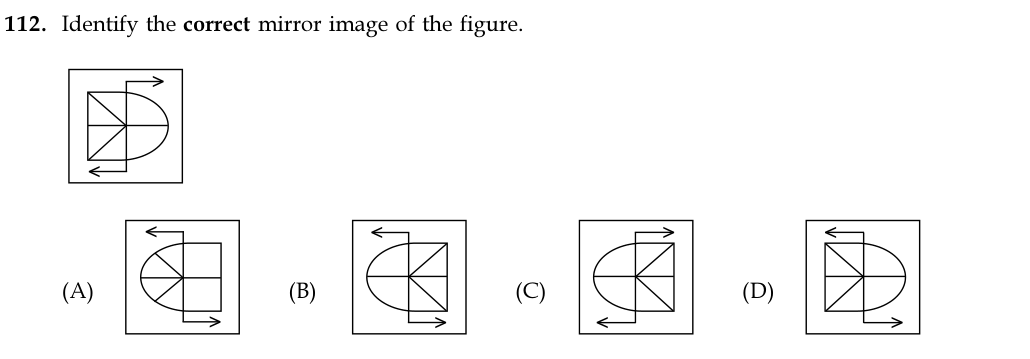
Show answer
Answer: (B)
Official final answer key
-
Which of the following is an award exclusively for music industry ?
- A The Oscars
- B Emmy Awards
- C Golden Globe
- D Grammy Awards
Show answer
Answer: (D) Grammy Awards
Official final answer key
-
A person purchases x number of items at the rate of ` x per item. The shop-keeper gives him a total
discount of ` x after which he pays ` 156. The cost per item after the discount is :- A ` 13
- B ` 12
- C ` 16
- D ` 14
Show answer
Answer: (B) ` 12
Official final answer key
-
Which type of Democracy is presently being practised in India ?
- A Direct Democracy
- B Representative Democracy
- C Social Democracy
- D Totalitarian Democracy
Show answer
Answer: (B) Representative Democracy
Official final answer key
-
225 − 25 − 16 =
729 144 81 ?
− 7 − 20 − 5 − 11
- A 12
- B 27
- C 9
- D 36
Show answer
Answer: (D) 36
Official final answer key
-
Which of the following is incorrect in regards of the ICC Men’s ODI Cricket World Cup ?
- A India has won the Cup twice.
- B Australia has won the maximum number of times.
- C England won the Cup in the first tournament.
- D Bangladesh has never won the Cup.
Show answer
Answer: (C) England won the Cup in the first tournament.
Official final answer key
-
In which country was Christopher Columbus born ?
- A Spain
- B England
- C Portugal
- D Italy
Show answer
Answer: (D) Italy
Official final answer key
-
How many times has Brazil won the Football World Cup ?
- A Three
- B Five
- C Four
- D Seven
Show answer
Answer: (B) Five
Official final answer key
-
Which of the following diagrams best represents Writers, Teachers and Musicians of our society ?
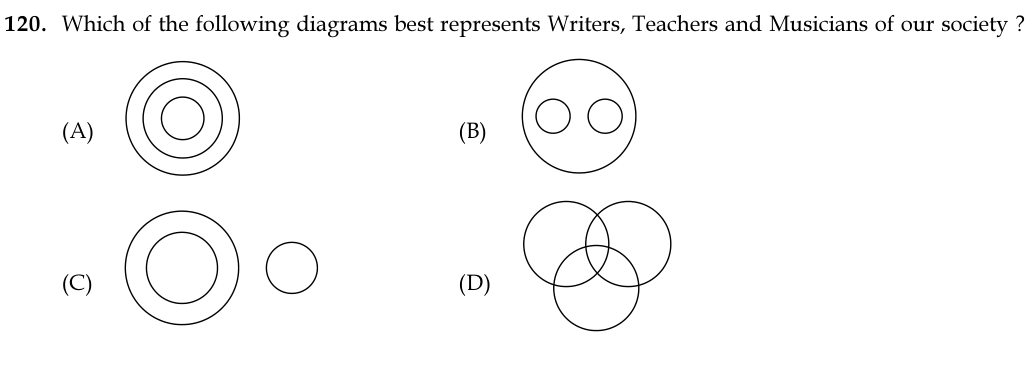
Show answer
Answer: (D)
Official final answer key
-
Who has been honoured with Assam Baibhav in 2024 ?
- A Ratan Tata
- B Ranjan Gogoi
- C Tapan Saikia
- D Ranjit Shekhar Mooshahary
Show answer
Answer: (B) Ranjan Gogoi
Official final answer key
-
A geometric figure has two pairs of parallel lines, intersecting at right angle. One pair is of length
8 cm each, and the other pair is of 6 cm. If the longer pair size is increased by 2 cm each, while the
shorter pair is reduced by 2 cm, which of the following statements is correct ?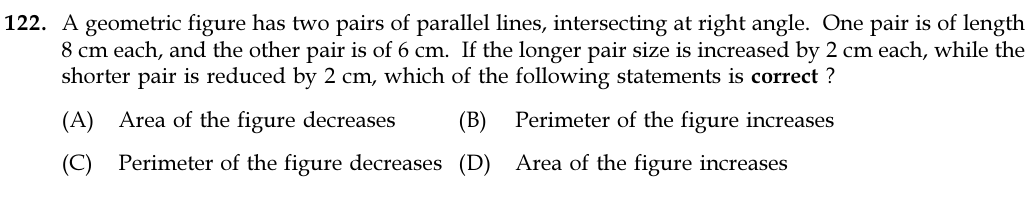
- A Area of the figure decreases
- B Perimeter of the figure increases
- C Perimeter of the figure decreases
- D Area of the figure increases
Show answer
Answer: (A) Area of the figure decreases
Official final answer key
-
Which of the following places does not host IPL matches ?
- A Mumbai
- B Dharamshala
- C Patna
- D Hyderabad
Show answer
Answer: (C) Patna
Official final answer key
-
Who is the Director of the movie “Village Rockstars” ?
- A Rima Das
- B Hima Das
- C Munin Das
- D Queen Das
Show answer
Answer: (A) Rima Das
Official final answer key
-
Apart from Jaipur, which was the home ground of Rajasthan Royals during IPL 2023 ?
- A Guwahati
- B Dharamshala
- C Bhubaneshwar
- D Panaji
Show answer
Answer: (A) Guwahati
Official final answer key
-
Previous climbers had cut steps in the ice.
- A Steps had been cut in the ice
- B Steps were cut in the ice
- C Climbers cut steps in the ice
- D Steps cut in the ice by climbers
Show answer
Answer: (A) Steps had been cut in the ice
Official final answer key
-
No one can do anything unless someone gives us more information.
- A Nothing can be done without giving information.
- B Nothing can be done unless we are given more information.
- C Nothing can be done unless someone gives more information.
- D Nothing can be done without information.
Show answer
Answer: (B) Nothing can be done unless we are given more information.
Official final answer key
-
Which word from the following is similar to beckon ?
- A light
- B beg
- C motion
- D hear
Show answer
Answer: (C) motion
Official final answer key
-
Which of these words is closest in meaning to the word kin ?
- A exult
- B twist
- C friend
- D relative
Show answer
Answer: (D) relative
Official final answer key
-
What would be the synonym for the word educe ?
- A demand
- B elicit
- C ideal
- D unlawful
Show answer
Answer: (B) elicit
Official final answer key
-
Choose the sentence that correctly communicates the meaning in the following sentence.
- A Barua was usually able to catch the six thirty-five train from Guwahati
- B Barua was usually able to catch a six thirty-five train from Guwahati
- C Barua was usually able to catch on six thirty-five train from Guwahati
- D Barua was usually able to latch the six thirty-five train from Guwahati
Show answer
Answer: (A) Barua was usually able to catch the six thirty-five train from Guwahati
Official final answer key
-
Put the verb in brackets into the present perfect tense, and fill the space by repeating the auxiliary.
Where you (be)? —
I (be) to the dentist.- A have you had, I have been
- B have you gone, I have been
- C have you been, I’ve been
- D went, I went
Show answer
Answer: (C) have you been, I’ve been
Official final answer key
-
Read the following passage and answer the questions (133-136) that follow :
The Okapi, a forest mammal of Central Africa, has presented zoologists with a number of difficult
questions since they first learned of its existence in 1900. The first was how to classify it. Because it was
horselike in dimension, and bore patches of striped hide similar to a zebra’s (a relative of the horse),
zoologists first classified it as a member of the horse family. But further studies showed that, despite
Okapis’ coloration and short necks, their closest relatives were giraffes. The Okapi’s rightful place within
the giraffe family is confirmed by its skin-covered horns (in males), two-lobed canine teeth, and long
prehensile tongue.
The vital question concerned the size of the Okapi population. Because Okapis were infrequently
captured by hunters, some zoologists believed that they were rare; however, others theorized that their
habits simply kept them out of sight. It was not until 1985, when zoologists started tracking Okapis by
affixing collars equipped with radio transmitters to briefly captured specimens, that reliable information
about Okapi numbers and habits began to be collected. It turns out that while Okapis are not as rare as
some zoologists suspected, their population is concentrated in an extremely limited chain of forestland
in north-eastern Central Africa, surrounded by savanna.
One reason for their seeming scarcity is that their coloration allows Okapis to camouflage themselves
even at close range. Another is that Okapis do not travel in groups or with other large forest mammals,
and neither frequent open riverbanks nor forage at the borders of clearings, choosing instead to keep to
the forest interior. This is because Okapis, unlike any other animal in the Central African forest, subsist
entirely on leaves: more than one hundred species of plants have been identified as part of their diet, and
about twenty of these are preferred. Okapis never eat one plant to the exclusion of others; even where
preferred foliage is abundant, Okapis will leave much of it uneaten, choosing to move on and sample
other leaves. Because of this, and because of the distribution of their food, Okapis engage in individual
rather than congregated foraging.
But other questions about Okapi behaviour arise. Why, for example, do they prefer to remain
within forested areas when many of their favourite plants are found in the open border between forest
and savanna ? One possibility is that this is a defence against predators; another is that the Okapi was
pushed into the forest by competition with other large, hoofed animals, such as the bushbuck and bongo,
that specialize on the forest edges and graze them more efficiently. Another question is why Okapis are
absent from other nearby forest regions that would seem hospitable to them. Zoologists theorize that
Okapis are relics of an era when forestland was scarce and that they continue to respect those borders
even though available forestland has long since expanded.The word hide in the first paragraph means :
- A smell
- B evade
- C skin
- D land
Show answer
Answer: (C) skin
Official final answer key
-
Read the following passage and answer the questions (133-136) that follow :
The Okapi, a forest mammal of Central Africa, has presented zoologists with a number of difficult
questions since they first learned of its existence in 1900. The first was how to classify it. Because it was
horselike in dimension, and bore patches of striped hide similar to a zebra’s (a relative of the horse),
zoologists first classified it as a member of the horse family. But further studies showed that, despite
Okapis’ coloration and short necks, their closest relatives were giraffes. The Okapi’s rightful place within
the giraffe family is confirmed by its skin-covered horns (in males), two-lobed canine teeth, and long
prehensile tongue.
The vital question concerned the size of the Okapi population. Because Okapis were infrequently
captured by hunters, some zoologists believed that they were rare; however, others theorized that their
habits simply kept them out of sight. It was not until 1985, when zoologists started tracking Okapis by
affixing collars equipped with radio transmitters to briefly captured specimens, that reliable information
about Okapi numbers and habits began to be collected. It turns out that while Okapis are not as rare as
some zoologists suspected, their population is concentrated in an extremely limited chain of forestland
in north-eastern Central Africa, surrounded by savanna.
One reason for their seeming scarcity is that their coloration allows Okapis to camouflage themselves
even at close range. Another is that Okapis do not travel in groups or with other large forest mammals,
and neither frequent open riverbanks nor forage at the borders of clearings, choosing instead to keep to
the forest interior. This is because Okapis, unlike any other animal in the Central African forest, subsist
entirely on leaves: more than one hundred species of plants have been identified as part of their diet, and
about twenty of these are preferred. Okapis never eat one plant to the exclusion of others; even where
preferred foliage is abundant, Okapis will leave much of it uneaten, choosing to move on and sample
other leaves. Because of this, and because of the distribution of their food, Okapis engage in individual
rather than congregated foraging.
But other questions about Okapi behaviour arise. Why, for example, do they prefer to remain
within forested areas when many of their favourite plants are found in the open border between forest
and savanna ? One possibility is that this is a defence against predators; another is that the Okapi was
pushed into the forest by competition with other large, hoofed animals, such as the bushbuck and bongo,
that specialize on the forest edges and graze them more efficiently. Another question is why Okapis are
absent from other nearby forest regions that would seem hospitable to them. Zoologists theorize that
Okapis are relics of an era when forestland was scarce and that they continue to respect those borders
even though available forestland has long since expanded.The function of the third paragraph is to :
- A pose a question about Okapi behaviour
- B rebut a theory about Okapi behaviour
- C counter the assertion that Okapis are rare
- D explain why Okapis appeared to be rare
Show answer
Answer: (D) explain why Okapis appeared to be rare
Official final answer key
-
Read the following passage and answer the questions (133-136) that follow :
The Okapi, a forest mammal of Central Africa, has presented zoologists with a number of difficult
questions since they first learned of its existence in 1900. The first was how to classify it. Because it was
horselike in dimension, and bore patches of striped hide similar to a zebra’s (a relative of the horse),
zoologists first classified it as a member of the horse family. But further studies showed that, despite
Okapis’ coloration and short necks, their closest relatives were giraffes. The Okapi’s rightful place within
the giraffe family is confirmed by its skin-covered horns (in males), two-lobed canine teeth, and long
prehensile tongue.
The vital question concerned the size of the Okapi population. Because Okapis were infrequently
captured by hunters, some zoologists believed that they were rare; however, others theorized that their
habits simply kept them out of sight. It was not until 1985, when zoologists started tracking Okapis by
affixing collars equipped with radio transmitters to briefly captured specimens, that reliable information
about Okapi numbers and habits began to be collected. It turns out that while Okapis are not as rare as
some zoologists suspected, their population is concentrated in an extremely limited chain of forestland
in north-eastern Central Africa, surrounded by savanna.
One reason for their seeming scarcity is that their coloration allows Okapis to camouflage themselves
even at close range. Another is that Okapis do not travel in groups or with other large forest mammals,
and neither frequent open riverbanks nor forage at the borders of clearings, choosing instead to keep to
the forest interior. This is because Okapis, unlike any other animal in the Central African forest, subsist
entirely on leaves: more than one hundred species of plants have been identified as part of their diet, and
about twenty of these are preferred. Okapis never eat one plant to the exclusion of others; even where
preferred foliage is abundant, Okapis will leave much of it uneaten, choosing to move on and sample
other leaves. Because of this, and because of the distribution of their food, Okapis engage in individual
rather than congregated foraging.
But other questions about Okapi behaviour arise. Why, for example, do they prefer to remain
within forested areas when many of their favourite plants are found in the open border between forest
and savanna ? One possibility is that this is a defence against predators; another is that the Okapi was
pushed into the forest by competition with other large, hoofed animals, such as the bushbuck and bongo,
that specialize on the forest edges and graze them more efficiently. Another question is why Okapis are
absent from other nearby forest regions that would seem hospitable to them. Zoologists theorize that
Okapis are relics of an era when forestland was scarce and that they continue to respect those borders
even though available forestland has long since expanded.Okapis stay within the forest interior. The passage relates this to the __________ of the Okapi.
- A scarcity
- B mind
- C culture
- D size
Show answer
Answer: (A) scarcity
Official final answer key
-
Read the following passage and answer the questions (133-136) that follow :
The Okapi, a forest mammal of Central Africa, has presented zoologists with a number of difficult
questions since they first learned of its existence in 1900. The first was how to classify it. Because it was
horselike in dimension, and bore patches of striped hide similar to a zebra’s (a relative of the horse),
zoologists first classified it as a member of the horse family. But further studies showed that, despite
Okapis’ coloration and short necks, their closest relatives were giraffes. The Okapi’s rightful place within
the giraffe family is confirmed by its skin-covered horns (in males), two-lobed canine teeth, and long
prehensile tongue.
The vital question concerned the size of the Okapi population. Because Okapis were infrequently
captured by hunters, some zoologists believed that they were rare; however, others theorized that their
habits simply kept them out of sight. It was not until 1985, when zoologists started tracking Okapis by
affixing collars equipped with radio transmitters to briefly captured specimens, that reliable information
about Okapi numbers and habits began to be collected. It turns out that while Okapis are not as rare as
some zoologists suspected, their population is concentrated in an extremely limited chain of forestland
in north-eastern Central Africa, surrounded by savanna.
One reason for their seeming scarcity is that their coloration allows Okapis to camouflage themselves
even at close range. Another is that Okapis do not travel in groups or with other large forest mammals,
and neither frequent open riverbanks nor forage at the borders of clearings, choosing instead to keep to
the forest interior. This is because Okapis, unlike any other animal in the Central African forest, subsist
entirely on leaves: more than one hundred species of plants have been identified as part of their diet, and
about twenty of these are preferred. Okapis never eat one plant to the exclusion of others; even where
preferred foliage is abundant, Okapis will leave much of it uneaten, choosing to move on and sample
other leaves. Because of this, and because of the distribution of their food, Okapis engage in individual
rather than congregated foraging.
But other questions about Okapi behaviour arise. Why, for example, do they prefer to remain
within forested areas when many of their favourite plants are found in the open border between forest
and savanna ? One possibility is that this is a defence against predators; another is that the Okapi was
pushed into the forest by competition with other large, hoofed animals, such as the bushbuck and bongo,
that specialize on the forest edges and graze them more efficiently. Another question is why Okapis are
absent from other nearby forest regions that would seem hospitable to them. Zoologists theorize that
Okapis are relics of an era when forestland was scarce and that they continue to respect those borders
even though available forestland has long since expanded.Zoologists assume that Okapis are relics and they respect the forestland borders. It means :
- A Okapis are humanoid creatures
- B They are culturally inclusive
- C They communicate with other bordering creatures
- D None of the above
Show answer
Answer: (D) None of the above
Official final answer key
-
Read the following sentences (137 & 138) and try to choose the best definition for the italicized word by
searching for context clues in the sentence.Mr. Powers was so gullible that he believed even the most outlandish excuses of his insincere
employees.- A intelligent
- B naive
- C dishonest
- D critical
Show answer
Answer: (B) naive
Official final answer key
-
Read the following sentences (137 & 138) and try to choose the best definition for the italicized word by
searching for context clues in the sentence.The new shipping and receiving building is an expansive facility, large enough to meet our growing
needs.- A obsolete
- B meagre
- C spacious
- D costly
Show answer
Answer: (C) spacious
Official final answer key
-
Read the following passage and answer the questions (139-142) that follow :
Today, bicycles are elegantly simple machines that are common around the world. Many people ride
bicycles for recreation, whereas others use them as a means of transportation. The first bicycle, called a
draisienne, was invented in Germany in 1818 by Baron Karl de Drais de Sauerbrun. Because it was made
of wood, the draisienne wasn’t very durable nor did it have pedals. Riders moved it by pushing their feet
against the ground.
In 1839, Kirkpatrick Macmillan, a Scottish blacksmith, invented a much better bicycle. Macmillan’s
machine had tyres with iron rims to keep them from getting worn down. He also used foot-operated
cranks, similar to pedals, so his bicycle could be ridden at a quick pace. It didn’t look much like the
modern bicycle, though, because its back wheel was substantially larger than its front wheel. Although
Macmillan’s bicycles could be ridden easily, they were never produced in large numbers.
In 1861, Frenchman Pierre Michaux and his brother Ernest invented a bicycle with an improved
crank mechanism. They called their bicycle a vélocipède, but most people called it a “bone shaker”
because of the jarring effect of the wood and iron frame. Despite the unflattering nickname, the vélocipède
was a hit. After a few years, the Michaux family was making hundreds of the machines annually,
mostly for fun-seeking young people.
Ten years later, James Starley, an English inventor, made several innovations that revolutionized
bicycle design. He made the front wheel many times larger than the back wheel, put a gear on the
pedals to make the bicycle more efficient, and lightened the wheels by using wire spokes. Although this
bicycle was much lighter and less tiring to ride, it was still clumsy, extremely top-heavy, and ridden
mostly for entertainment.
It wasn’t until 1874 that the first truly modern bicycle appeared on the scene. Invented by another
Englishman, H.J. Lawson, the safety bicycle would look familiar to today’s cyclists. The safety bicycle
had equal-sized wheels, which made it much less prone to toppling over. Lawson also attached a chain
to the pedals to drive the rear wheel. By 1893, the safety bicycle had been further improved with air-
filled rubber tyres, a diamond-shaped frame, and easy braking. With the improvements provided by
Lawson, bicycles became extremely popular and useful for transportation. Today, they are built, used,
and enjoyed all over the world.The first person to use a gear system on bicycles was :
- A H.J. Lawson
- B Kirkpatrick Macmillan
- C Pierre Michaux
- D James Starley
Show answer
Answer: (D) James Starley
Official final answer key
-
Read the following passage and answer the questions (139-142) that follow :
Today, bicycles are elegantly simple machines that are common around the world. Many people ride
bicycles for recreation, whereas others use them as a means of transportation. The first bicycle, called a
draisienne, was invented in Germany in 1818 by Baron Karl de Drais de Sauerbrun. Because it was made
of wood, the draisienne wasn’t very durable nor did it have pedals. Riders moved it by pushing their feet
against the ground.
In 1839, Kirkpatrick Macmillan, a Scottish blacksmith, invented a much better bicycle. Macmillan’s
machine had tyres with iron rims to keep them from getting worn down. He also used foot-operated
cranks, similar to pedals, so his bicycle could be ridden at a quick pace. It didn’t look much like the
modern bicycle, though, because its back wheel was substantially larger than its front wheel. Although
Macmillan’s bicycles could be ridden easily, they were never produced in large numbers.
In 1861, Frenchman Pierre Michaux and his brother Ernest invented a bicycle with an improved
crank mechanism. They called their bicycle a vélocipède, but most people called it a “bone shaker”
because of the jarring effect of the wood and iron frame. Despite the unflattering nickname, the vélocipède
was a hit. After a few years, the Michaux family was making hundreds of the machines annually,
mostly for fun-seeking young people.
Ten years later, James Starley, an English inventor, made several innovations that revolutionized
bicycle design. He made the front wheel many times larger than the back wheel, put a gear on the
pedals to make the bicycle more efficient, and lightened the wheels by using wire spokes. Although this
bicycle was much lighter and less tiring to ride, it was still clumsy, extremely top-heavy, and ridden
mostly for entertainment.
It wasn’t until 1874 that the first truly modern bicycle appeared on the scene. Invented by another
Englishman, H.J. Lawson, the safety bicycle would look familiar to today’s cyclists. The safety bicycle
had equal-sized wheels, which made it much less prone to toppling over. Lawson also attached a chain
to the pedals to drive the rear wheel. By 1893, the safety bicycle had been further improved with air-
filled rubber tyres, a diamond-shaped frame, and easy braking. With the improvements provided by
Lawson, bicycles became extremely popular and useful for transportation. Today, they are built, used,
and enjoyed all over the world.Which of the following statements from the passage represents the writer’s opinion ?
- A The safety bicycle would look familiar to today’s cyclists.
- B Two hundred years ago, bicycles didn’t even exist.
- C The Michaux brothers called their bicycle a vélocipède.
- D Macmillan’s machine had tyres with iron rims.
Show answer
Answer: (A) The safety bicycle would look familiar to today’s cyclists.
Official final answer key
-
Read the following passage and answer the questions (139-142) that follow :
Today, bicycles are elegantly simple machines that are common around the world. Many people ride
bicycles for recreation, whereas others use them as a means of transportation. The first bicycle, called a
draisienne, was invented in Germany in 1818 by Baron Karl de Drais de Sauerbrun. Because it was made
of wood, the draisienne wasn’t very durable nor did it have pedals. Riders moved it by pushing their feet
against the ground.
In 1839, Kirkpatrick Macmillan, a Scottish blacksmith, invented a much better bicycle. Macmillan’s
machine had tyres with iron rims to keep them from getting worn down. He also used foot-operated
cranks, similar to pedals, so his bicycle could be ridden at a quick pace. It didn’t look much like the
modern bicycle, though, because its back wheel was substantially larger than its front wheel. Although
Macmillan’s bicycles could be ridden easily, they were never produced in large numbers.
In 1861, Frenchman Pierre Michaux and his brother Ernest invented a bicycle with an improved
crank mechanism. They called their bicycle a vélocipède, but most people called it a “bone shaker”
because of the jarring effect of the wood and iron frame. Despite the unflattering nickname, the vélocipède
was a hit. After a few years, the Michaux family was making hundreds of the machines annually,
mostly for fun-seeking young people.
Ten years later, James Starley, an English inventor, made several innovations that revolutionized
bicycle design. He made the front wheel many times larger than the back wheel, put a gear on the
pedals to make the bicycle more efficient, and lightened the wheels by using wire spokes. Although this
bicycle was much lighter and less tiring to ride, it was still clumsy, extremely top-heavy, and ridden
mostly for entertainment.
It wasn’t until 1874 that the first truly modern bicycle appeared on the scene. Invented by another
Englishman, H.J. Lawson, the safety bicycle would look familiar to today’s cyclists. The safety bicycle
had equal-sized wheels, which made it much less prone to toppling over. Lawson also attached a chain
to the pedals to drive the rear wheel. By 1893, the safety bicycle had been further improved with air-
filled rubber tyres, a diamond-shaped frame, and easy braking. With the improvements provided by
Lawson, bicycles became extremely popular and useful for transportation. Today, they are built, used,
and enjoyed all over the world.Read the following sentence from the fourth paragraph :
Ten years later, James Starley, an English inventor, made several innovations that revolutionized
bicycle design.
As it is used in the sentence, the underlined word revolutionized means :
- A cancelled
- B changed drastically
- C became outdated
- D exercised control over
Show answer
Answer: (B) changed drastically
Official final answer key
-
Read the following passage and answer the questions (139-142) that follow :
Today, bicycles are elegantly simple machines that are common around the world. Many people ride
bicycles for recreation, whereas others use them as a means of transportation. The first bicycle, called a
draisienne, was invented in Germany in 1818 by Baron Karl de Drais de Sauerbrun. Because it was made
of wood, the draisienne wasn’t very durable nor did it have pedals. Riders moved it by pushing their feet
against the ground.
In 1839, Kirkpatrick Macmillan, a Scottish blacksmith, invented a much better bicycle. Macmillan’s
machine had tyres with iron rims to keep them from getting worn down. He also used foot-operated
cranks, similar to pedals, so his bicycle could be ridden at a quick pace. It didn’t look much like the
modern bicycle, though, because its back wheel was substantially larger than its front wheel. Although
Macmillan’s bicycles could be ridden easily, they were never produced in large numbers.
In 1861, Frenchman Pierre Michaux and his brother Ernest invented a bicycle with an improved
crank mechanism. They called their bicycle a vélocipède, but most people called it a “bone shaker”
because of the jarring effect of the wood and iron frame. Despite the unflattering nickname, the vélocipède
was a hit. After a few years, the Michaux family was making hundreds of the machines annually,
mostly for fun-seeking young people.
Ten years later, James Starley, an English inventor, made several innovations that revolutionized
bicycle design. He made the front wheel many times larger than the back wheel, put a gear on the
pedals to make the bicycle more efficient, and lightened the wheels by using wire spokes. Although this
bicycle was much lighter and less tiring to ride, it was still clumsy, extremely top-heavy, and ridden
mostly for entertainment.
It wasn’t until 1874 that the first truly modern bicycle appeared on the scene. Invented by another
Englishman, H.J. Lawson, the safety bicycle would look familiar to today’s cyclists. The safety bicycle
had equal-sized wheels, which made it much less prone to toppling over. Lawson also attached a chain
to the pedals to drive the rear wheel. By 1893, the safety bicycle had been further improved with air-
filled rubber tyres, a diamond-shaped frame, and easy braking. With the improvements provided by
Lawson, bicycles became extremely popular and useful for transportation. Today, they are built, used,
and enjoyed all over the world.Macmillan added iron rims to the tyres of his bicycle to :
- A add weight to the bicycle
- B make the tyres last longer
- C make the ride less bumpy
- D make the ride less tiring
Show answer
Answer: (B) make the tyres last longer
Official final answer key
-
Find the analogy of the relation between the words from those given below on the basis of the
indicative uppercase word-pair preceding the choices.
SHELF : BOOKCASE- A arm : leg
- B stage : curtain
- C bench : chair
- D key : piano
Show answer
Answer: (D) key : piano
Official final answer key
-
This application was written __________ a pen.
- A by
- B with
- C off
- D nib
Show answer
Answer: (B) with
Official final answer key
-
Choose the correct pair to fill up the blanks :
He put some __________ on the hinge, so that it should not __________.- A oil, squeak
- B water, spill
- C colour, stand
- D paper, seat
Show answer
Answer: (A) oil, squeak
Official final answer key
-
Read the following passage and answer the question that follows :
Light pollution is a growing problem worldwide. Like other forms of pollution, light pollution
degrades the quality of the environment. Where it was once possible to look up at the night sky
and see thousands of twinkling stars in the inky blackness, one now sees little more than the
yellow glare of urban sky-glow. When we lose the ability to connect visually with the vastness of
the universe by looking up at the night sky, we lose our connection with something profoundly
important to the human spirit, our sense of wonder.
The passage implies that the most serious damage done by light pollution is to our :- A art history
- B sense of paleness
- C cultural advancement
- D questing spirit
Show answer
Answer: (D) questing spirit
Official final answer key
-
Everyone admired ___________ his courage.
- A at
- B of
- C for
- D no word required
Show answer
Answer: (D) no word required
Official final answer key
-
Read the passage and answer the questions (148-150) that follow :
Reality for human beings is not action or feeling but meaning. Humans are symbol using creatures; a
symbol is anything that carries a particular meaning recognised by the people who share culture. A
whistle, a wall of graffiti, a flashing red light, a fist raised in the air—all serve as symbols. We see the
human capacity to create and manipulate symbols in the various ways a simple wink of the eye can
convey interest, understanding, or insult. We are so dependent on our culture’s symbols that we take
them for granted. Often, however, we gain a heightened sense of the importance of a symbol when
someone uses it in an unconventional way. Entering an unfamiliar culture also reminds us of the power
of symbols; culture shock is nothing more than the inability to “read” meaning in one’s surroundings.
We feel lost, unsure of how to act, and sometimes frightened—a consequence of slipping outside the
symbolic web of culture. Culture shock is both what travellers experience and what they inflict on
others by acting in ways that may offend them.How is reality defined as in the passage ?
- A meaning
- B action
- C feeling
- D web
Show answer
Answer: (A) meaning
Official final answer key
-
Read the passage and answer the questions (148-150) that follow :
Reality for human beings is not action or feeling but meaning. Humans are symbol using creatures; a
symbol is anything that carries a particular meaning recognised by the people who share culture. A
whistle, a wall of graffiti, a flashing red light, a fist raised in the air—all serve as symbols. We see the
human capacity to create and manipulate symbols in the various ways a simple wink of the eye can
convey interest, understanding, or insult. We are so dependent on our culture’s symbols that we take
them for granted. Often, however, we gain a heightened sense of the importance of a symbol when
someone uses it in an unconventional way. Entering an unfamiliar culture also reminds us of the power
of symbols; culture shock is nothing more than the inability to “read” meaning in one’s surroundings.
We feel lost, unsure of how to act, and sometimes frightened—a consequence of slipping outside the
symbolic web of culture. Culture shock is both what travellers experience and what they inflict on
others by acting in ways that may offend them.In the context of the passage, which of the following does not serve as a symbol ?
- A whistle
- B graffiti
- C flashing red light
- D culture shock
Show answer
Answer: (D) culture shock
Official final answer key
-
Read the passage and answer the questions (148-150) that follow :
Reality for human beings is not action or feeling but meaning. Humans are symbol using creatures; a
symbol is anything that carries a particular meaning recognised by the people who share culture. A
whistle, a wall of graffiti, a flashing red light, a fist raised in the air—all serve as symbols. We see the
human capacity to create and manipulate symbols in the various ways a simple wink of the eye can
convey interest, understanding, or insult. We are so dependent on our culture’s symbols that we take
them for granted. Often, however, we gain a heightened sense of the importance of a symbol when
someone uses it in an unconventional way. Entering an unfamiliar culture also reminds us of the power
of symbols; culture shock is nothing more than the inability to “read” meaning in one’s surroundings.
We feel lost, unsure of how to act, and sometimes frightened—a consequence of slipping outside the
symbolic web of culture. Culture shock is both what travellers experience and what they inflict on
others by acting in ways that may offend them.In the context of the topic of the passage, when do we feel lost, or frightened ?
- A When we lose in a competition
- B When we slip outside the symbolic web of culture
- C When we cannot locate our action
- D None of the above - o O o -
Show answer
Answer: (B) When we slip outside the symbolic web of culture
Official final answer key
Frequently asked questions
How many questions are in the ADRE 2024 Grade III Graduate paper?
The paper has 150 multiple-choice questions. The largest subject is English with 35 questions.
Where do the answers for the ADRE 2024 Grade III Graduate paper come from?
Official final answer key for 150 questions.
Can I download the original ADRE 2024 Grade III Graduate question paper PDF?
Yes. The original booklet PDF is linked on this page from the open AxomRank PYQ dataset on GitHub.
More ADRE papers
- ADRE 2024 Grade III HSSLC paper
- ADRE 2024 Grade III Driver paper
- ADRE 2024 Grade IV HSLC paper
- ADRE 2024 Grade IV Class VIII paper
- ADRE 2022 Grade III HSSLC paper
- ADRE 2022 Grade III Graduate paper
- ADRE 2022 Grade III Driver paper
- ADRE 2022 Grade IV HSLC paper
- ADRE 2022 Grade IV Class VIII paper
Sources and corrections
Questions are taken from the original booklet and are part of the open AxomRank PYQ dataset. Spotted a mistake? See how to report a correction.