Indian Constitution Questions from Assam Exams: 60 Previous Year MCQs with Answers
Every indian constitution question from 16 real Assam recruitment papers, in one place. Use it to see which facts come up again and again.
Where these questions were asked
| Exam | Questions |
|---|---|
| ADRE | 33 |
| APSC CCE Prelims | 22 |
| DME Assam | 2 |
| Assam TET | 2 |
| Assam Police SI | 1 |
Most-asked subtopics
| Subtopic | Questions |
|---|---|
| Parliament | 6 |
| Schedules of the Constitution | 6 |
| Fundamental Rights | 5 |
| Special provisions for states | 5 |
| President and Vice President | 5 |
| Preamble | 3 |
| Constitutional amendments | 2 |
| Union Territories | 2 |
| Form of government | 2 |
| High Courts | 2 |
| Directive Principles and duties | 2 |
| Constitution basics | 1 |
| Sources of the Constitution | 1 |
| Impeachment | 1 |
| Making of the Constitution | 1 |
All 60 questions
-
Who is the Chairman of the Rajya Sabha?
- A The Prime Minister
- B The Vice President
- C The Speaker of the Lok Sabha
- D The President
Show answer
Answer: (B) The Vice President
Official final answer key
-
Who administers the Oath of Office to the President of India?
- A The Prime Minister
- B The Chief Justice of the Delhi High Court
- C The Chief Justice of the Supreme Court
- D The Speaker of the Lok Sabha
Show answer
Answer: (C) The Chief Justice of the Supreme Court
Official final answer key
-
An hour during a day’s session when questions/issues may be raised without prior
notice in the Indian Parliament is called- A Freedom Hour
- B Lunch Hour
- C Zero Hour
- D Party Hour
Show answer
Answer: (C) Zero Hour
Official final answer key
-
Who is the Vice President of India, as on 1st of January, 2024?
- A Gulab Chand Kataria
- B Ram Nath Kovind
- C Jagdeep Dhankhar
- D Rajnath Singh
Show answer
Answer: (C) Jagdeep Dhankhar
Official final answer key
-
Which of the following is not a component of the Constitution of India?
- A The Directive Principles of State Policy
- B The Directive Rights of the Centre
- C The Fundamental Rights
- D The Fundamental Duties
Show answer
Answer: (B) The Directive Rights of the Centre
Official final answer key
-
From the Constitution of which country, the concept of residual powers in the Constitution of
India has been borrowed ?- A Belgium
- B Canada
- C France
- D Switzerland
Show answer
Answer: (B) Canada
Official final answer key
-
A political and legal process by which a legislative body or other legally constituted tribunal initiates
charges against a public official for misconduct is termed as :- A Impeachment
- B Re-election
- C Enforcement
- D Enactment
Show answer
Answer: (A) Impeachment
Official final answer key
-
Which type of Democracy is presently being practised in India ?
- A Direct Democracy
- B Representative Democracy
- C Social Democracy
- D Totalitarian Democracy
Show answer
Answer: (B) Representative Democracy
Official final answer key
-
Who is known as the Father of Indian Constitution ?
- A Pt. Jawaharlal Nehru
- B Dr. Bhimrao Ambedkar
- C Dr. Rajendra Prasad
- D Dr. Sarvepalli Radhakrishnan
Show answer
Answer: (B) Dr. Bhimrao Ambedkar
Official final answer key
-
Which of the following is a Union Territory of India ?
- A Jammu and Kashmir
- B Goa
- C Sikkim
- D Telangana
Show answer
Answer: (A) Jammu and Kashmir
Official final answer key
-
The Upper House of the Parliament of India is called :
- A Lok Sabha
- B Rajya Sabha
- C Vidhan Sabha
- D Vidhan Parishad
Show answer
Answer: (B) Rajya Sabha
Official final answer key
-
Which of the following words is NOT in the Preamble of the Constitution of India ?
- A Fraternity
- B Dignity
- C Modesty
- D Liberty
Show answer
Answer: (C) Modesty
Official final answer key
-
What is the introduction to Constitution of India called ?
- A The Preamble
- B The Preface
- C The Introduction
- D The First Page
Show answer
Answer: (A) The Preamble
Official final answer key
-
Which of the following is not a criterion for citizenship of India ?
- A Acquisition of Territory
- B Buying property
- C Naturalization
- D Descent
Show answer
Answer: (B) Buying property
Official final answer key
-
Who is presently the Supreme Commander of the Defence Forces of India?
- A Narendra Modi
- B Rajnath Singh
- C Droupadi Murmu
- D Anil Chauhan
Show answer
Answer: (C) Droupadi Murmu
Official final answer key
-
Which of the following is the Lower House of the Parliament of India?
- A Vidhan Sabha
- B Rajya Sabha
- C Lok Sabha
- D Vidhan Parishad
Show answer
Answer: (C) Lok Sabha
Official final answer key
-
Which of the following is not a Fundamental Right?
- A Right to equality
- B Right to freedom
- C Right to digital information
- D Right to constitutional remedies
Show answer
Answer: (C) Right to digital information
Official final answer key
-
Which of the following positions is appointed by the President of India?
- A The Governor of a State
- B The Chief Minister of a State
- C The Speaker of the Legislative Assembly
- D The Cabinet Minister of a State
Show answer
Answer: (A) The Governor of a State
Official final answer key
-
Which article of Indian Constitution prohibits discrimination on the grounds
of religion, race, caste, sex and place of birth ?- A Article 25
- B Article 13
- C Article 15
- D Article 19
Show answer
Answer: (C) Article 15
Article 15 prohibits discrimination on the listed grounds.
Worked solution by AxomRank (no official key was published)
-
Article 17 of the Constitution of India deals with the abolition of :
- A Slavery
- B Bonded Labour
- C Untouchability
- D Sati
Show answer
Answer: (C) Untouchability
Article 17 abolishes untouchability.
Worked solution by AxomRank (no official key was published)
-
As of January 2022, the state which has the maximum number of seats in the
Rajya Sabha, is :- A Karnataka
- B Madhya Pradesh
- C Rajasthan
- D Uttar Pradesh
Show answer
Answer: (D) Uttar Pradesh
Uttar Pradesh has the largest Rajya Sabha allocation among the listed states.
Worked solution by AxomRank (no official key was published)
-
The minimum age for acquiring voting right in India was reduced from
21 years to 18 years, in the year- A 1986
- B 1988
- C 1990
- D 1992
Show answer
Answer: (B) 1988
The amendment reducing the voting age was the Constitution (61st Amendment) Act, 1988.
Worked solution by AxomRank (no official key was published)
-
Bodoland Territorial Council is a result of which of the following
Constitutional provisions ?- A Second Schedule
- B Seventh Schedule
- C Sixth Schedule
- D Fifth Schedule
Show answer
Answer: (C) Sixth Schedule
BTC operates under the Sixth Schedule.
Worked solution by AxomRank (no official key was published)
-
Which of the following is NOT a Union Territory ?
- A Puducherry
- B Ladakh
- C Kodaikanal
- D Chandigarh
Show answer
Answer: (C) Kodaikanal
Kodaikanal is a town in Tamil Nadu, not a Union Territory.
Worked solution by AxomRank (no official key was published)
-
How many schedules are in the Indian Constitution ?
- A 14
- B 10
- C 15
- D 12
Show answer
Answer: (D) 12
The Constitution has twelve schedules.
Worked solution by AxomRank (no official key was published)
-
The Right to Education Act as a Fundamental Right was enacted under
_____.
(A) Article 21
- B Article 25
- C Article 18
- D Article 23
Show answer
Answer: (A)
The image's Article 21(a) refers to Article 21A, the right to education.
Worked solution by AxomRank (no official key was published)
-
Which form of Democracy is followed in India ?
- A Representative Democracy
- B Presidential Democracy
- C Parliamentary Democracy
- D Participatory Democracy
Show answer
Answer: (C) Parliamentary Democracy
India's governmental system is parliamentary democracy; it is also representative in the broader sense.
Worked solution by AxomRank (no official key was published)
-
Which of the following words does not appear in the preamble of the
Constitution of India ?- A Secular
- B Democratic
- C Federal
- D Socialist
Show answer
Answer: (C) Federal
Federal is absent from the Preamble.
Worked solution by AxomRank (no official key was published)
-
Which schedule of the Indian Constitution has made provisions for
autonomous administration for hills and tribal regions of North East India ?- A Sixth Schedule
- B Fifth Schedule
- C Eighth Schedule
- D Ninth Schedule
Show answer
Answer: (A) Sixth Schedule
The Sixth Schedule provides autonomous tribal administration in specified northeastern areas.
Worked solution by AxomRank (no official key was published)
-
Which among the following criteria need not to be fulfilled to become a
Member of Parliament in India ?- A Must be a citizen of India.
- B Must not be less than 25 years of age.
- C Must be a voter in any constituency in India.
- D Must pass class 10 level of examination.
Show answer
Answer: (D) Must pass class 10 level of examination.
No Class 10 educational qualification is required for parliamentary membership.
Worked solution by AxomRank (no official key was published)
-
Which among the following is NOT included in the Eighth schedule, as per
the Constitution of India ?- A Santhali
- B Bodo
- C Maithili
- D Karbi
Show answer
Answer: (D) Karbi
Karbi is not among the Eighth Schedule languages.
Worked solution by AxomRank (no official key was published)
-
Which Article of Indian Constitution grants special status to the states of
North East India ?- A Article 14
- B Article 377
- C Article 371
- D Article 254
Show answer
Answer: (C) Article 371
Article 371 and its related lettered provisions contain special state provisions.
Worked solution by AxomRank (no official key was published)
-
Under which schedule of the Constitution of India is the North Cachar Hills
Autonomous Council (NCHAC) formed ?- A Seventh Schedule
- B Fifth Schedule
- C Eighth Schedule
- D Sixth Schedule
Show answer
Answer: (D) Sixth Schedule
The NCHAC is constituted under the Sixth Schedule.
Worked solution by AxomRank (no official key was published)
-
The President of India summons, prorogues and dissolves the legislature. What does
prorogue mean?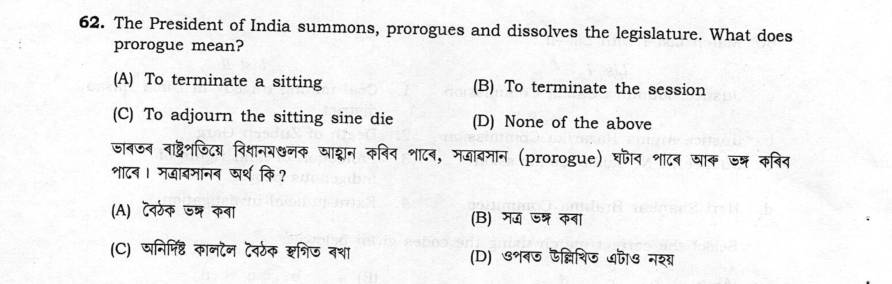
- A To terminate a sitting
- B To terminate the session
- C To adjourn the sitting sine die
- D None of the above
Show answer
Answer: (B) To terminate the session
Official provisional answer key
-
According to the Tenth Schedule of the Constitution of India, as amended by the
Constitution (Ninety-First Amendment) Act, 2003, a merger between political parties
shall be exempted from disqualification on the ground of defection only if
at least rd of the members of the legislative party opts to form a new fraction
a simple majority of the members of the legislative party approves the merger
not less than 2rds of the members of the legislative party agree to such a merger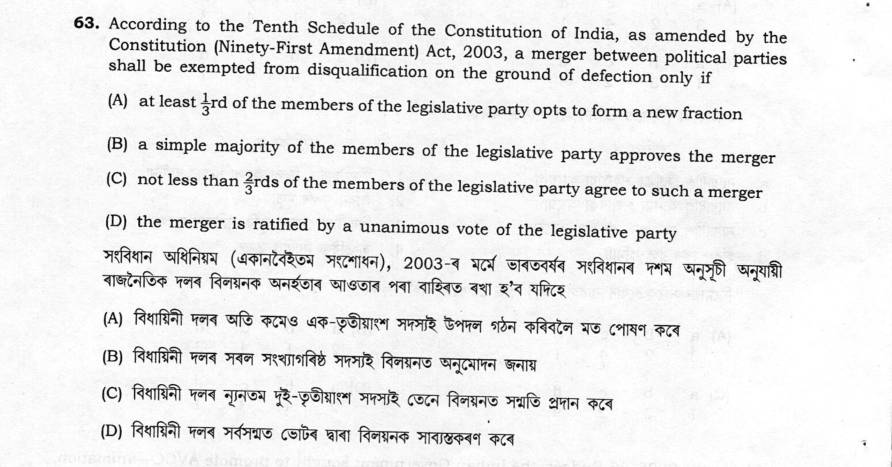
Show answer
Answer: (C)
Official provisional answer key
-
With reference to the Supreme Court of India, consider the following statements and
identify the incorrect answer from the options given below.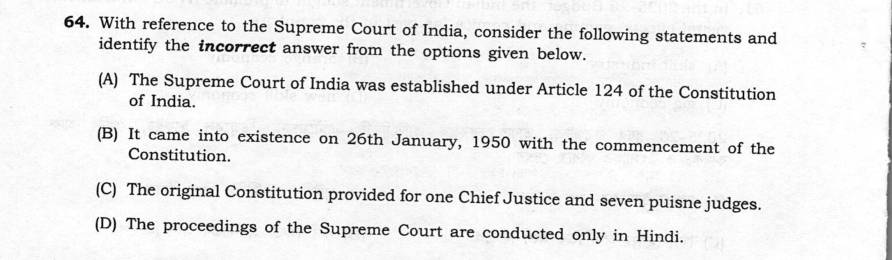
- A The Supreme Court of India was established under Article 124 of the Constitution of India.
- B It came into existence on 26th January, 1950 with the commencement of the Constitution.
- C The original Constitution provided for one Chief Justice and seven puisne judges.
- D The proceedings of the Supreme Court are conducted only in Hindi.
Show answer
Answer: (D) The proceedings of the Supreme Court are conducted only in Hindi.
Official provisional answer key
-
The Indian Constitution includes special provisions under Part XXI, Articles 371A to
371H to safeguard the unique cultural, social and customary practices of certain
North-Eastern States. Match the Articles in List-I which apply to specific
North-Eastern States in List-II :
List-I List-II
a. Article 371A 1. Assam
b. Article 371B 2. Manipur
c. Article 371C 3. Mizoram
d. Article 371G 4. Nagaland
Select the correct match using the codes given below.
d Ba b c d
a q c
1 2. 3 4 4 3 2 1
b d (D)a b c d
)a c
2 3 1 4 2 3
4 1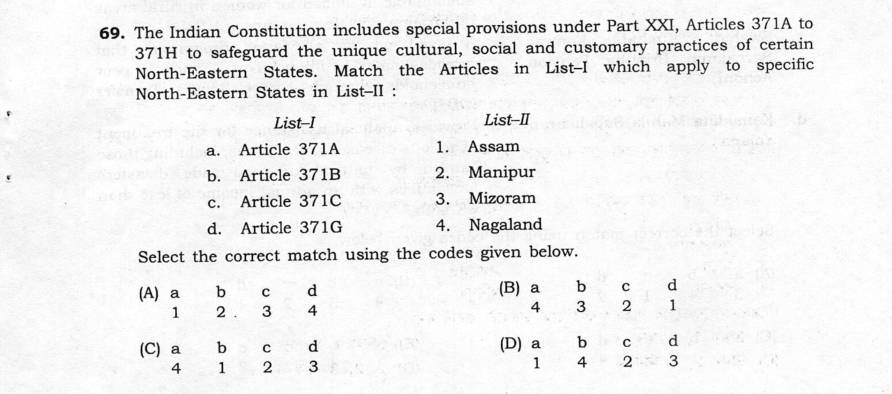
Show answer
Answer: (C)
Official provisional answer key
-
The Goods and Services Tax (GST) Council comprises which of the following members?
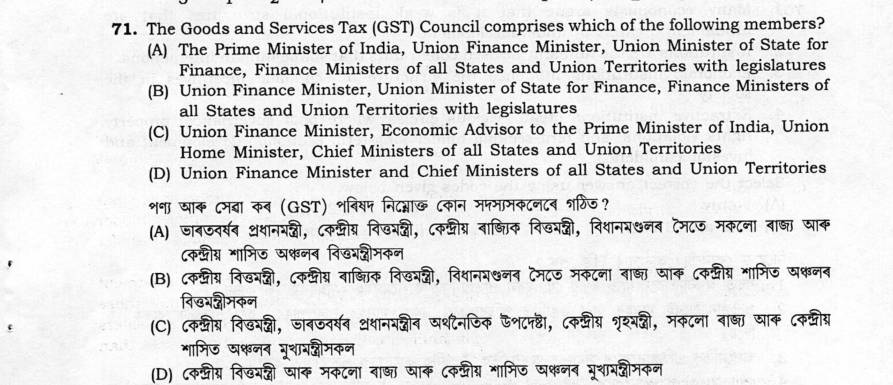
- A The Prime Minister of India, Union Finance Minister, Union Minister of State for Finance, Finance Ministers of all States and Union Territories with legislatures
- B Union Finance Minister, Union Minister of State for Finance, Finance Ministers of all States and Union Territories with legislatures
- C Union Finance Minister, Economic Advisor to the Prime Minister of India, Union Home Minister, Chief Ministers of all States and Union Territories
- D Union Finance Minister and Chief Ministers of all States and Union Territories
Show answer
Answer: (B) Union Finance Minister, Union Minister of State for Finance, Finance Ministers of all States and Union Territories with legislatures
Official provisional answer key
-
The 100th Constitutional Amend-
ment of India enabled the
implementation of a controversial
international agreement. Which of
the following is referred to here?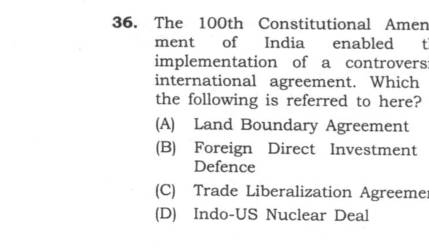
- A Land Boundary Agreement
- B Foreign Direct Investment in Defence
- C Trade Liberalization Agreement
- D Indo-US Nuclear Deal
Show answer
Answer: (A) Land Boundary Agreement
Official provisional answer key
-
The Supreme Court of India has
placed the Right to Privacy under
which of the following Articles of the
Constitution of India?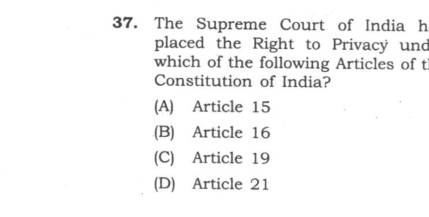
- A Article 15
- B Article 16
- C Article 19
- D Article 21
Show answer
Answer: (D) Article 21
Official provisional answer key
-
Which of the following are
constituted by the President of
India?
(i) The Finance Commission of
India
(ii) The NITI Aayog
(iii The Commission on Official
Languages
iv The Union Public Service
Commission
Select the correct answer using the
codes given below.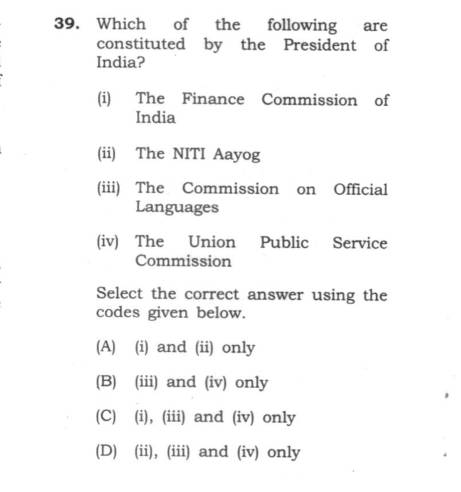
- A (i) and (ii) only
- B (iii) and iv) only
- C (i), (iii) and v) only
- D (ii)(iii) and(iv only
Show answer
Answer: (C) (i), (iii) and v) only
Official provisional answer key
-
Which of the following is/are
common feature(s) of both the Indian
and American Federalism?
(i) Single citizenship
(ii) Three lists of division of powers
in the Constitution
ii)Dual Judiciary
(iv) The Supreme Court to interpret
the Constitution
Select the correct answer using the
codes given below.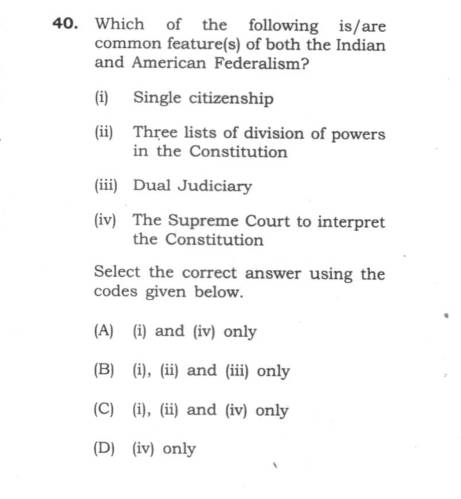
- A (i) and v) only
- B i),(ii) and (iii) only
- C (i), (ii) and (v) only
- D iv) only
Show answer
Answer: (D) iv) only
Official provisional answer key
-
Which of the following comes under
the Directive Principles of State
Policy?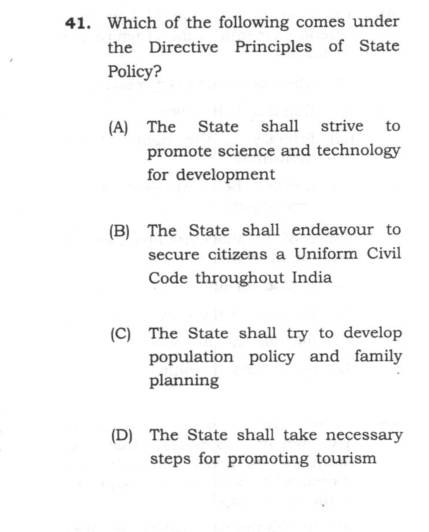
- A The State shall strive to promote science and technology for development
- B The State shall endeavour to secure citizens a Uniform Civil Code throughout India
- C )The State shall try to develop population policy and family planning
- D The State shall take necessary steps for promoting tourism
Show answer
Answer: (B) The State shall endeavour to secure citizens a Uniform Civil Code throughout India
Official provisional answer key
-
In which of the following States,
there is a constitutional requirement
to have a minister in charge of the
tribal welfare?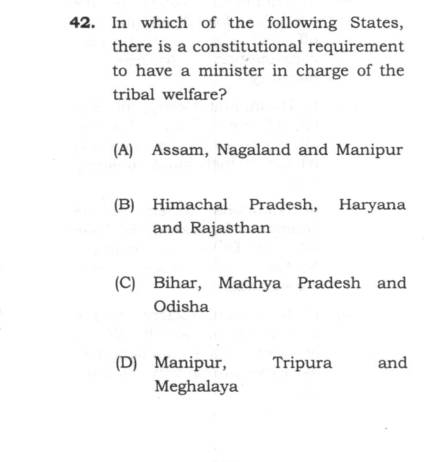
- A Assam, Nagaland and Manipur
- B Himachal Pradesh, Haryana and Rajasthan
- C Bihar, Madhya Pradesh and Odisha
- D Manipur, Tripura and Meghalaya
Show answer
Answer: (C) Bihar, Madhya Pradesh and Odisha
Official provisional answer key
-
Which of the following States was
the last one to get the status of full
statehood?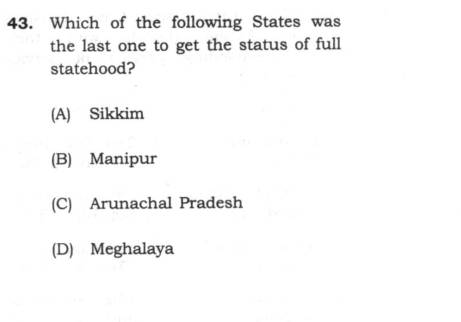
- A Sikkim
- B Manipur
- C ()Arunachal Pradesh
- D Meghalaya
Show answer
Answer: (C) ()Arunachal Pradesh
Official provisional answer key
-
Under which Article of the Indian
Constitution, a special provision is
made for the State of Assam?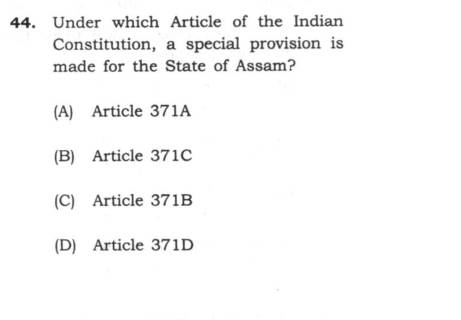
- A Article 371A
- B Article 371C
- C Article 371B
- D Article 371D
Show answer
Answer: (C) Article 371B
Official provisional answer key
-
Which of the following Articles of the
Constitution of India grants the
Supreme Court of India the power
to review its own judgements and
orders?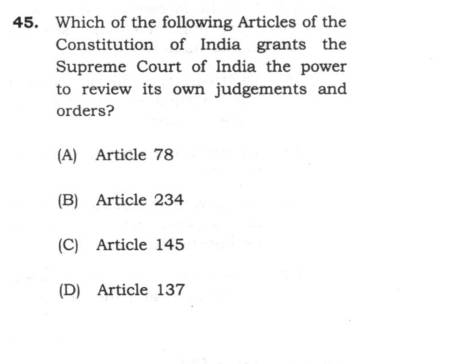
- A )Article 78
- B Article 234
- C Article 145
- D Article 137
Show answer
Answer: (D) Article 137
Official provisional answer key
-
The concept of 'Rule of Law' has
several elements, some of which are
as follows:
(i) Absence of arbitrary power
(ii) Equality before law
(ii) Primacy of the rights of the
individual
(iv) Cannot be destroyed by an
amendment
Which of the above are applicable to
the Indian system?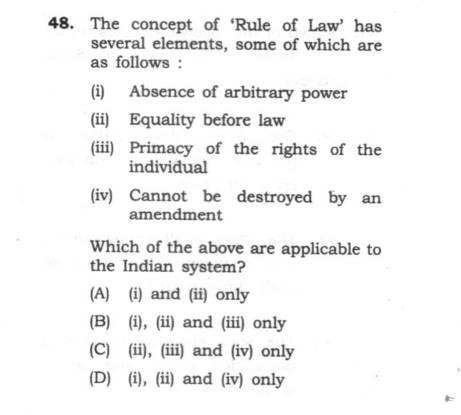
- A (i) and ii) only
- B (i),(ii) and (ii) only
- C (ii), (iii) and v) only
- D (i)(ii) and iv) only
Show answer
Answer: (D) (i)(ii) and iv) only
Official provisional answer key
-
Consider the following statements
regarding Article 226 of the
Constitution of India :
(i) Article 226 of the Constitution
of India empowers a High Court
to issue writs including habeas
corpus, mandamus, certiorari,
prohibition and quo warranto
for the enforcement of the
Fundamental Rights of the
citizens and for any other
purpose.
(ii) The phrase for any other
purposerefers to the
enforcement of an ordinary
legal right. This implies that the
writ jurisdiction of the High
Court is wider than that of the
Supreme Court.
(iii) The Supreme Court can issue
writs only for the enforcement
of the Fundamental Rights and
not for any other purpose, i.e.,
it does not extend to a case
where the breach of an ordinary
legal right is alleged.
(ivThe High Court can issue writs
to any person, authority and
government not only within its
territorial jurisdiction but also
outside itset territorial
jurisdiction if the cause of
actionariseswithin its
territorial jurisdiction.
Select the correct statements using
the codes given below.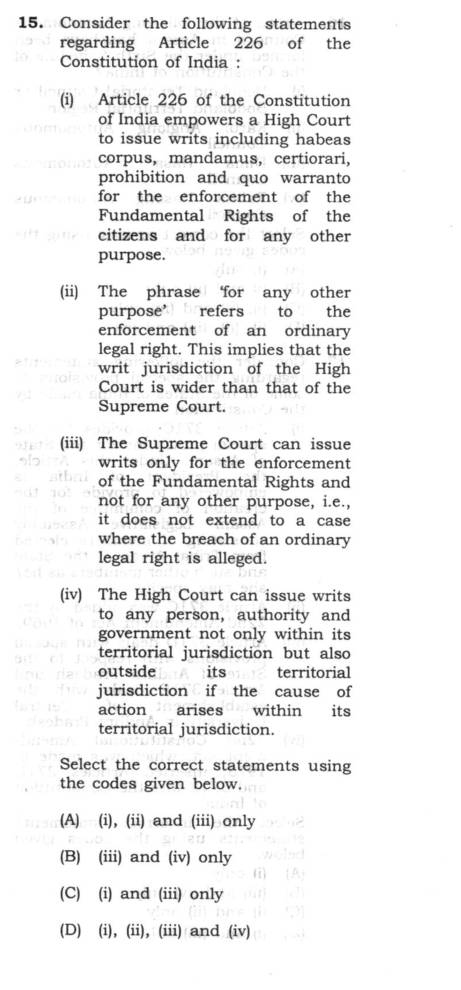
- A (i), (ii) and (iii) only
- B ii and (iv only
- D and (iii) only (i),(ii), (ii) and iv) ASE
Show answer
Answer: (D) and (iii) only (i),(ii), (ii) and iv) ASE
Official provisional answer key
-
Consider the following statements
regarding the special provisions to
some of the States of India made by
the Constitution :
(i) Article 371C provides for the
special provisions for the State
of Assam. Under this Article,
the President of India is
empowered to provide for the
creation of committee of the
Assam Legislative Assembly
consisting of members elected
from Tribal Areas of the State
and such other members as he/
she may specify.
(ii) Article 371C was added by the
22nd Amendment Act of 1969.
(iii) Article 371D deals with special
provisions with respect to the
State of Andhra Pradesh and
Article 371E deals with the
establishmentofCentral
University in Andhra Pradesh.
(iv) 32nd Constitutional Amend-
ment Act, which was made in
1973, inserted Articles 371D
and 371E into the Constitution
of India.
Select the incorrect statement/
statements using the codes given
below.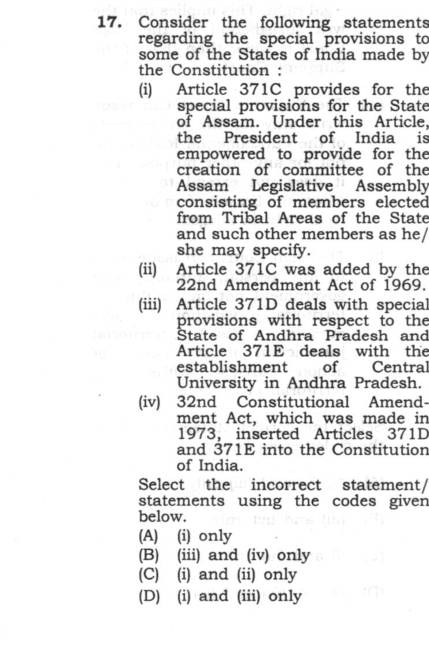
- A (i) only
- B ii) and v) only
- C (i) and (i) only
- D (i) and (ii) only
Show answer
Answer: (D) (i) and (ii) only
Official provisional answer key
-
Consider the following statements
22 regarding the provisions of official
languages in India :
(i) Article 343 of the Constitution
of India has made Hindi in
Devanagari Script as the
National Language of India.
(ii) The Legislature of a State may
by law adopt any one or more of
the languages in use in the
State as the official language/
languages of the State as per
Article 345 of the Constitution
of India.
(iii) The Assam Official Language
Act, 1960 has been legislated
as per Article 345 of the
Constitution of India.
Select the correct statements using
the codes given below.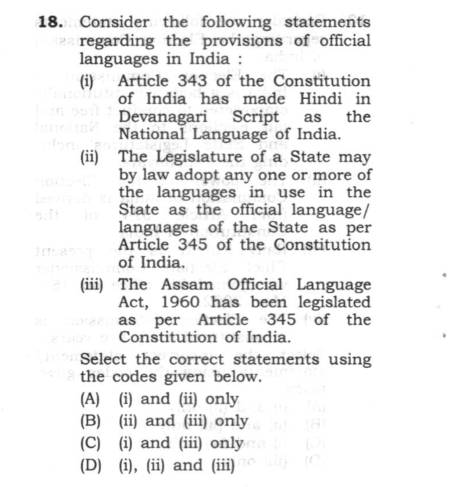
- A ()(i) and (ii) only
- B (ii) and (ii) only
- C and (iii) only
- D (i), (ii) and (iii)
Show answer
Answer: (B) (ii) and (ii) only
Official provisional answer key
-
Match the following Schedules of the
Indian Constitution (List-I) with
their subject matters (List-II) :
List-I List—II
a. Fourth Schedule 1. Forms of Oath
or Affirmations
b. Eleventh Schedule 2. Languages
c. Eighth Schedule 3. Powers of
Panchayats
d. Third Schedule 4. Allocation of
Seats in the
Council of
States
Select the correct answer using the
codes given below.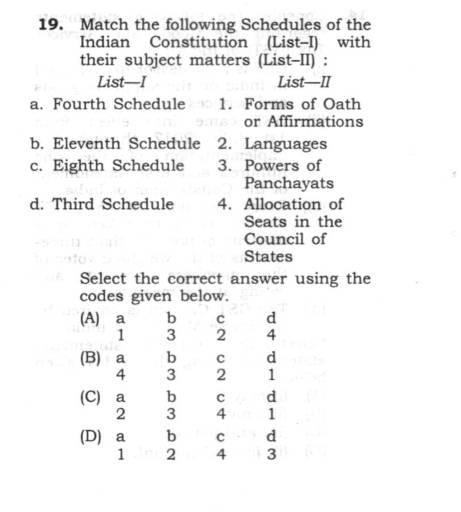
- A a b c d 1 3 2 4
- B b c d 4 3 2 1
- C a b c d 2 3 4 1
- D a b c d 1 2 4 3
Show answer
Answer: (B) b c d 4 3 2 1
Official provisional answer key
-
Which of the following statements
are correct about the difference
between censure and no-confidence
motion?
(i) A censure motion should state
the reason for its adoption. On
the other hand, a no-confidence
motion need not state the
reason for its adoption.
(ii) A no-confidence motion can be
moved only against the Council
of Ministers. In contrast, a
censure motion can be moved
against the Council of Ministers
or an individual Minister, or a
group of Ministers.
(ii) The government must resign if
a no-confidence motion is
passed. On the other hand, the
government need not resign if a
censure motion is passed.
(iv) A censure motion can be moved
in both the Lok Sabha and the
Rajya Sabha, whereas a no-
confidence motion can be
moved only in the Lok Sabha.
Select the correct answer using the
codes given below.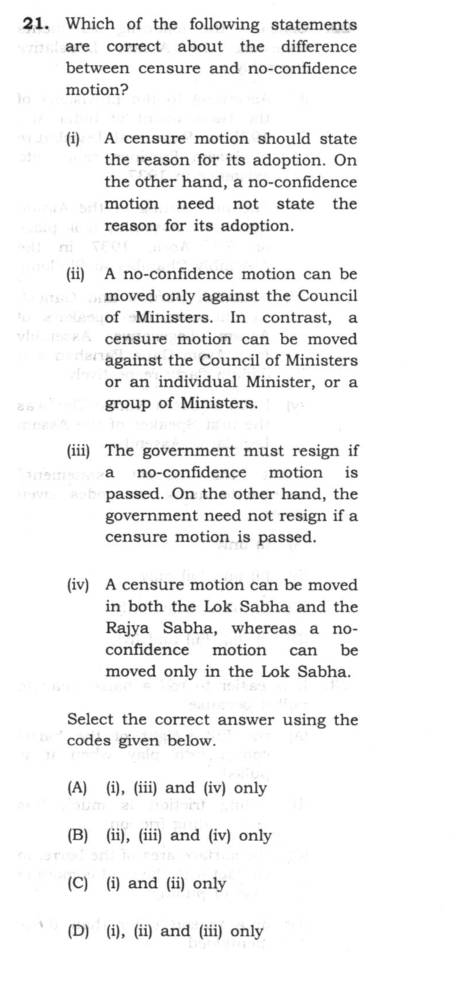
- A (i),(iii) and (iv) only
- B i), (ii) and (iv only
- C (i) and (ii) only
- D (i), (ii) and (ii) only
Show answer
Answer: (D) (i), (ii) and (ii) only
Official provisional answer key
-
Protection of wildlife comes under
which of the following in the
Constitution of India?
(i) Fundamental Duties
(ii) Directive Principles
(iii) Seventh Schedule
(iv) Fundamental Rights
Select the correct answer using the
codes given below.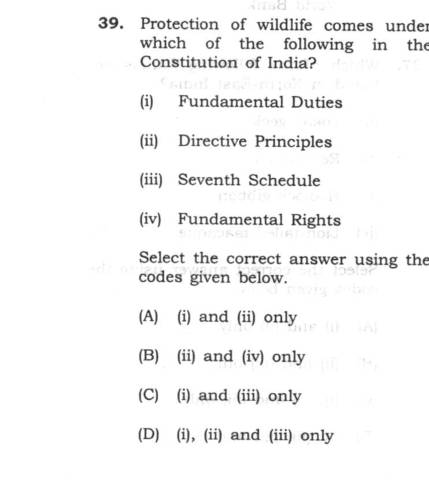
- A (i) and (ii) only
- B ii)and v only
- C (i) and (iii) only
- D ()ii) and (ii)only
Show answer
Answer: (D) ()ii) and (ii)only
Official provisional answer key
-
Which of the following statements
are correct about the Women's
Reservation Bill, 2023?
(i) The Women's Reservation Bill,
2023 proposes 33% reservation
for women in the Lok Sabha
and the Assemblies of States
and National Capital Territory
of Delhi.
(ii) Similar reservation will also be
provided within the seats
reserved for SC and ST.
(iii) The Bill proposes that the
reservation will continue for
25years.
(iv) The Bill which reserves 33% of
seats for women in the Lok
Sabha and State Assemblies
includes the quota for women
from the OBCs.
Select the correct answer using the
codes given below.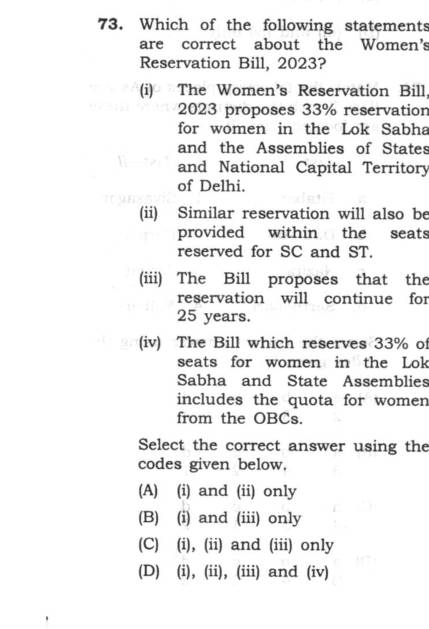
- A (i) and (ii) only
- B and (ii) only
- C , ii) and (i) only
- D (i),(ii), (ii) and iv)
Show answer
Answer: (A) (i) and (ii) only
Official provisional answer key
-
Who has the power to dissolve the Lok Sabha?
- A The Prime Minister
- B The President
- C The Speaker of the Lok Sabha
- D The Chief Justice of India
Show answer
Answer: (B) The President
Official final answer key
-
Which article from our constitution talks of Early Childhood Care and Education ?
- A Article 16
- B Article 45
- C Article 46
- D Article 310
Show answer
Answer: (B) Article 45
Article 45 addresses early childhood care and education.
Worked solution by AxomRank (no official key was published)
-
Parliament consists of :
- A Lok Sabha
- B Lok Sabha and Rajya Sabha
- C President, Lok Sabha and Rajya Sabha
- D President, Lok Sabha, Rajya Sabha and the Speaker
Show answer
Answer: (C) President, Lok Sabha and Rajya Sabha
Parliament comprises the President and both Houses.
Worked solution by AxomRank (no official key was published)
-
Who is known as the Father of the Indian Constitution?
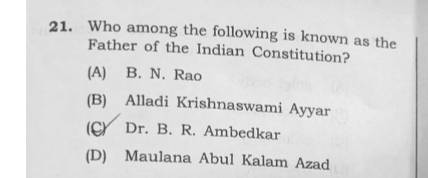
- A B. N. Rao
- B Alladi Krishnaswami Ayyar
- C Dr. B. R. Ambedkar
- D Maulana Abul Kalam Azad
Show answer
Answer: (C) Dr. B. R. Ambedkar
B. R. Ambedkar chaired the Constitution's Drafting Committee.
Worked solution by AxomRank (no official key was published)
-
The Chief Justice of a High Court is
appointed by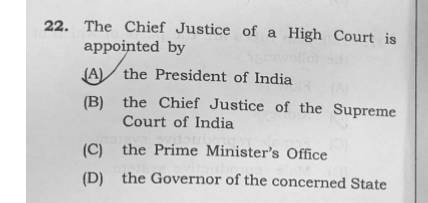
- A the President of India
- B the Chief Justice of the Supreme Court of India
- C the Prime Minister's Office
- D the Governor of the concerned State
Show answer
Answer: (A) the President of India
The President appoints a High Court's Chief Justice.
Worked solution by AxomRank (no official key was published)
Sources and corrections
From the open AxomRank PYQ dataset. Each question links back to its paper. See how to report a correction.